Since we’re well into my “bird season,” focused on migratory and other birds, I’ll stick with that theme a bit longer. I photographed this pair of geese (I’m pretty sure they are Ross’s geese) back at the beginning of December. Near the end of the day I moved to where the light would come in from the right, highlighting light and shadow and the textures of the birds features. Not too long before sunset, geese began to arrive and land in the pond, and I was able to photograph their descent.
I often marvel at the contortions of these birds during the final instants of their flights. In the air they are often graceful, but the landings vacillate between that grace and nearly-out-of-control clumsiness as they transform from creatures of the to earthbound animals. They glide in, instinctively facing into the breeze, and can sometimes then seem to almost drop right out of the sky. Wings go upwards, feet extend down, and necks stretch forward, and quickly they are on the ground.
A flock of sandhill cranes flies through an evening winter sky about the San Joaquin River
During winter I travel to California’s Central Valley somewhat frequently, ostensibly to photograph birds but, to be honest, also to photograph the landscape — one that often features fog, fields and trees on the trajectory between winter and spring, unusual effects of light, and those birds. In mid-January I was there one afternoon, on my way to an opening reception at the Carnegie Arts Center in Turlock. The drive would usually take me about two hours, but I left early to create some time to explore areas along the San Joaquin River as it approaches the delta and eventually San Francisco Bay.
It was an interesting weather day. It was range when I left the San Francisco Bay Area, but I got ahead of the front as I crossed into the valley, and it was partly sunny as I headed east on country roads towards this destination. Out here by the river it was hazy and foggy, as it so often is this time of year, and before long the clouds of that front caught up with me and produced an interesting and evocative “atmospheric soup” that was occasionally illuminated subtly when the clouds above the fog to the west thinned. The photograph looks across fallow and muddy fields where sandhill cranes were collecting and towards the scattered trees that grow nearer to the river, above which a flock of cranes flies past.
UPDATE: As of 2020 I am no longer posting annual updates concerning this subject — and I am editing older posts on the subject in light of the need to be more responsible about not encouraging the onslaught. I also no longer recommend going to the Valley to see it. Unfortunately, too much exposure (yes, I played a part in it, unfortunately) has led to absurd crowds, traffic jams, littering, destruction of areas in the Valley where too many people go to see it… and the park has increasingly — and appropriately — cracked down. Parking options have been eliminated, at least one viewing location has been closed. Good news! The rest of Yosemite Valley is still there and often exceptionally beautiful at this time of year.
Horsetail Fall, Early Evening
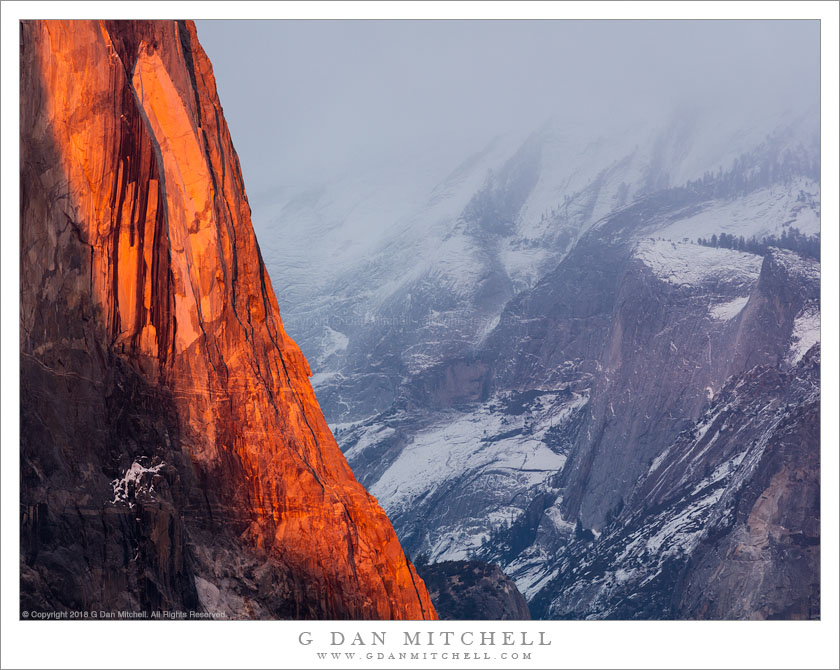
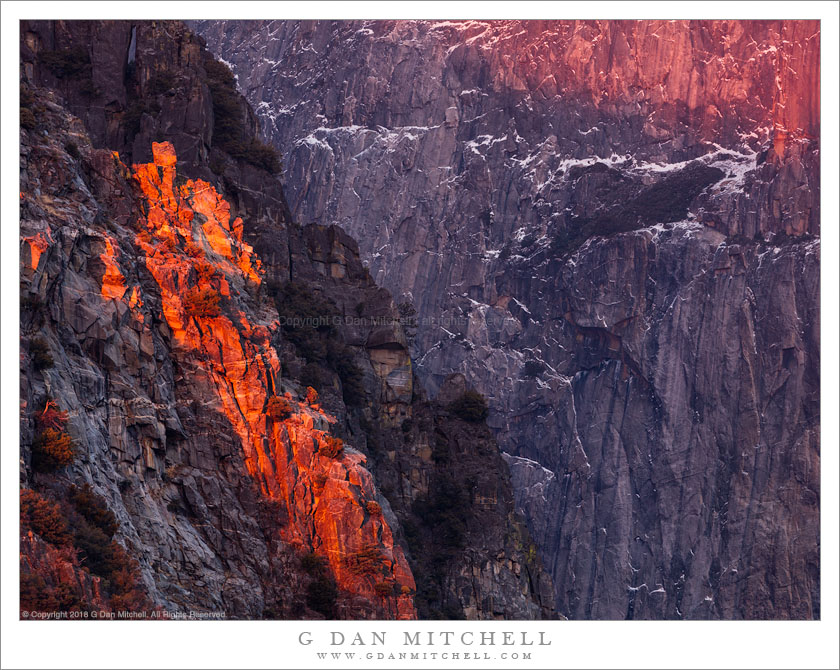
Every winter, for roughly a week or so starting just after mid-February, the sun and various geological features line up so that sunset light falls on the seasonal and ephemeral Horsetail Fall near the east end of the face of El Capitan. Sometimes the light of the setting sun may illuminate this waterfall from behind and briefly make the waterfall and its misty spray glow in sunset colors.
Since it is that time of year again, I’m going to briefly share a few bits of information and perspective about Yosemite Valley’s Horsetail Fall. For more, see an earlier article.
But before you get too excited…
This is another extremely dry winter in California, with Sierra snowpack far below normal. There is very little snow in the drainage the feeds the fall, and forecasts suggest that it will remain dry. In other words, there probably won’t be enough water to start the fall.
The “event” has gotten out of control as thousands of people showed, parking everywhere and trampling through forests. The park service decided that something has to change. This year access to the typical viewpoints will be more difficult, with extremely limited parking (by advance permit only), and roads near the viewing area will be closed to parking or shut down completely. If you don’t have one of those permits, you have a long walk ahead of you… and probably a long return walk in the dark.
Third, what you see in photographs (including my own) is not what you are likely to see in person.
My best advice this year? Probably don’t bother. Between the uncooperative weather and the access restrictions, you are perhaps more likely to experience a #HorseFailFall than Horsetail Fall.
Also, while seeing this phenomenon can be special, it is but one of many, many special experiences to be found in the Sierra. Too often these days, social media convinces use that such experiences are Super Mega Peak Astonishing Ultra Wonders. This poses some dangers, and you should consider resisting. It falsely transforms quiet, contemplative experiences into the equivalent of a sports event, unfortunately creating greater distance between observers and the experience they crave. It also brings crowd that threaten the very places that they come to see.
Perhaps consider something else?
Fortunately, winter in Yosemite Valley has a whole lot to offer besides this event. Fog often forms in quiet meadows at dawn, clouds frequently float among cliffs and peaks, you might get lucky and see some snow, some wildlife is much easier to see in winter, the crowds are generally a lot smaller, and some interesting events take place, such as the Yosemite Renaissance Exhibit opening near the end of the month in the Visitor Center Museum Gallery. (I’ll be in the park during this period as a Yosemite Renaissance “artist in residence,” photographing and attending the opening of the exhibit.)
Sunlight begins to illuminate a small wetland island as San Joaquin Valley tule fog thins
We all know that (apparently false) story about the number of words that Inuit people have for the myriad types of snow. I suspect that it would be possible to have a similarly diverse vocabulary of descriptions for fog, dependent upon its thickness, temperature, quality and color of light, tendency to move, effect on sound, time of day, season, persistence, and much more. Photographing in California is something of a laboratory in the nature of fog, in that we have so many types. Living in the San Francisco Bay Area I am very familiar with the type of fog created by the marine influence — often cold and gray and damp, and frequently a feature of the late-spring and summer months. Photographing Central Valley birds (and driving across the great valley while traveling to and from the Sierra Nevada) has given me ample opportunities to know the tule fog, mostly a winter phenomenon caused by cool and damp conditions over land.
On winter days when I photograph in the valley I experience transitions though many different types of fog and fog-light. I often start before dawn, when the fog and darkness can close the world down to what I can (barely) see in my headlights, or by the glow of commercial signs and streetlights as I pass through towns. Before sunrise the fog can glow in colors ranging from sky blue to the gaudy reds, oranges, yellows, and purples of first light on clouds above the fog. Eventually that color dissipates and the fog can simply become gray. Then, as it things (often from the top down), and light begins to filter down to the ground level, the colors of grasses and trees and water being to appear faintly.
Photographer and visual opportunist. Daily photos since 2005, plus articles, reviews, news, and ideas.
Manage Consent
To provide the best experiences, we use technologies like cookies to store and/or access device information. Consenting to these technologies will allow us to process data such as browsing behavior or unique IDs on this site. Not consenting or withdrawing consent, may adversely affect certain features and functions.
Functional
Always active
The technical storage or access is strictly necessary for the legitimate purpose of enabling the use of a specific service explicitly requested by the subscriber or user, or for the sole purpose of carrying out the transmission of a communication over an electronic communications network.
Preferences
The technical storage or access is necessary for the legitimate purpose of storing preferences that are not requested by the subscriber or user.
Statistics
The technical storage or access that is used exclusively for statistical purposes.The technical storage or access that is used exclusively for anonymous statistical purposes. Without a subpoena, voluntary compliance on the part of your Internet Service Provider, or additional records from a third party, information stored or retrieved for this purpose alone cannot usually be used to identify you.
Marketing
The technical storage or access is required to create user profiles to send advertising, or to track the user on a website or across several websites for similar marketing purposes.