
Tag Archives: valley

Winter Oaks, Morning Mist

Winter Oaks, Morning Mist

Winter Oaks, Morning Mist. Yosemite Valley, California. February 23, 2013. © Copyright 2013 G Dan Mitchell – all rights reserved.

Morning mist swirls around Glacier Point beyond the silhouetted branches of winter oak trees, Yosemite Valley.

This morning proved – yet again – that there is “always something to see” if I’m just out there looking. We had stayed overnight in The Valley the night before, following the opening reception for Yosemite Renaissance 28, the annual juried exhibit of work created by artists inspired by and working in and around Yosemite National Park. (It is a wonderful show and you should stop by the Museum Gallery in the Valley if you are in the Valley during the next few months.) After heading out for a late dinner with a group of other participants after the reception, we got to bed quite late and the idea of waking up well before dawn to photograph was not sounding as appealing as it sometimes can. It didn’t help that the weather forecast was for clouds and a chance of rain or snow.

I woke up at 5:30 and reset my alarm for the relatively late hour of 6:30, thinking that whatever photography there might be would be almost outside my door and realizing that sunrise would not be until after 7:00 a.m. I got up, quickly dressed and grabbed camera gear, headed out the door and started walking. In the pre-dawn light I could see that the clear areas of the sky were quickly diminishing and that clouds were ringing the Valley. I ended up in nearly deserted Cooks Meadow, where I made a few photographs of trees and cliffs and so forth. Then it started to rain lightly. I kept shooting a bit longer, but soon realized that I couldn’t really stay out there since I had not thought to bring anything waterproof for me or my gear. I retreated to a nearby shuttle bus stop and found shelter under its roof. Now of all the places to look for aesthetic inspiration in the Sierra, a Yosemite Valley shuttle stop might be very close to the least likely. However, finding myself in one and with nothing else to do, I began to look around to see what I could see from this small sheltered area. First I noticed a large granite face to my east that was becoming reflective in the light rain, and I shot a few photographs in that direction. Then I looked up through the branches of dormant oak trees toward Glacier Point and saw clouds swirling about it and nearby pinnacles and trees, occasionally broken enough to allow some of the sunrise light to create a glow behind the mist. And there you have it – the first photograph I have made from under the roof of a shuttle stop… ;-)

G Dan Mitchell is a California photographer and visual opportunist whose subjects include the Pacific coast, redwood forests, central California oak/grasslands, the Sierra Nevada, California deserts, urban landscapes, night photography, and more.
Blog | About | Flickr | Twitter | Facebook | Google+ | 500px.com | LinkedIn | Email

Text, photographs, and other media are © Copyright G Dan Mitchell (or others when indicated) and are not in the public domain and may not be used on websites, blogs, or in other media without advance permission from G Dan Mitchell.
Salt Flat Patterns

Salt Flat Patterns
Salt Flat Patterns

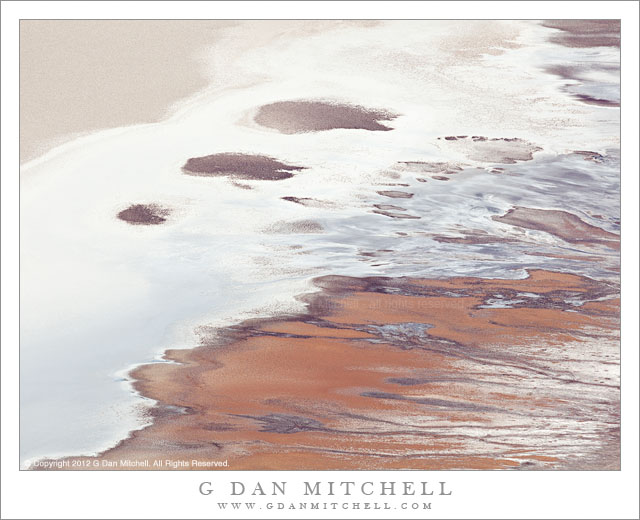
Salt Flat Patterns. Death Valley National Park, California. March 30, 2011. © Copyright 2012 G Dan Mitchell – all rights reserved.

Detail of a section of Death Valley salt flats as seen from Dantes View

Death Valley is often not quite what it seems to be. Repeat visits and views from different perspectives – far away, very close up, from above – begin to reveal things that you might not see at first. From next to and on the salt flats in the lowest section of the Valley, you see a very desolate terrain – one of the most non-human terrains I know. Here, well below sea level, there are places that seem completely inhospitable and alien, landscapes of caked salt, worked and sharp-edged salt and dried mud, seeps of shallow water, occasional odd plants, and landscape that often seems to go on almost endlessly the same way. But just as looking more closely reveals surprises (such as living creatures in those millimeters-deep pools of salty water), the view from overhead shows patterns that cannot be readily seen up close.

This photograph was made from the summit of Dantes View. This high point along the eastern side of the valley is close to a mile above the Valley floor. The view can often be panoramic, stretching for tremendous distances in almost all directions, blocked only by the higher peaks of the Panamint Range to the west and a few other high points nearby. Although Dantes View is one of the best known “iconic” locations in the park, I have a complicated relationship with the place. First of all, I seem to attract awful weather when I go there, perhaps because I tend to do so in the season that is winter elsewhere in the state. Not too long ago I attempted to drive to the summit on a winter day and was turned back by a snow storm perhaps a half mile from the end of the road. In addition, it has been hard for me to warm up to the place as a photographic subject. In some ways, there is almost just too much in the view for me to see how to isolate a photograph out of that detailed immensity. I dealt with that here by using a very long lens and restricting my view to a small section of the valley floor, without much context of surrounding terrain, which I think produces a photograph that allows the features in this frame to be seen as abstractions.

G Dan Mitchell is a California photographer and visual opportunist whose subjects include the Pacific coast, redwood forests, central California oak/grasslands, the Sierra Nevada, California deserts, urban landscapes, night photography, and more.
Blog | About | Flickr | Twitter | Facebook | Google+ | 500px.com | LinkedIn | Email

Text, photographs, and other media are © Copyright G Dan Mitchell (or others when indicated) and are not in the public domain and may not be used on websites, blogs, or in other media without advance permission from G Dan Mitchell.
The Annual Horsetail Fall Post

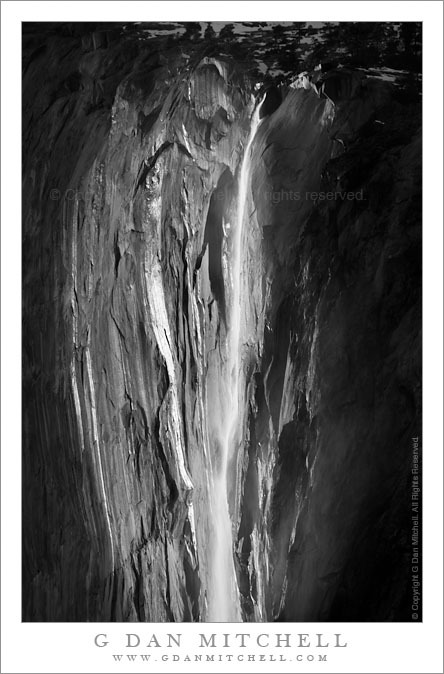
Horsetail Fall, Early Evening

UPDATE: As of 2020 I am no longer posting annual updates concerning this subject — and I am editing older posts on the subject in light of the need to be more responsible about not encouraging the onslaught. I also no longer recommend going to the Valley to see it. Unfortunately, too much exposure (yes, I played a part in it, unfortunately) has led to absurd crowds, traffic jams, littering, destruction of areas in the Valley where too many people go to see it… and the park has increasingly — and appropriately — cracked down. Parking options have been eliminated, at least one viewing location has been closed. Good news! The rest of Yosemite Valley is still there and often exceptionally beautiful at this time of year.

Horsetail Fall, Early Evening. Yosemite Valley, California. February 15, 2010. © Copyright G Dan Mitchell – all rights reserved.

The silver strand of Horsetail Fall and water reflecting on surrounding cliffs in late afternoon light, Yosemite Valley, California.

Although it seems like it would be extremely difficult to make a truly original photograph of Horsetail Fall at this point, I won’t completely rule out the possibility, and recently I have seen a few interesting and imaginative photographs of the phenomenon.

The necessary conditions are fairly specific, and even when the basics are in place there is no guarantee that the show will occur on a given evening. To be honest, the odds are distinctly against you, and you are more likely to see something that doesn’t match your expectations.

  • There must be flowing water in the creek near the east end of the face of El Capitan that feeds the fall. This is not a sure thing in mid-winter. There must be sufficient snow above El Capitan and the temperatures must be warm enough to melt it, or there must have been a recent warm storm that brought some rain to higher elevations.
  • The setting sun must align just right with a gap in the mountains to the west of El Capitan so that the setting sun (miraculously) casts its last beams right on the face of El Capitan where the fall is located. Roughly speaking this occurs during the second half of February, right around February 20 or so.
  • You must be in a position such that the fall is back-lit by the sunset light beam. In addition, your position must provide a clear view of the fall – not necessarily a simple thing given the forest cover in the Valley. These areas are now subject to terrible crowding that has damaged areas of the park, and the park service is wisely reducing or eliminating access.
  • Although photographs make it seem like a huge, overpowering spectacle, it is actually very small. It takes place high on a distant cliff face, and to photograph it you’ll need a very long lens.
  • Finally, the skies to the west of Yosemite must be clear so that the golden hour sunset light is not blocked. Many tell stories of clouds that made it obvious that the show would not happen or, even more frustrating, developing light that was killed at the last minute when the sun dropped behind clouds to the west, which are quite common.

Any post about the February Horsetail Fall occurrence must include a few other important points:

  • The event has become so popular in recent years that the experience has been significantly compromised. You will not have an experience of relative solitude such as Galen Rowell likely had when he made the iconic photograph of the subject decades ago. Instead you will likely find yourself among hundreds or thousands (you read that right) of other photographers lined up with lenses pointed the same direction.
  • This, of course, implies that parking and finding “your spot” may both be challenges. As a result of traffic jams, illegal parking, overwhelming crowds, gross littering, and damage to meadow, forest, and river… the park service is wisely putting several access limits in place, even closing one of the favorite areas as of 2020.
  • If Horsetail isn’t an option, you are are still in one of the most beautiful and compelling places on the face of the planet for making photographs! Speaking of which, while the crowds are focused on Horsetail, you might consider photographing other things away from the crowds…

The annual Yosemite Renaissance art show typically opens at about this time each February and features the work of photographers and other artists working in Yosemite. The show is in the Yosemite Museum Gallery and the 2013 edition runs from February 22 through May 5, with the opening reception at 5:30-7:30 on February 22.  (You can view my work in the show this year.) In addition, there is always something interesting to see at the nearby Ansel Adams Gallery – this year an exhibit of Michael Frye’s photographs opens on February 16.

NOTE: The 2017 edition of the exhibit, Yosemite Renaissance 32, opens with a free public reception at 5:30 PM on Friday, February 24. One of my photographs is in the exhibit again this year. See you there!

G Dan Mitchell is a California photographer and visual opportunist whose subjects include the Pacific coast, redwood forests, central California oak/grasslands, the Sierra Nevada, California deserts, urban landscapes, night photography, and more.

Blog | About | Flickr | Twitter | Facebook | Google+ | 500px.com | LinkedIn | Email

Text, photographs, and other media are © Copyright G Dan Mitchell (or others when indicated) and are not in the public domain and may not be used on websites, blogs, or in other media without advance permission from G Dan Mitchell.

Dawn Sky, Panamint Range

Dawn Sky, Panamint Range

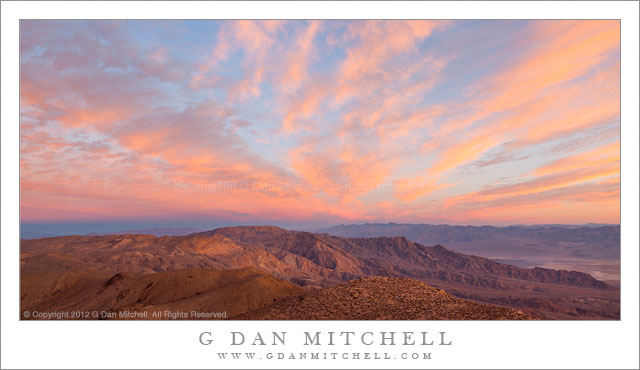
Dawn Sky, Panamint Range. Death Valley National Park, California. January 5, 2012. © Copyright 2012 G Dan Mitchell – all rights reserved.

First dawn light on clouds above Death Valley, as seen from high in the Panamint Range

I recently “discovered” (or perhaps “remembered?”) this photograph that I made nearly a year earlier during an early January 2012 trip to do winter photography in Death Valley National Park. Winter is a wonderful time in Death Valley, though the season can present its own challenges – not the same as summer, but challenges nonetheless. The challenges include, believe it or not, the possibility of some very, very cold weather, especially in some of the higher outlying areas of the park an up in the mountains, such as here in the Panamint Range. But there are special rewards, too, including the possibility of snow among the peaks and the more interesting skies that can come with the passage of winter low pressure systems that originate in the Pacific Ocean.

On this morning I had gotten out of my sleeping bag well before dawn so that I would have time to drive to this overlook high in the Panamints before sun rise. It was still dark as I drove the last section of the gravel road approach, and its wasn’t until after I arrived that there was enough light to see that this might turn out to be a spectacular sunrise. (When you get up in darkness and drive many miles, you have to take it on faith that something special might occur, and accept the possibility that it might not.) My original subject ideas for this location were not so much about sky as about deep valleys and receding ridges, but when the first sun hit these high clouds I was willing to angle the tripod up a bit to photograph them! This light on the clouds only lasted a few minutes, and after that I turned my attention back to the landscape below.

G Dan Mitchell is a California photographer and visual opportunist whose subjects include the Pacific coast, redwood forests, central California oak/grasslands, the Sierra Nevada, California deserts, urban landscapes, night photography, and more.
Blog | About | Flickr | Twitter | Facebook | Google+ | 500px.com | LinkedIn | Email

Text, photographs, and other media are © Copyright G Dan Mitchell (or others when indicated) and are not in the public domain and may not be used on websites, blogs, or in other media without advance permission from G Dan Mitchell.