A Sierra Nevada creek, swollen from spring runoff, flows across granite slabs – Yosemite National Park.
The image and sound of spring runoff water rushing over granite slabs are common in the high Sierra. Though the scene is almost a generic one, for me it also brings to mind many very specific places and experiences throughout the range. (Some of my backpacking friends might think of a spot along Tyndall Creek on the John Muir Trail where we have camped more than once.)
The exact location of this little bit of cascading and rushing water is probably not very important – you are never far from a little scene like this if you are near almost any little creek high in the Sierra! Here the water flows mostly across very smooth rock – so smooth that you can see right through the rushing water to the rocks in many places. In this precise spot there is a weakness in the rock and a small ledge has formed, and the result is a bit of white water.
I’ll share a few technical observations about this photograph, too. First, there isn’t a sharp thing in the image! While sharp focus can be important, I don’t think it is here. (Though if you look closely, the patterns of the blurred, fast-moving water are sharp in a fuzzy sort of way. ;-) The rocks beneath the water cannot be sharp because they are blurred by the water; the water cannot be sharp since I intentionally chose a shutter speed that allowed motion blur. Second, I have to admit that I did not originally have a black and white photograph in mind when I made this exposure. I worked on it for a while in color and though I liked the motion of the water I just wasn’t happy with the coloration of the scene. I finally realized that this image wasn’t about the “reality” of the rocks and water but about creating an impression of the rushing water – and that perhaps monochrome might work. Third, this is yet another “landscape” photograph made with a lens that the “common wisdom” (which often turns out to be not so wise) would say is not a landscape lens – a 70-200mm zoom.
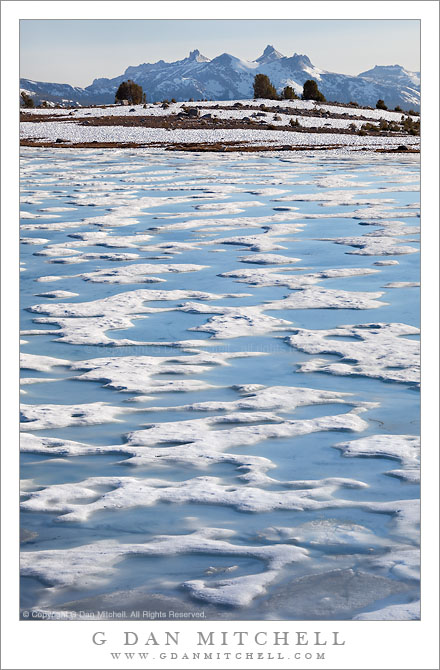
The distant Cathedral Range rises above the melting ice of Gaylor Lake, Yosemite National Park.
Near the end of June last summer I hiked up here late in the day with my friends Mike and Karl. This was a somewhat unusual season in the Yosemite Sierra, in that there had been a lot of snow during the winter season and it had continued right on into spring. Consequently, the high passes opened up later than usual, and on a very late June day when things would typically be a bit more summer-ish, it looked more like late winter up here when we arrived.
I’ve visited this place quite a few times, but had never seen quite this scene before. More typically, the snow and ice are completely gone by the time I manage to get up there, and a typical visit usually entails arriving late on a warm afternoon and then hanging out in the sun while waiting for the evening light to come on. This time we were in snow before we crossed the ridge before the lake, and we had to think a bit about just how to head down toward the lake since the usual path was covered in snow. The lake itself was (obviously, judging from the photo!) still covered in ice, though melting was underway and the surface was a jigsaw puzzle of alternating blue pools and white ice.
We found a location near clumps of trees on rocky talus slopes above the lake to do our photography. In this photograph I shot down the length of the lake to mostly fill the frame with the melting ice. Beyond a small rocky rise at the end of the lake, the terrain drops off towards the meadows of the Tuolumne region, and beyond rise the peaks of the Cathedral range in early evening light.
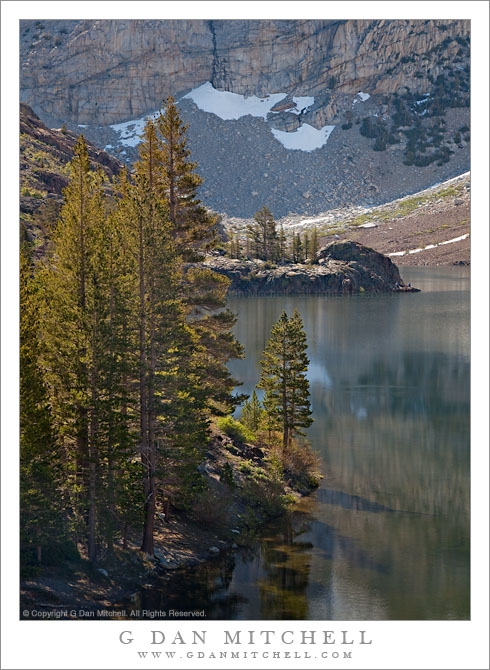
Morning light on Ellery Lake and surrounding mountains near Tioga Pass.
Yosemite National Park visitors who enter or leave the park via the Tioga Pass Road route are familiar with the sub-alpine lakes just east of the pass including Tioga Lake, Ellery Lake, and many smaller ponds. Ellery Lake – which is made a bit higher by a dam on its outlet stream – is the last lake before the drop-off into Lee Vining Canyon, and a place that people often stop during the summer months. Even during the very early and late season it is a popular place – in the early season right after the road opens you can often see back-country skiers on the steep slopes above the lake.
I rarely pass this particular cove near the upper end of the lake without stopping. However, I have also found it a tricky photographic subject! Very early light is blocked by the very tall ridge whose lower slopes are seen in the distance in this photograph. It is often quite windy. Late in the day the color of the light can be special, but it also tends to be almost directly behind the photographer and to leave some deep foreground shadows. There are other places like this – they seem like they should be photographic “slam dunks,” but they turn out to be more difficult than they appear. Or maybe it is just me! :-)
In any case, on this late June morning I had earlier finished photographing in the Mono Lake area and was heading back up towards Tuolumne Meadows. And, as always, as I drove around the curve above this cove I caught a view of the lake out of the corner of my eye and couldn’t resist stopping.
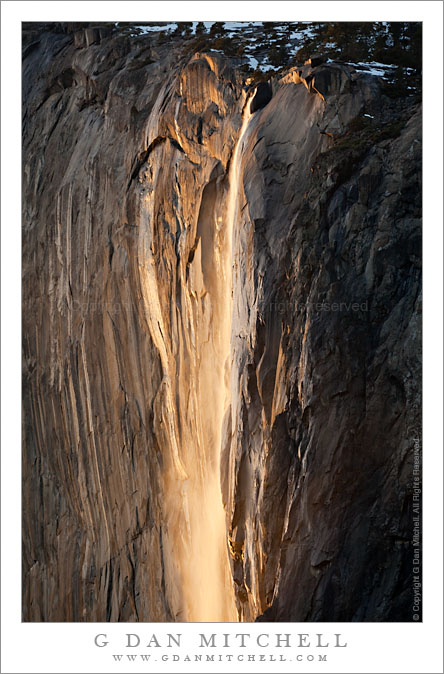
UPDATE: As of 2020 I am no longer posting annual updates concerning this subject — and I am editing older posts on the subject in light of the need to be more responsible about not encouraging the onslaught. I also no longer recommend going to the Valley to see it. Unfortunately, too much exposure (yes, I played a part in it, unfortunately) has led to absurd crowds, traffic jams, littering, destruction of areas in the Valley where too many people go to see it… and the park has increasingly — and appropriately — cracked down. Parking options have been eliminated, at least one viewing location has been closed. Good news! The rest of Yosemite Valley is still there and often exceptionally beautiful at this time of year.
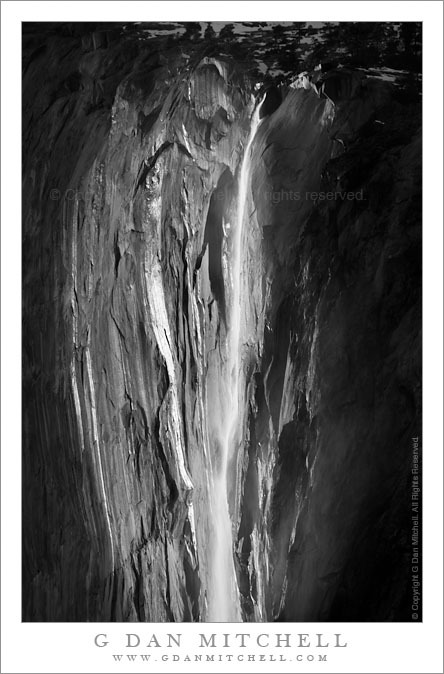
I recall first becoming aware of Galen Rowell’s famous photograph of Yosemite’s Horsetail Fall (the “natural fire fall”) many years ago, quite possibly as it appears on page 25 of my 1979 edition of his book “High and Wild” ( Sierra Club Books) which I probably picked up when I worked in a bookstore for several years. (Each bookstore employee had a shelf in a back room where we put aside books until we could afford them. My shelf often held books of photography including large format books of landscape photography. I still have original copies of several of the well-known Ansel Adams books in new condition, but that is a story for another post perhaps.) I am sure that I saw the photograph again from time to time, and the story of its creation is now well known. Of course, I did not really know then where the fall was, other than “somewhere in Yosemite Valley,” nor did I know when the purportedly brief appearance of the fall occurred each year. It was a mystery, almost a myth, and it seemed like something that only a few privileged people had been able to see.
Although I’ve visited the Valley for decades — long enough that I remember watching the unnatural fire fall being pushed over the edge of Glacier Point when I was a child – I had never really tried to find Horsetail Fall, much less photograph it. Truth be told, some decades ago I actually avoided the Valley for a number of years, with the exception of a time when I did a bit of climbing, since I preferred the high country of the park and elsewhere in the Sierra to the crowds and traffic in the Valley.
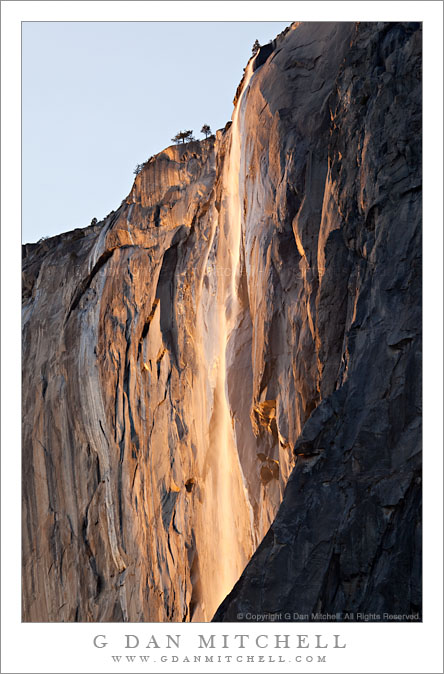
A few years ago – and a bit before the current insane craze for photographing the thing – I read more about Horsetail and finally got the urge to photograph it. I think back to a February day when Northside Drive was closed for a period of major road work. It had snowed in the Valley and the only way to get over to the El Capitan picnic area was to park on Southside drive, load up a pack with camera gear, and walk the cross-valley road in the snow. Since it was my first attempt to photograph the fall, I walked across early. Having plenty of time, I turned west on Northside and wandered in a snow-covered El Capitan Meadow completely alone — no cars and, to the best of my memory, not another person. After spending perhaps an hour alone photographing the oak-filled meadow in the late afternoon, I walked back to the east and wandered up to the picnic area where a handful of other photographers were getting set up. I looked up and thought, “Oh, that’s Horsetail,” and then made some credible but fairly conventional photographs of the sight as the sunset light came on.
Horsetail Fall, Sunset (#2)
I returned to photograph Horsetail a few more times, on occasion making this the main goal of winter visits to the Valley. I explored the surroundings near the picnic area more thoroughly, and found more nearby areas to shoot from that created some variations in perspective. I joined the growing throng at a more accessible spot and there figured out that the fall could be photographed from more than precisely one location. Before I was done I created a few photographs of the subject that I like. (I don’t mean to imply that I was always successful. On one “memorable” evening I set up and watched as the sunset light began to glow and focus itself on the fall. It was just about to reach its peak… when someone hit the “off switch” and everything went gray as the setting sun dropped behind clouds far to the west.)
Over the past couple of years more and more people have shown up for Horsetail. It might seem odd that few others photographed it for so many decades after Rowell made his iconic image, and that then many suddenly began to try to do so. But a couple of things changed. First, the advent of digital photography and DSLRs has radically increased the number of photographers out and about and searching for things to photograph. There have long been many people with cameras in the Valley, but it sometimes has seemed to become a bit crazy in recent years. Secondly, and not entirely unrelated, the Internet has made it much easier to share information about such things as Horsetail and, even more so, to quickly update people on what is happening right now with certain photographic subjects. I think this has encouraged photographers whose time is limited and who want to “get that shot” as quickly as possible to be ready to drop everything and head out now if they hear that conditions will be promising.
And the crowds certainly do show up! A few years ago I drove to a viewing area area one February day — the road was open once again — to find a parking lot completely full and then some. Photographers were set up tripod-to-tripod and scattered in nearby forest and meadows. One evening I decided to try the other location again, and having caught on to what was happening I arrived quite early… to find that photographers were already staking out their spots hours ahead of time. I found a spot up a hill a ways in some trees, and waited… as scores of photographers began to show up and point their lenses in the same direction.
Unfortunately, the problem has continued to spiral out of control, with newspaper and magazine articles and breathless social media posts amping the thing up beyond all reason… and beyond the park’s ability to withstand the onslaught. In places where a dozen or two folks used to show up on a busy night, the crowds doubled, then doubled again, then reached into the hundreds and now into the thousands. Traffic jams ensued, huge crowds assembled in fragile meadows, forests, and river bank areas, trampling down vegetation and soil and leaving litter behind. The park service had no choice but to (wisely) institute restrictions, and as of 2020 access has been made much more difficult and limited and one of the two popular areas has been closed entirely.
That lovely, mythical, magical experience of a decade or more ago no longer exists. I urge readers to forego this one. The Valley is still utterly beautiful at this time of year, but go elsewhere and photograph its other wonderful features. Don’t be part of the out of control horde…
Horsetail Fall, Sunset (#3)
Photographically, the subject has become less and less appealing to me. I’ll photograph an “icon” in more or less a couple circumstances. First, I’ll do it if I don’t already have a decent image of the icon in question. Once I have an effective image I’ll often stay away unless there is something extra special about the conditions or unless I can find a new or different perspective on the subject or unless I’m working to refine a way of photographing it that I have worked on previously. It is hard, I think, to attempt this with Horsetail. The number of locations from which it is photographed is rather limited. Most photographs are made more or less from two basic locations, with slight variations. And while weather conditions can vary a lot in the Valley, the range of conditions that will still permit the sunset light to hit the fall and be photographed is very limited.
In the end, even very good photographs of the fall tend to look quite a bit like other very good photographs of the fall, mostly varying only a bit. Although I’ve recently seen many competent and well-made photographs of the fall… I’ve only seen one that was truly original. (I’m not going to identify it here since if I don’t want to encourage the next crowd to start coming out to try to recreate that image! :-)
So, I didn’t go this year. I was in Death Valley at about the time that the light started, and I spent time doing night photography on a later weekend when I might have gone.
I think I prefer to remember that evening a few years ago when I walked across the Valley in snow, spent an hour alone in El Capitan Meadow before walking to the picnic area, photographed Horsetail in the quiet with a small number of other photographers, and then walked back across the Valley in the peaceful darkness of the early evening.
G Dan Mitchell is a California photographer and visual opportunist whose subjects include the Pacific coast, redwood forests, central California oak/grasslands, the Sierra Nevada, California deserts, urban landscapes, night photography, and more. Blog | About | Flickr | Twitter | Facebook | Google+ | 500px.com | LinkedIn | Email
Photographer and visual opportunist. Daily photos since 2005, plus articles, reviews, news, and ideas.
Manage Consent
To provide the best experiences, we use technologies like cookies to store and/or access device information. Consenting to these technologies will allow us to process data such as browsing behavior or unique IDs on this site. Not consenting or withdrawing consent, may adversely affect certain features and functions.
Functional
Always active
The technical storage or access is strictly necessary for the legitimate purpose of enabling the use of a specific service explicitly requested by the subscriber or user, or for the sole purpose of carrying out the transmission of a communication over an electronic communications network.
Preferences
The technical storage or access is necessary for the legitimate purpose of storing preferences that are not requested by the subscriber or user.
Statistics
The technical storage or access that is used exclusively for statistical purposes.The technical storage or access that is used exclusively for anonymous statistical purposes. Without a subpoena, voluntary compliance on the part of your Internet Service Provider, or additional records from a third party, information stored or retrieved for this purpose alone cannot usually be used to identify you.
Marketing
The technical storage or access is required to create user profiles to send advertising, or to track the user on a website or across several websites for similar marketing purposes.