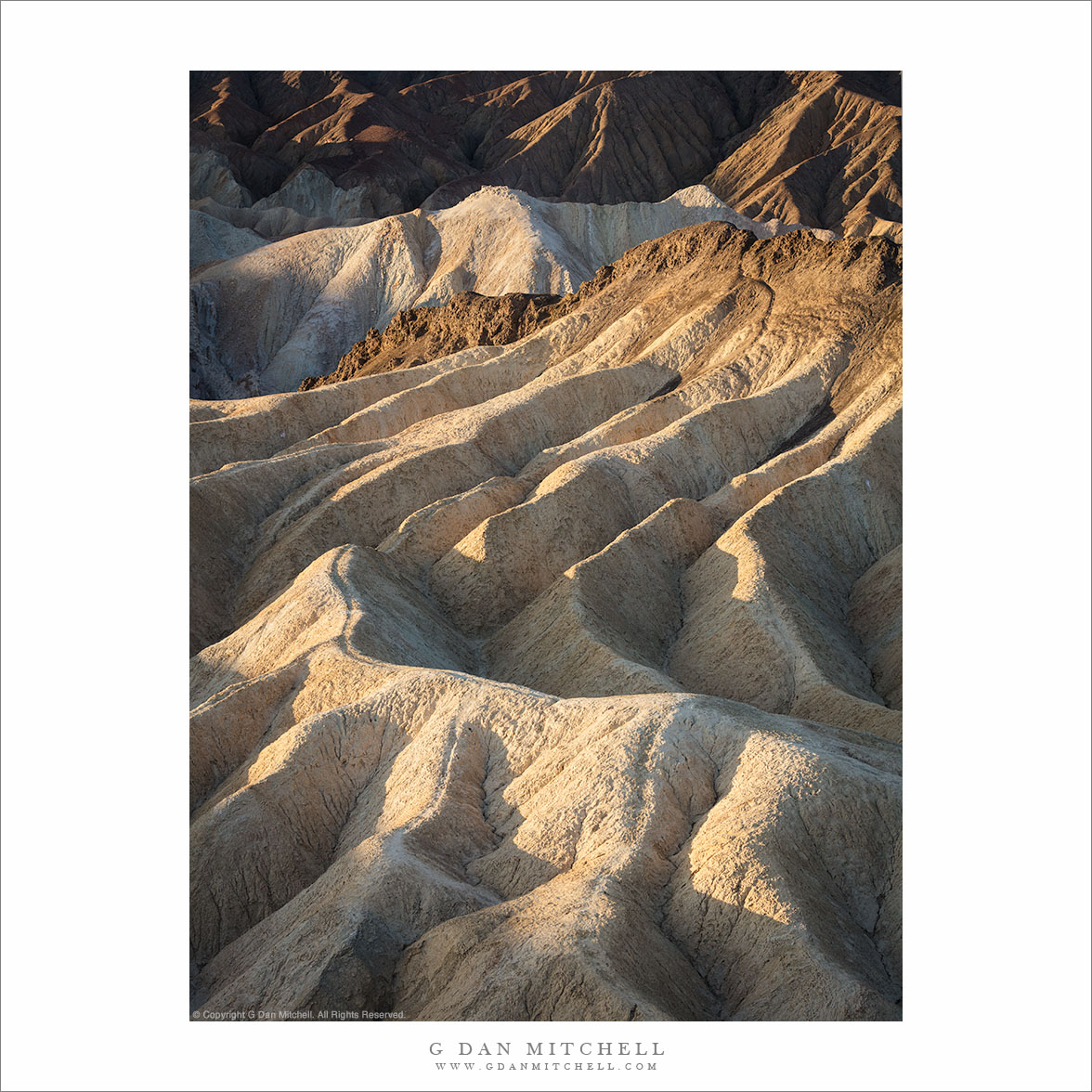
“Gulllies and Strata, Morning Light” — Highly eroded gullies and strata, Death Valley National Park.
Some geological formations in Death Valley National Park are simply otherworldly. The sparse vegetation lays these features bare — they are more visible than in places covered by forests and other vegetation. The landscape has been uplifted, split, warped, and eroded in remarkable ways. Here tilted strata emerge in deeply eroded land, and morning shadows add more contrast.
I’ve often noted the irony that this place, known for its dryness and heat, is one of the best places to clearly see the effects of water on the landscape. The material in these formations was laid down under water millennia ago. And the diagonal gullies were created by water erosion. If you have your eyes open, you’ll see that the evidence of water’s effect on the landscape is visible everywhere in this park.
G Dan Mitchell is a California photographer and visual opportunist. His book, “California’s Fall Color: A Photographer’s Guide to Autumn in the Sierra” (Heyday Books) is available directly from him.
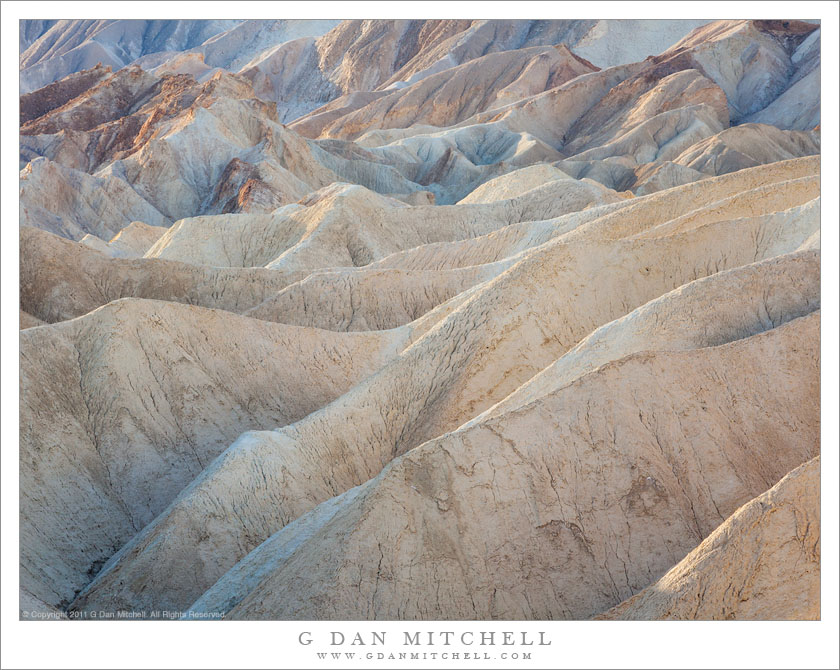
“Badlands Gullies, Morning” — The first direct sunlight sweeps across the curving shapes of badlands erosion gullies, Death Valley.
I have a rule about returning to photograph popular subjects that I first photographed years ago: Only stop if it looks like something unusual and very special might happen. The rule applies to Zabriskie Point in Death Valley, where scores of photographers (and others) gather before dawn to await the sunrise. During the last week of February I drove past on my way to a different subject. In the dim light I thought I saw developing clouds that might produce something special at sunrise. So I (literally) slammed on the brakes, turned around, parked, and joined the throng.
The special light I hoped for didn’t develop. Instead of turning colorful at sunrise, the colors just went flat. Ah, well. I can never be fully certain about what will happen in these situations, and my hunches merely improve the odds — sometimes things don’t work like I hope. But there I was, set up to make photograph s at this location. So, what else could I photograph there? I turned my attention to nearby badlands terrain and photographed it as the direct light arrived, softened a bit by high clouds.
G Dan Mitchell is a California photographer and visual opportunist. His book, “California’s Fall Color: A Photographer’s Guide to Autumn in the Sierra” (Heyday Books) is available directly from him.
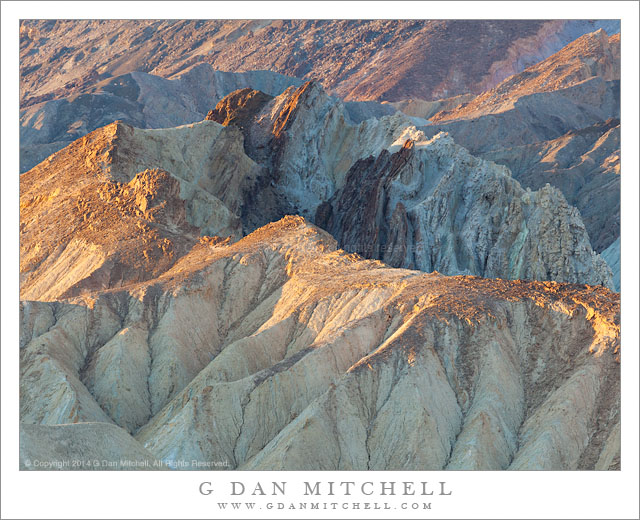
Layers of overlapping badlands formations in morning light, Death Valley National Park.
This location provides a spectacular bit of Death Valley scenery, but it isn’t photographed as often as some nearby areas that are regarded as being more iconic. It also tends to be a bit more visually attractive, at least in my view, at a time of the day that is later than the usual “golden hour” morning time when most photographers tend to be in the area. Over the years I have had a sort of informal project to photograph this spot during these times.
This is also an older photograph — not from this year’s two visits to Death Valley but rather from a trip about eight years ago. Every so often I “discover” a photograph that I had overlooked when I originally made it. Missing them has puzzled me a bit, but I think it is some combination of moving on to the “next thing” a bit too quickly, not being ready to understand how to “see” the image as a final photograph right away, and being distracted by other contemporaneous work. Back then I did work up another view of this scene — it included more of the contrasting colors near the top of the frame, and by comparison this one may have seemed too subtle… which, of course, is now part of what I like about it!
G Dan Mitchell is a California photographer and visual opportunist. His book, “California’s Fall Color: A Photographer’s Guide to Autumn in the Sierra” is available from Heyday Books and Amazon.
Early morning light on tortured badlands formations, Death Valley National Park
I made this photograph at a truly iconic location (arguably the iconic location) at Death Valley National Park back in early April. While I don’t always photograph icons, and I make a point of looking for other things when photographing in well-known areas, I’m not anti-icon. My relationship with them is complex, but when I’m with someone who has not seen them before or when I visit a new place for the first time or when unusual and spectacular conditions arise… I’ll be there with everyone else. (Though sometimes I’ll be there without everyone else, since sometimes I go to these places in less likely conditions or an unusual times.)
All of this is my introduction to saying that I made this photograph at the famous Zabriskie Point area of Death Valley. I have photographed here quite a few times over the years, and while I don’t always revisit the spot, when I do I always find something interesting to photograph. It could be special conditions (clouds, full moon, haze, etc.), but more often I like to seek out smaller component elements of this famous landscape and see if I can make photographs of them. This terrain certainly provides plenty of opportunities! It is a rugged place where gully-riddled ridges are stacked one above the other, and at the right times of the day the light can glance across these elements in beautiful ways. The light in this photograph came well after dawn, when the sun had risen enough to begin to light the features more thoroughly, but on a morning when its intensity was diminished just enough by high, thin clouds.
G Dan Mitchell is a California photographer and visual opportunist whose subjects include the Pacific coast, redwood forests, central California oak/grasslands, the Sierra Nevada, California deserts, urban landscapes, night photography, and more. Blog | About | Flickr | Twitter | Facebook | Google+ | 500px.com | LinkedIn | Email
Photographer and visual opportunist. Daily photos since 2005, plus articles, reviews, news, and ideas.
Manage Consent
To provide the best experiences, we use technologies like cookies to store and/or access device information. Consenting to these technologies will allow us to process data such as browsing behavior or unique IDs on this site. Not consenting or withdrawing consent, may adversely affect certain features and functions.
Functional
Always active
The technical storage or access is strictly necessary for the legitimate purpose of enabling the use of a specific service explicitly requested by the subscriber or user, or for the sole purpose of carrying out the transmission of a communication over an electronic communications network.
Preferences
The technical storage or access is necessary for the legitimate purpose of storing preferences that are not requested by the subscriber or user.
Statistics
The technical storage or access that is used exclusively for statistical purposes.The technical storage or access that is used exclusively for anonymous statistical purposes. Without a subpoena, voluntary compliance on the part of your Internet Service Provider, or additional records from a third party, information stored or retrieved for this purpose alone cannot usually be used to identify you.
Marketing
The technical storage or access is required to create user profiles to send advertising, or to track the user on a website or across several websites for similar marketing purposes.