
Turnstile Shadows

Turnstile Shadows
Turnstile Shadows

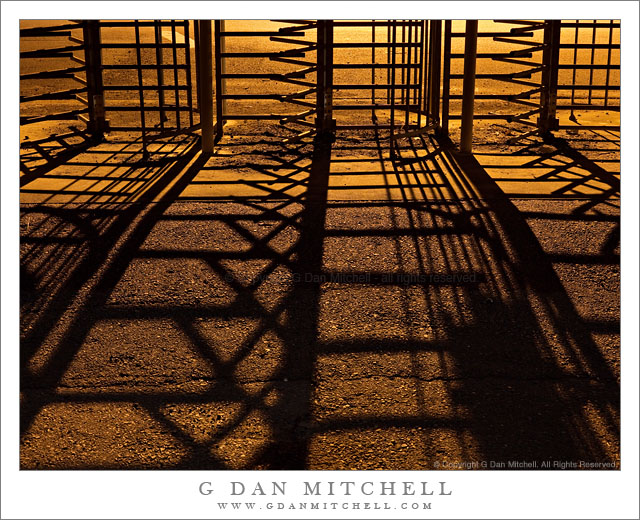
Turnstile Shadows. Mare Island Naval Ship Yard, California. February 12, 2011. © Copyright G Dan Mitchell – all rights reserved.

Shadows cast by sodium vapor lamps shining on old turnstiles at Mare Island Naval Ship Yard.

This old row of abandoned turnstiles stands at the entrance to an alley through which we almost always walk as we begin shooting in the core area of the historic Mare Island Naval Ship Yard near Vallejo, California. It seems odd to see the structure here since now one can just walk around them, but I suspect that this area must have been somewhat secure at times since military ships were built here.

This isn’t an easy subject to photograph. Several of us were talking about how we have struggled to find a composition built around the turnstiles. I have one other photograph that I made a few years ago that I think works pretty well. In that one I aimed a bit higher and let the metal structure pretty much fill the frame, and I also ended up making it a black and white image. (It was used as a cover for a book at one point.) But on this evening a few of us were staring at the turnstiles again and remarking that there must be more photographs in there… somewhere… but that we are still trying to find them.

I thought it might be interesting to make the long and complex patterns of the shadows fill most of the frame, so I moved back just a little and pointed the camera down so that just a portion of the turnstile structure appears at the top of the frame. This also helps with a couple of technical challenges: the bright lights beyond the structure create a tremendously large dynamic range in the scene, and it can be difficult to keep some distracting background elements (like a stop sign!) out of the image. The garish yellow/orange light is from a large sodium vapor lamp that sits above the intersection on the road in the background. That coloration is part of what made me choose to make the previous photograph of this subject black and white, but on this night I decided to go with the color.

The final image is a blend of two exposures. The shorter one was selected to avoid blowing out the brightest areas in the upper part of the frame, and the longer one let me keep a bit more detail in the shadowed asphalt foreground.

G Dan Mitchell Photography | Flickr | Twitter | Facebook | Email
Text, photographs, and other media are © Copyright G Dan Mitchell (or others when indicated) and are not in the public domain and may not be used on websites, blogs, or in other media without advance permission from G Dan Mitchell.
Lamp, the ‘UFO Building” at Night

Lamp, the 'UFO Building" at Night

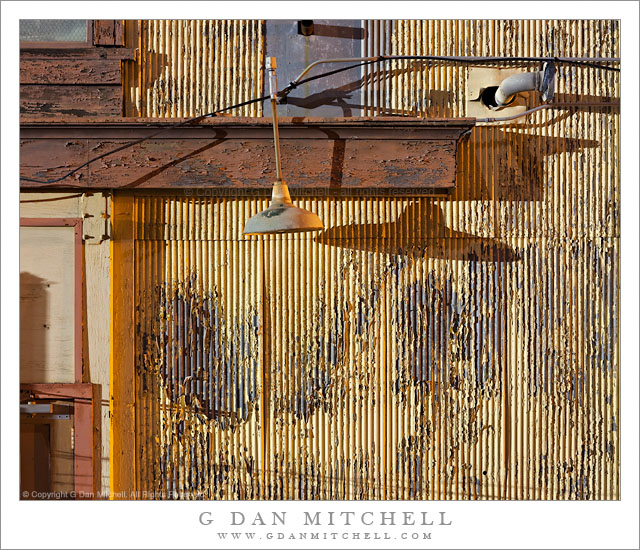
Lamp, the ‘UFO Building” at Night. Mare Island Naval Ship Yard, California. February 12, 2011. © Copyright G Dan Mitchell – all rights reserved.

A lamp casts a shadow in bright artificial light in a night photograph of the wall of the ‘UFO Building’ at Mare Island Naval Shipyard.

The first time I photographed the side of this weathered and peeling building and Mare Island Naval Ship Yard, I didn’t see the feature that gives this building its informal name. I’ll be that you can though, right? Due to a lucky alignment of this small exterior lamp (which appears to be non-functional) and some nearby sodium vapor lamps, the lamp casts a shadow on the corrugated wall of the building that has a striking and easily recognized shape!

It may not immediately be apparent that this photograph was made at night in very low light. However, a look at the lighting should make it apparent that this cannot be daytime light. Note that the lamp that creates a shadow to its right… is also getting some nice illumination from the right side! One of the fun things about shooting in an industrial location like Mare Island is the amazing mixture of lighting sources. Though it wasn’t much of an influence on this night, the full moon can provide light that is color balanced pretty much like daylight… only a lot dimmer. The sodium vapor lamps that light this area (they are common in street lamps) produce a strongly yellow or yellow/red light. Occasional fluorescent or tungsten lamps provide yet more color variations. In the end, it is just about impossible to say what kind of color balance is “real” – and doubly-so since the actual shooting conditions are near darkness. The only reason that images like this look daylight-bright is because they are typically the result of long exposures. In fact, this one was relatively short at just over a minute. Somewhere in the 2 to 5 minute range is perhaps more typical.

The crazy lighting is apparent in this image if you look a bit more closely. As mentioned above, there is cross lighting here from both sides of the frame. While the strongest light comes from the left (and creates that UFO shadow) there is also significant light from a bit further away to the right. You may also be able to see that the in some areas the shadows created by light from one side are filled in by garishly colored lights coming from the other directions – see some of the very yellow areas along the sides of vertical boards and along the ridges of the corrugated wall.

G Dan Mitchell Photography | Flickr | Twitter | Facebook | Email
Text, photographs, and other media are © Copyright G Dan Mitchell (or others when indicated) and are not in the public domain and may not be used on websites, blogs, or in other media without advance permission from G Dan Mitchell.

Pipes, Tank, and Cyclone Fence Shadows

Pipes, Tank, and Cyclone Fence Shadows

Pipes, Tank, and Cyclone Fence Shadows. Mare Island Naval Ship Yard, California. February 12, 2011. © Copyright G Dan Mitchell – all rights reserved.

Black and white night photorgraph of pipes, a tank, and cyclone fence shadows falling across a brick wall at the Mare Island Naval Ship Yard.

This past weekend I had a chance to join my friends from The Nocturnes for an introduction to night photography at the historic Mare Island Naval Ship Yard near Vallejo, California. The Nocturnes schedule events at this wonderful and rich location several times each year, and I have done night photography there many times in the past. Many of the photographers at this particular event were experimenting with “the dark side” for the first time, so I decided to go both to do a bit of my own shooting and to help Tim Baskerville answer questions from some of the first-timers.

This bit of industrial “stuff” is in a location I have shot many, many times. It is in an alley next to what is now the Mare Island Historic Museum, and it traditionally the first place that many MINSY night photographers start their evening of night photography. Since I’ve shot quite a few of the standard subjects at Mare Island, I had in mind a few slightly different subjects and different approaches in mind this time. One was to focus specifically on shadows as a compositional element and another was to look for some of the smaller details of the place in addition to shooting the very interesting larger structures that so often get my attention.

So, after shooting nearby structure with shadows angling across the alley, I thought that I’d see what I could do with this odd bit of old pipes and a tank against a brick wall, and illuminated by nearby sodium vapor lamps shining through a cyclone fence. I liked the shiny texture of the pipes and their shapes as they radiated from the central tank, along with the shapes of both the very dark and large shadows and the net of fainter shadows thrown over the whole scene by the fence.

G Dan Mitchell Photography | Flickr | Twitter | Facebook | Email
Text, photographs, and other media are © Copyright G Dan Mitchell (or others when indicated) and are not in the public domain and may not be used on websites, blogs, or in other media without advance permission from G Dan Mitchell.

Too Much Information. Too Much of a Good Thing?

Following on the heels of my own recent post about Horsetail Fall, this may seem like a bit of a strange post. With that out of the way, here goes.

Earlier today I saw a discussion in which someone had asked for some advice about when and where to photograph a particular seasonal landscape subject – the specific place probably isn’t important in the context of this post. Various responses ensued, and they offered different types and amounts of information about the subject and how to photograph it. Eventually I saw a response that included a detailed map that contained many “photo locations” indicated with what appeared to be GPS-level precision and labeled according to the subject that one might photograph from each location.

I’m partly sympathetic to the desire to know exactly where to go and when to go there to find “that shot” of a subject that is intriguing and fascinating. And I also really do understand the importance of emulation when it comes to learning photography and much else. We might see an effective photograph and wonder what went in to creating it, and one way to learn about the process is to attempt to create something very close to that photograph. I may have mentioned before that I carry around a mental repository of images and fragments of images that will be triggered by seeing a particular subject, and the images in my “repository” come from many, many places including the work of other photographers that I admire. In fact, when I photograph certain subjects I often think of very specific images by very specific photographers. But, no, I have no interest in trying to recreate their photographs, and when presented with the opportunity to do so I usually point my lens somewhere else.

That said, while using the process of re-creation as a learning tool has some real value, focusing on trying to reproduce yet another photograph of a familiar subject, from the familiar position, with the familiar light seems to do more to limit ones photographic vision than to expand it. And wanting to know precisely where to place ones tripod in order to get “that photograph” (just like the one the other guy made) is often a bit misguided. In the end, I think it is also going to be unsatisfying for the photographer.

I have to admit that I do sometimes photograph very familiar subjects. Heck, I’ve just posted a string of photographs of the Golden Gate Bridge – and you would be hard pressed to find many more-photographed subjects than that! But I have never asked where or when to photograph it, and from my perspective I come to the subject (relatively) free of preconceptions of what a “good” Golden Gate Bridge photograph should look like. I like to think that this might eventually make it possible for me to create something that isn’t just like all the other photographs. But beyond that, I am sure that I get a lot more personal pleasure from the extended process of learning about the subject through repeated visits, consideration of what does and doesn’t work and so forth than I would if I went and shot it exactly the way that someone promised me would result in a photograph that was just like the other photographs I’ve seen of the Bridge.

To be clear, I can’t claim to be completely consistent in this regard. I do share some information about where and how I shoot at this blog and elsewhere. But I would tend to draw the line when it comes to specifying the precise location from which “the shot” should be made. In the end, I think I’m doing a favor for any photographer who might visit the same place and attempt to photograph it.

G Dan Mitchell Photography | Flickr | Twitter | Facebook | Email
Text, photographs, and other media are © Copyright G Dan Mitchell (or others when indicated) and are not in the public domain and may not be used on websites, blogs, or in other media without advance permission from G Dan Mitchell.