
Mesquite Dunes and Cottonwood Mountains

Mesquite Dunes and Cottonwood Mountains

Mesquite Dunes and Cottonwood Mountains. Death Valley National Park, California. March 29, 2011. © Copyright G Dan Mitchell – all rights reserved.

Soft and hazy late-afternoon light on Mesquite Dunes and lower Cottonwood Mountains, Death Valley National Park.

The color of the sand dunes of Death Valley changes radically at different times of the day, in different weather conditions, and even seasonally. Many of the photographs of these dunes – the “Mesquite Dunes” in the middle Valley near Stovepipe Wells – are made in the early morning or in the evening. At those times the dunes take on the colors of sunrise/sunset light (generally very warm yellow to golden colors) or the pre-dawn or (better yet) post-sunset light of the sky, which can include a range of colors from blues to pinks to purples and so on. Judging by photographs you might think that the dunes are brightly and intensely colorful. (Or black and white, but that’s a different story.)

Most of the time the coloration is quite different from what we see at the early and late “edges” of the day. The less saturated colors at other times of day can be a bit more complicated to shoot, but they can also create some wonderful subtle effects if you happen to look in the right place at the right time. Late in the afternoon on this early spring day, there was some haze in the atmosphere – perhaps from some blowing dust and/or some clouds and moisture that had been around earlier. As the sun drops at Mesquite Dunes, it goes behind mountains to the west well before actual sunset. When this happens, the dunes are gently back-lit by soft light from the western sky, and the backlit haze mutes the colors of the dunes and, even more, the distant slopes of the rugged Cottonwood Mountains.

My idea here was to isolate the undulating shapes of the softly lit dunes in front of the background of the very, very muted colors and shapes of the lower Cottonwood Mountains, which are obscured by haze. There is some color in this scene, but it is subdued and edges quite a ways towards pastels.

G Dan Mitchell Photography | Flickr | Twitter | Facebook | Email
Text, photographs, and other media are © Copyright G Dan Mitchell (or others when indicated) and are not in the public domain and may not be used on websites, blogs, or in other media without advance permission from G Dan Mitchell.
Dusk, Death Valley Ridges

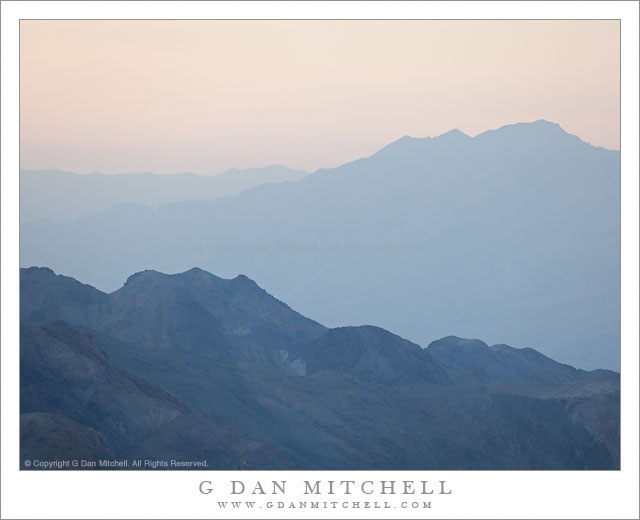
Dusk, Death Valley Ridges

Dusk, Death Valley Ridges. Death Valley National Park, California. March 30, 2011. © Copyright G Dan Mitchell – all rights reserved.

Dusk light on ridges above Death Valley, California.

This photograph was made in the evening from Aguereberry Point, high in the Panamint Mountain Range along the west side of Death Valley. The point is a spectacular overlook with panoramic views in all directions. The number of visitors is relatively low since it is at the end of a gravel road and is a good long drive from most of the places where people tend to stay when they visit the park. It is also windy!

(Those who read the brief technical information about the photographs might wonder at my use of ISO 400 for a landscape photograph – but when shooting at 400mm in windy conditions, a lower ISO makes it darn near impossible to deal with camera vibrations.)

The range of lighting conditions and effects as the day comes to an end at Aguereberry Point is tremendous. To the west (roughly behind me and over my left shoulder as I shot this photograph) the sky is very bright as the sun drops towards the distant Sierra Nevada. Below the Valley and the canyons along the mountains on either side gradually dim and become hazy. As the sun drops and is blocked by intervening peaks and mountain ranges, even the higher peaks and ridges take on these subtle and pastel shadings. It probably isn’t too important to identify the specific ridges in this image, but they are to the northeast of the point. The nearer ridge is along the west side of the Valley (probably part of the Tucki Mountain complex) and the further ridges are a much greater distance to the northeast across the upper Valley.

G Dan Mitchell Photography | Flickr | Twitter | Facebook | Email
Text, photographs, and other media are © Copyright G Dan Mitchell (or others when indicated) and are not in the public domain and may not be used on websites, blogs, or in other media without advance permission from G Dan Mitchell.

A Forum Post About Photography and ‘Realism’

From time to time I share here a post I made elsewhere. Recently I posted something in one of those familiar threads lamenting that some photographer did something in an image that “altered reality” in some way. Yes, that topic. Again.

With apologies to all of you who know that the following is pretty darn obvious, here is the post:

The notion that a photograph can portray something equal to the original reality of the subject is a myth. All photographs lie.

This is not news to those who are familiar with the history of photography or with philosophical musings about the medium. The process of determining what to include and what to leave out, deciding when to click the shutter, selecting the time of day or season of year to make the exposure, chosing whether to shoot black and white (which isn’t remotely real!) or color, using filters on the camera, using filters in digital or optical/chemical post, using shift and tilt lenses, controlling DOF with aperture selection, choosing what paper to print on, selecting one frame over another, choosing how to describe and explain explain or simply title the image, dodging and burning, choosing methods of developing film for their effect on the image, shooting Velvia (!), attaching a polarizing filter, adding a hood to control flare, using flare as part of the image, brushing that bug off the leaf, adding a bug to the leaf, waiting for the bug to land/fly away, picking the prettier bird out of the flock rather than the other one with the bent wing, choosing to point your camera in the direction that excludes the power line or the buildings, waiting for the wining smile, waiting for the smile to to away, shooting with very short focal lengths, shooting with very long focal lengths, and on and on and on and on…

It is impossible for a photograph to be an analog of “reality.” At best it can suggest something that the photographer saw or felt in the presence of  that reality or something about how the photographer views it. It can evoke a memory, an association, or an imagination in the viewer. It cannot portray objective components of the “reality” of the subject such as the cool breeze on your face, the smell of pine trees, the moisture in the air, your sore feet from the long walk, the warmth of sun on the back of your neck, the sound of birds and wind – all of which are components of the “reality” we experience in the presence of the actual subject.

And I really don’t care. If the only thing that I thought photography could do was “capture” an objectively accurate rendition of reality I wouldn’t bother to make photographs – which would always fail to equal the experience of that original reality. I’d get rid of may camera and just go experience it. (Which I actually did for a time, but that is not a story for this post.)

But that isn’t what photography does, and it would be far less than photography can do. One of the most interesting and humane things it does is it offers us a view into the mind and world of the person of the photographer. Frankly, in the end I’m far more interested in what the photograph tells me about the person who made the image, and perhaps about myself, than I am in the extent to which the photograph pretends that it can stand in for the real.

Imagining that the purpose of photography is merely to “capture” the real, thus creating a sort of second-best shadow image of the real, is simplistic and naive. It is also nearly completely contrary to the history and development of the craft and art of photography. It is essentially impossible to find photographs that are totally “pure” – whatever that even means.

And when I view a great and powerful photograph, virtually the last thing I ask myself is, “is this a real thing?” I think about the effect it has on me, what it tells me or suggests to me about the world, its pure aesthetic power as an image, its intrinsic beauty, the associations I draw between it and my experience.

G Dan Mitchell Photography | Flickr | Twitter (follow me) | Facebook (“Like” my page) | LinkedIn | Email
Text, photographs, and other media are © Copyright G Dan Mitchell (or others when indicated) and are not in the public domain and may not be used on websites, blogs, or in other media without advance permission from G Dan Mitchell.

Lower Slopes of Tucki Mountain, Dawn

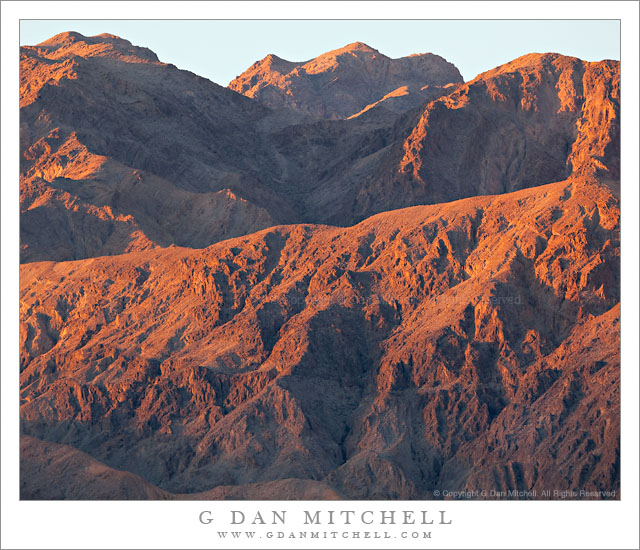
Lower Slopes of Tucki Mountain, Dawn

Lower Slopes of Tucki Mountain, Dawn. Death Valley National Park, California. March 31, 2011. © Copyright G Dan Mitchell – all rights reserved.

Dawn light on the faces and gullies of the lower slopes of Tucki Mountain, Death Valley National Park.

On the final morning of my recent (March, 2011) visit to Death Valley I decided to go to a spot not far from my campsite at Stovepipe Wells where I know of a bit of raised terrain that provides large-scale views of big chunks of this part of the Valley. I arrived before dawn and lugged my gear to the top of this rise with the primary plan of using a long lens to photograph across the Mesquite Dunes toward the Cottonwood Mountains at sunrise.

However, when standing in a spot like this one there are so many interesting effects of light all around that it is impossible, for me anyway, to just shoot that one thing. Far up the Valley to the north light starts to hit the highest peaks of several mountain ranges, to the east the light comes through and illuminates morning haze and layers of low hills, and to the southwest of my position the light began to reach the top of Tucki Mountain. So, between photographs of my intended subject to the west, I swung the camera though the entire 360 degrees to photograph many of these other subjects.

Tucki Mountain has fascinated me since I “discovered” it one morning while shooting on the “back side” of the Mesquite Dunes. At dawn I had been photographing the low dunes and other features on the side of the dunes that cannot be seen from the usual roadside viewpoints. As the light changed I worked my way up into the dunes a bit to photograph the shapes and textures of the sand, and I saw a composition that included this massive mountain to the south with it dark and jagged features. It was only later that I found out that it was Tucki Mountain. (If you have visited Stovepipe Wells, you have been right below the mountain.) It is a huge, sprawling peak – almost more of its own small range than a simple peak, or so it seems to me.

On this morning I first saw a big of the deep red first dawn light hitting the top of the peak and noticed lower ridges starting to pick up traces of this light. I swung that tripod head around to point this direction and decided to tightly frame some images of the overlapping ridges and valleys ascending toward the peak as the light worked its way down toward the Valley floor.

G Dan Mitchell Photography | Flickr | Twitter | Facebook | Email
Text, photographs, and other media are © Copyright G Dan Mitchell (or others when indicated) and are not in the public domain and may not be used on websites, blogs, or in other media without advance permission from G Dan Mitchell.