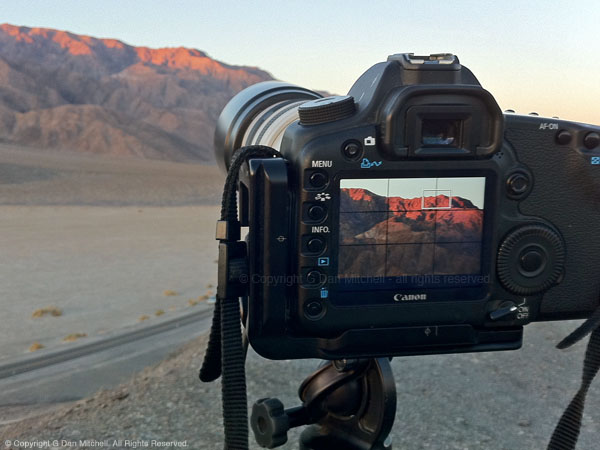
I’ll be at tonight’s monthly San Francisco Photography Meetup Group get-together. It is always a fun event and a good time to get together to view photographs and talk photography. I’m bringing some recent prints from my recent Death Valley visits and perhaps a few others.
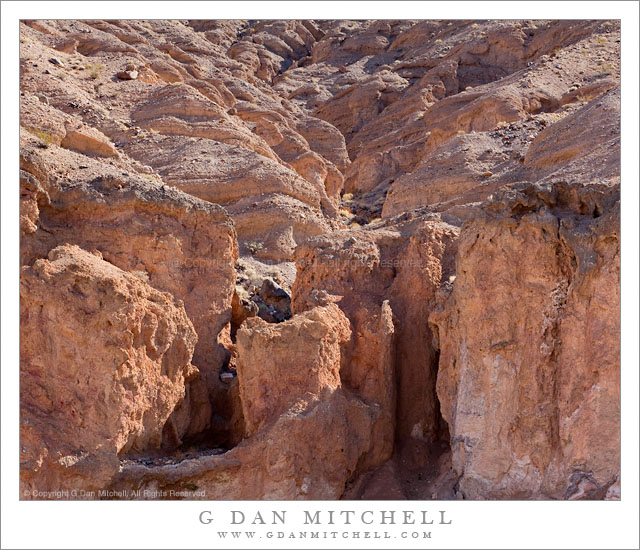
A red rock gully and wash in the Panamint Range of Death Valley National Park.
I have driven past this area along the road from Death Valley up to Wildrose Canyon quite a few times, and as I do I always am impressed by the many convoluted little canyons and odd and interesting rock formations. Most often I have been on my way to some other place or the light wasn’t quite right, but I always take a look and make a mental list of little spots to keep an eye on. This particular little canyon is one you might not even notice unless you were looking carefully as you passed it. It is in a narrow section of the lower canyon where it is one of many such little landscapes. On this morning I was coming back down from shooting up higher in the Panamints and I was watching carefully as I drove, frequently pulling over to stop and check things out more carefully. At first I almost drove past this spot, but it looked like the light might be interesting this time so I quickly stopped and backed up and made a series of photographs including this one.
The question of how to frame this scene was an interesting one. As is often the case I cover more than one base and shoot the subject in several ways. Initially I worked with a vertical orientation that includes a bit more of the rough terrain a bit higher in the canyon. That image may still see the light of day! But as I shot the scene I also realized that I could use a horizontal orientation too, more tightly frame the entrance to the small canyon, and give up some of the upper canyon formations.
With many subjects I would prefer softer light, and I would probably try to shoot much earlier in the day or come back in the evening. But this canyon, I think, works well in the light of a bit later in the morning when the sun has topped the ridge and direct light hits the top of the rocks and reflects into the recesses a bit more.
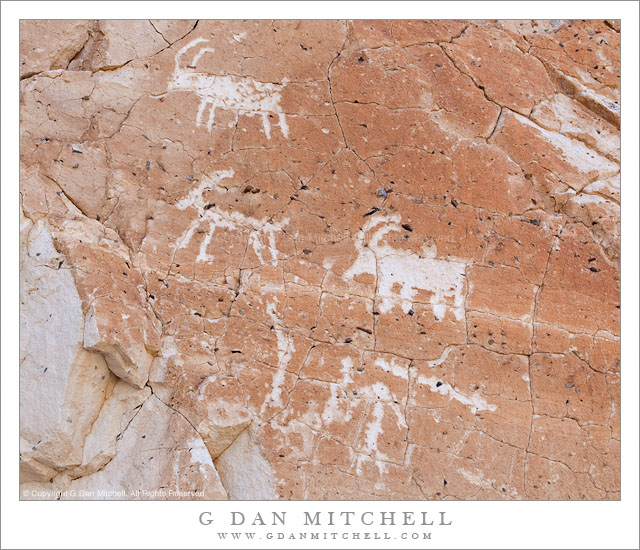
Petroglyphs of bighorn sheep in the Panamint Range of Death Valley National Park.
If you keep your eyes open, think about your surroundings, and know where to look, eventually you will come across the signs of much earlier residents of Death Valley. From my basic knowledge, I understand that there is evidence that a series of native American cultures resided in and around the Valley for at least the past 11,000 years, a period over which the climate changed from one that was originally much wetter to the hotter, drier climate that we know today. Because many of these people apparently had to migrate locally to find food sources at different times of the year it seems that evidence of their presence can be found in a wide variety of locations.
I recall the first time I found an artifact of one of these cultures. It was on my first visit to Death Valley back in the 1990s. At one point I wandered away from a place where I was camped and walked out across a section of a very large gravel wash, where I found a comfortable rock to sit on and enjoy the view. As I sat there I happened to look down and notice an unusual rock. I picked it up and realized that someone had formed it into a shape that could be used for carving or cutting, and I later read that it was a sort of knife. As I held it, surprised by finding any human signs in such a place, I began to wonder about the life of the person who made it and used it – a life I could barely imagine. A few minutes later I returned the object to where I had found it and walked back to camp.
For me, an encounter with rock art such as these petroglyphs provokes a lot of deep thoughts about time and culture and the lives of people who seem about as far removed from my experience as I can imagine. I try to imagine myself in their lives, but know that I fail.
Of course, I won’t say more about where such things are located than what is on this page. If you know where this example is located, let’s keep it a secret, OK?
Photographer and visual opportunist. Daily photos since 2005, plus articles, reviews, news, and ideas.
Manage Consent
To provide the best experiences, we use technologies like cookies to store and/or access device information. Consenting to these technologies will allow us to process data such as browsing behavior or unique IDs on this site. Not consenting or withdrawing consent, may adversely affect certain features and functions.
Functional
Always active
The technical storage or access is strictly necessary for the legitimate purpose of enabling the use of a specific service explicitly requested by the subscriber or user, or for the sole purpose of carrying out the transmission of a communication over an electronic communications network.
Preferences
The technical storage or access is necessary for the legitimate purpose of storing preferences that are not requested by the subscriber or user.
Statistics
The technical storage or access that is used exclusively for statistical purposes.The technical storage or access that is used exclusively for anonymous statistical purposes. Without a subpoena, voluntary compliance on the part of your Internet Service Provider, or additional records from a third party, information stored or retrieved for this purpose alone cannot usually be used to identify you.
Marketing
The technical storage or access is required to create user profiles to send advertising, or to track the user on a website or across several websites for similar marketing purposes.