
Mesquite Dunes and Cottonwood Mountains, Morning

Mesquite Dunes and Cottonwood Mountains, Morning

Mesquite Dunes and Cottonwood Mountains, Morning. Death Valley National Park, California. March 31, 2011. © Copyright G Dan Mitchell – all rights reserved.

Early morning light on Mesquite Dunes and the Cottonwood Mountains, Death Valley National Park.

This is one of the images I had in mind on the most recent late-March trip to Death Valley. When I visited earlier this year in February I started thinking about photographing the dawn light on the lower slopes of the Cottonwood Mountains along the west side of upper Death Valley. I had (and still have!) in mind several locations from which to explore this interesting terrain and light, but among them were a few that placed the Mesquite Dunes (a.k.a. “Death Valley Dunes”) in the foreground. (Why didn’t I shoot this subject back in February, you ask? The weather did not cooperate! There was rarely good light in the morning and, in fact, I had to deal with rain and snow on that visit!)

Besides finding a location from which to line up the elements of the shot, the other keys are having a long enough lens and, well, being there at the right time! And, as I was reminded in February, a bit of luck with the weather doesn’t hurt either. Although it had snowed and rained right before my arrival on this visit, this time the weather ended up being clear for the most part and was even turning downright hot by the time I left later on the day that this photograph was made.

G Dan Mitchell Photography | Flickr | Twitter | Facebook | Email
Text, photographs, and other media are © Copyright G Dan Mitchell (or others when indicated) and are not in the public domain and may not be used on websites, blogs, or in other media without advance permission from G Dan Mitchell.
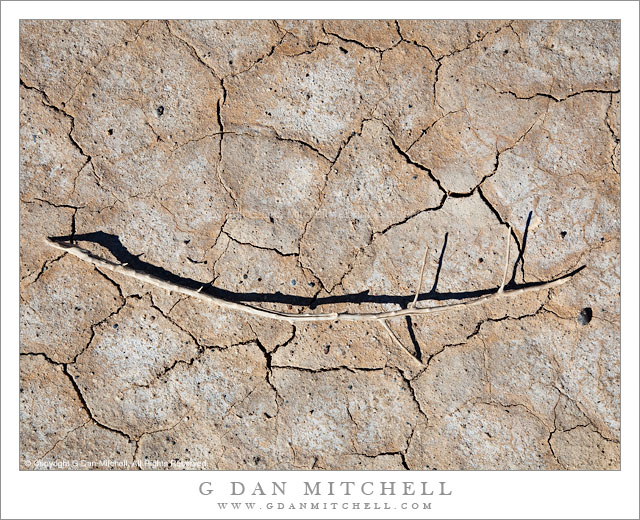
Branch on Playa, Panamint Valley

Branch on Playa, Panamint Valley

Branch on Playa, Panamint Valley. Death Valley National Park, California. March 31, 2011. © Copyright G Dan Mitchell – all rights reserved.

A lone branch lies across dried mud on the playa of Panamint Valley, Death Valley National Park.

First, a story about the location. My first visit to Death Valley was sometime in the late 1990s, when the “hiking and biking” club at my kids’ middle and high school did a trip there. The club is a long and interesting story that I don’t have time or space to describe here fully. Suffice it to say that the teacher, “Mr. Hodges,” had for decades taken kids on amazing outdoor adventures throughout the western United States every year, and that the trip that year was to involve visits to several places in the park and then a backpacking trip down to the Valley from up in the Teakettle Junction vicinity. This may sound like a crazy thing to do with a bunch of school kids, but the group had a record of success. I was along as a parent chaperone since my oldest son was a participant in the trip.

The “readers digest” version of the story of the trip is that, as is often the case near the beginning of April, we encountered an astonishing range of weather conditions. Early on it snowed and the wind blew at gale force levels. This forced us to abandon our initial backpacking plans after we had already camped overnight near Teakettle Junction, and to head back down to the Valley. We readjusted our plans and decided that we might still be able to do an overnight hike down the length of the upper Valley and (leaving out a bunch of intervening adventures in this narrative) we arrived at Stovepipe Wells and set up camp… just in time for a tremendous dust storm to blow in. The next morning the “bus” arrived that was to take the kids and a few of the chaperones home (the rest of us were in a truck carrying tons – literally – of gear on the roof rack and in a trailer) and we headed up to cross Towne Pass. It turned out that the “bus” (which was more or less a large airport shuttle-type van) was ill-equipped for these conditions and after struggling up the pass and then racing down the other side, the transmission blew out at the bottom of the descent into Panamint Valley. Those of us in the truck pulling the trailer arrived a few minutes later to find a group of scared kids and parents who had just experienced more excitement than they wanted.

I have a strong visual memory of “Mary,” one of the parents, who had just had a bit too much excitement walking quietly north away from the road and across this playa. Ever since that time, this place that most people would probably blow right past, has almost always warranted a stop as I passed by on my way out of the Valley. This trip was no exception. I left my camera gear in the car and just walked a ways out onto the playa. As I walked, even though I had been certain that my photography for this trip was finished, I started noticing some of the small details on the playa… and I went back to my car to get my camera, then returned and made a few hand-held exposures of some of these small subjects.

G Dan Mitchell Photography | Flickr | Twitter | Facebook | Email
Text, photographs, and other media are © Copyright G Dan Mitchell (or others when indicated) and are not in the public domain and may not be used on websites, blogs, or in other media without advance permission from G Dan Mitchell.

How Do We Really Shoot?

This is probably going to be a sort of “thinking out loud” post, so forgive me if I’m sharing some half-formulated thoughts. I may even have to take back some of what I write afterwards! It is complicated. (Slightly revised on 8/14/11)

This afternoon I was reading an article about a photographer who produces some excellent and compelling work that I like quite a bit. The photographer’s identity is not important in the context of what I’ll write, since the person’s story only served to remind me of many similar stories I have read elsewhere regarding quite a few other photographers. Aside from the commentary on this person’s wonderful photographs, there were two other threads I noticed in the article – and I recognized both of them from a lot of other writing by and about photographers that I’ve seen, specifically about landscape/nature photographers.

First, I noticed that there was almost as much discussion about the circumstances in which the photographer works as there was about the photography itself – and the circumstances seemed quite dramatic. (It seems curious to me that photographers are often more interested in writing about and readers more interested in these circumstances than in the actual photographs, but that is something for another post…) There were stories of working in freezing cold with the risk of frostbite, of traveling to wild and seemingly dangerous places, and of encountering scary and threatening circumstances, working alone, coupled with an impression that the photographer was unable to resist the call to “risk it all” for “the shot.” It all sounds quite dramatic and even dangerous! That, however, is going to be a subject for a future post.

The second thing that caught my attention was a claim that the photographer had imagined a specific shot and then had gone to a certain place and spent a week waiting for that shot. The photograph that was the result of these efforts is, indeed, a very wonderful photograph and one that I find quite compelling. But from my own experience in photographing similar subjects in similar places and circumstances, the claim of seeing the image before arriving and then waiting for exactly the imagined image to appear didn’t quite add up, especially given the ephemeral nature of the effects and conditions that make the image in question so powerful.

It is this second issue that I’m interested in exploring a bit right now – the question of whether we simply capture the image we saw in our mind’s eye before arriving on the scene, or perhaps do something a lot more complex and, I think, much more intuitive and instantaneous. Do we arrive on the scene and wait for the thing we imagined to happen, or do we arrive on the scene and find a way to photograph what we find there? Or, what is the balance between this opposite poles? Continue reading How Do We Really Shoot?

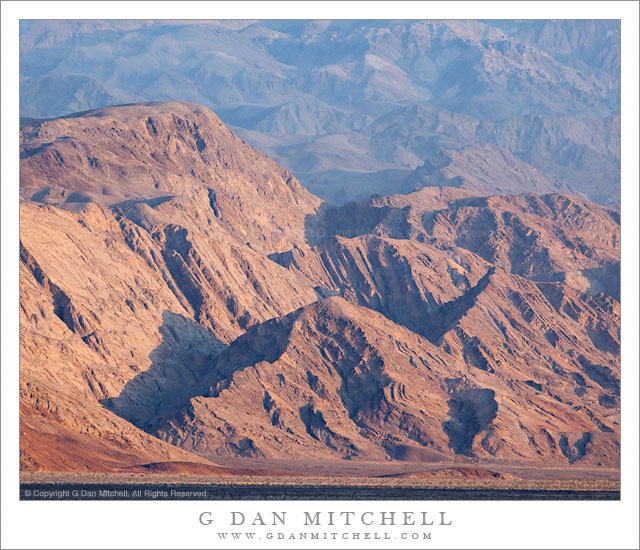
Dawn Light, Base of the Cottonwood Mountains

Dawn Light, Base of the Cottonwood Mountains

Dawn Light, Base of the Cottonwood Mountains. Death Valley National Park, California. March 29, 2011. © Copyright G Dan Mitchell – all rights reserved.

Dawn light on the based of the Cottonwood Mountains at the edge of Death Valley.

This is (yet another) one of those photographs that is the result of some odd combination of “planning” and serendipity. When I travel somewhere to do photography I often, though not always, have some ideas about certain types of subjects I would like to photograph or about ways I’d like to photograph them. On this visit to Death Valley I had a few such ideas in mind – one of them had to do with scenes that filled the frame with the rugged and forbidding and seemingly lifeless mountains and valleys and ridges of the place. Another had to do with photographing in the early light along the west side of the Valley, something I thought about but didn’t really try on my previous visit. This photograph and a few others like grew out of those ideas.

On the other hand, I wouldn’t have been in this spot at this moment if I had not had an electrical problem with my car! The night before I had returned to the campground from a bit of late shooting, parked the car, and went about my “camp business” before crawling into the tent and setting my alarm for an appropriate pre-dawn hour so that I could arrive at a particular location before the sun came up. The alarm went off at the appointed time, and a few minutes later I emerged from my tent and got into my car. It wouldn’t start. I soon realized that the car was electrically “dead” – no interior lights, etc. Since it was still completely dark, the idea of doing auto repair outside the tents and RVs of lots of other sleeping campers was out of the question, so I went back into my tent and speculated uncomfortably about the potential costs of towing and automobile repair in Death Valley.

Later, as the sky began to lighten, I heard other campers stirring. I got up – again – and opened the engine compartment to find that one of the battery cables had come off, perhaps as I drove a rather rough road the previous day! Relieved to find that this was something that I could fix, I reattached the cable, quickly got in the car, and figured I would see what I could salvage of the morning shoot. I headed west across the Valley toward Towne Pass, thinking about photographing some snow that was high on the ridge. As I drove I saw that the first light had still not quite reached the Valley floor along the base of the Cottonwood Range. I quickly found a slight rise along the road where the view wasn’t obstructed by desert plants, pulled over, put on the long lens, and made a few photographs as this beautiful light worked its way down the face of the range and began to work its way out across the giant wash along the edge of the Valley.

G Dan Mitchell Photography | Flickr | Twitter | Facebook | Email
Text, photographs, and other media are © Copyright G Dan Mitchell (or others when indicated) and are not in the public domain and may not be used on websites, blogs, or in other media without advance permission from G Dan Mitchell.