
All posts by G Dan Mitchell

G Dan Mitchell, photographer and visual opportunist focusing on the Pacific coast, the Sierra Nevada, redwood forests, California oak/grasslands, California deserts, urban landscapes, night photography and more. Posting daily photographs since 2005, along with articles, reviews, news, and ideas.

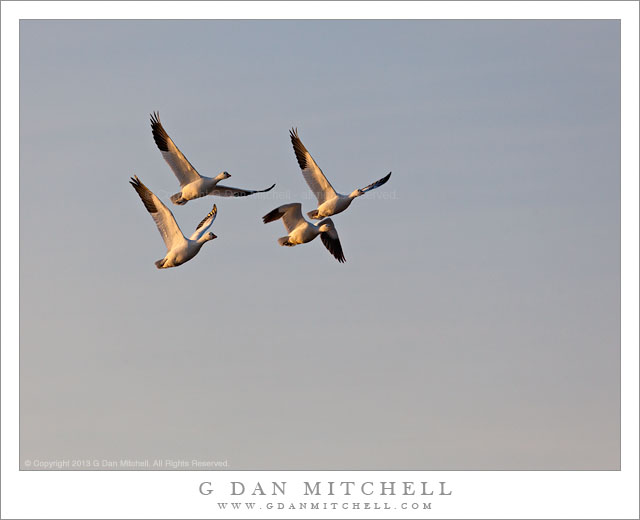
Four Ross’s Geese, Sunset Light

Four Ross's Geese, Sunset Light
Four Ross’s Geese, Sunset Light

Four Ross’s Geese, Sunset Light. San Joaquin Valley, California. January 21, 2013. © Copyright 2013 G Dan Mitchell – all rights reserved.

Four Ross’s geese in flight against the sky in sunset light

I photographed this group of Ross’s geese late in the day, just as golden hour light was beginning to intensify. We had spent the day in the San Joaquin Valley, visiting a couple of wildlife refuges, and returned at the end of the day to the place where we had begun shooting before dawn. We hoped for some combination of evening geese and then a dusk fly-in of sandhill cranes.

The amount of control you have when photographing these birds is minimal. It is up to them to decide where they will settle in, when and in what direction they will fly, and much more. A lot of the process involves doing things that you hope will increase your odds – being in likely spots at likely times, and so forth – then being ready to take advantage of whatever comes your way. The latter requires some sensitivity to how things are developing, some experience with the camera so that you can make decisions quickly and track flying birds that may turn up unexpectedly, and more. The situation with the geese on this evening was a bit unusual, at least in my experience. At this place we have often been able to find very large flocks of the birds late in the day, at which point a reasonable strategy is to position yourself nearby, taking into consideration the direction of the light, possible backgrounds, and the paths they will likely fly. Then you wait, ready to photograph, until the birds decide to do what birds decide to do! With luck, they will lift off in interesting groups, against interesting backdrops, and in good light. On this evening, we were only able to find one relatively small group of Ross’s geese. (We saw other much larger groups in the area, but they were further off and in places inaccessible to us.) So we found out spot nearby and waited, photographing very small groups of them as they lifted off and flow to the north. However, a few groups did an extra loop or two around us, coming back over our position quite low. You never know how the birds will line up, and often they will ether be too separated from one another or else they are so tightly clustered that you get blocked heads or wings that cover other birds. However, this group was polite enough to line themselves up in such a way that as they flew past each of them was completely visible in the evening light.

G Dan Mitchell is a California photographer and visual opportunist whose subjects include the Pacific coast, redwood forests, central California oak/grasslands, the Sierra Nevada, California deserts, urban landscapes, night photography, and more.
Blog | About | Flickr | Twitter | Facebook | Google+ | 500px.com | LinkedIn | Email

Text, photographs, and other media are © Copyright G Dan Mitchell (or others when indicated) and are not in the public domain and may not be used on websites, blogs, or in other media without advance permission from G Dan Mitchell.

“Philip Hyde Books” – Q.T. Luong

Q.T. Luong has shared an insightful and well-written tribute to photographer Philip Hyde: Philip Hyde Books.

Philip Hyde has been described as one of the most important members of the mid-to-late twentieth-century generation of American landscape photographers – in Luong’s article he is described as being a member of a trinity that includes Ansel Adams and Eliot Porter. Of the three, Hyde is the least known – perhaps not so much because his work wasn’t seen but, rather, because it was often seen in the service of other things, mostly environmental causes. His son, David Leland Hyde, who carries on his father’s legacy, has said that his father may have regarded the value his photographs had in the campaign to keep two dams out of Grand Canyon National Park to be his greatest success – not a bad legacy, I’d say!

Hyde’s work was featured in the early Sierra Club “coffee table books” on environmental and wilderness subjects. Today, even as role of actual books fades and online imagery (in some ways, unfortunately) increases, we still take these sorts of books for granted, and we perhaps forget just how important they were. How many of use had our first profound experience with the power of photographs through these books? I know that I and many others who began doing photography during the latter half of the 1900s certainly did. In his article, Luong acknowledges that he formed much of is own orientation to photography before he knew about Hyde, but he also acknowledges an affinity he feels for Hyde’s work. This is no accident. The influence of Hyde’s way of seeing the natural world has, I am certain, affected many photographers (and others) who are unaware of the source of this influence – precisely because the effect of his work and of the books through which it was shared was so widespread and pervasive.

I know that I saw Hyde’s work when I was much younger. I worked in a book store for some years and managed to purchase just about any Sierra Club book that we had on the shelves. But I’m afraid that I didn’t connect what I saw to Hyde himself at that time, though the power of the photographs certainly affected me. When I first photographed in the Sierra and elsewhere in California, it was these images (along with those of Adams and Porter and Weston and others) that I held in mind as a model of what I wanted my photographs to do.

A few years ago I stopped at the Mono Lake visitor center and wandered into a side room where there is a small (and, unfortunately, somewhat neglected) gallery of photographs.  Among the images in this gallery are several of Hyde’s photographs. As I looked at them, I “saw” them for the first time and recognized a source of the way of seeing that is pervasive in the work of so many who photograph the natural world. (Needless to say, I now visit that little gallery almost every time I’m near Mono Lake.)

Evening Shadows, Pebbles, and Tracks

Evening Shadows, Pebbles, and Tracks

Evening Shadows, Pebbles, and Tracks. Death Valley National Park, California. April 5, 2013. © Copyright 2013 G Dan Mitchell – all rights reserved.

The tracks of a passing animal among small pebbles in evening shadows on the dunes, Death Valley National Park

The day before I made this photograph a huge wind/dust storm had swept across Death Valley, raising tall clouds of dust high into the air, blowing away tents and anything else not firmly tied down, and spreading a thin film of dust into cars, tents, sleeping bags, and just about everything else. The idea of a desert dust/sand storm is interesting and exciting, and there are certainly some elements in this weather that are photographically compelling – but the reality is that they can make like quite difficult for a while.

On the other hand, after the dust storm passes, many of the usual traces of human presence are temporarily erased from sand dune areas. So on this evening after the dust storm I wandered out into low dunes away from the more popular areas and saw virtually no human tracks where I ended up. However, I did non-human tracks, perhaps more clearly given that there were fewer of them and they were isolated against the newly clean and smooth wind-blown sand. I just happened to spot these small tracks (a lizard?) as I entered a small “dune” valley. I first noticed the uppermost shape, which reminded me of a small branch or twig or possibly a bit of coral. I soon noticed the more linear track up the middle of the branch-like tracks – a tail? – and thought I might be able to make a photographic composition out of these tracks, a few small rocks embedded in the sand, and some of the early afternoon shadows across the sand.

G Dan Mitchell is a California photographer and visual opportunist whose subjects include the Pacific coast, redwood forests, central California oak/grasslands, the Sierra Nevada, California deserts, urban landscapes, night photography, and more.
Blog | About | Flickr | Twitter | Facebook | Google+ | 500px.com | LinkedIn | Email

Text, photographs, and other media are © Copyright G Dan Mitchell (or others when indicated) and are not in the public domain and may not be used on websites, blogs, or in other media without advance permission from G Dan Mitchell.

Backcountry Road, Desert Mountains

Backcountry Road, Desert Mountains

Backcountry Road, Desert Mountains. Death Valley National Park, California. March 6, 2013. © Copyright 2013 G Dan Mitchell – all rights reserved.

Titus Canyon road twists through rugged desert landscape of Titanothere Canyon before climbing to its high point at Red Pass

I have driven through this desert back-country quite a few times during my visits to Death Valley National Park. This time was a bit different in two specific ways. First, in the past I have usually combined this route with an early morning shoot at a nearby location, shooting at this other location first, taking a breakfast break, and only then heading out on this drive. Consequently, I’ve always made the drive quite a bit later in the day when the light is much different – usually more hazy and with the sun higher in the sky. This time I started my day on this route, heading out just before dawn. Secondly, I made this a more leisurely passage. Sometimes in the past I have allowed myself to pass by too many portions of this region a bit too quickly, telling myself I had to move on in order to get to other things in time. This time I stopped a lot, and I often lingered at these stops for quite some time, poking around and looking for things to photograph that I might previously missed.

I mentioned in an earlier post that I have sometimes found certain aspects of the desert terrain to be quite difficult to “see” as photographs. I think that the limited color palette has been one issue (often spanning the range from gray to tan!) as has the tendency for things to have a rather uniform appearance – often it is hard to find one central and prominent feature to focus on. In addition, for a photographer who has tended to work in places with water and greenery, the desert possess some different challenges. More than on some previous visits, this time I think I realized more that it is absolutely critical to slow down and adapt to the different pace and rhythms of this world. This time, rather than looking and deciding to move on, I stopped and looked some more. And as I did I began to see that there are more of the patterns and juxtapositions and forms that intrigue me than I had realized.

G Dan Mitchell is a California photographer and visual opportunist whose subjects include the Pacific coast, redwood forests, central California oak/grasslands, the Sierra Nevada, California deserts, urban landscapes, night photography, and more.
Blog | About | Flickr | Twitter | Facebook | Google+ | 500px.com | LinkedIn | Email

Text, photographs, and other media are © Copyright G Dan Mitchell (or others when indicated) and are not in the public domain and may not be used on websites, blogs, or in other media without advance permission from G Dan Mitchell.