
Category Archives: Photographs: Desert

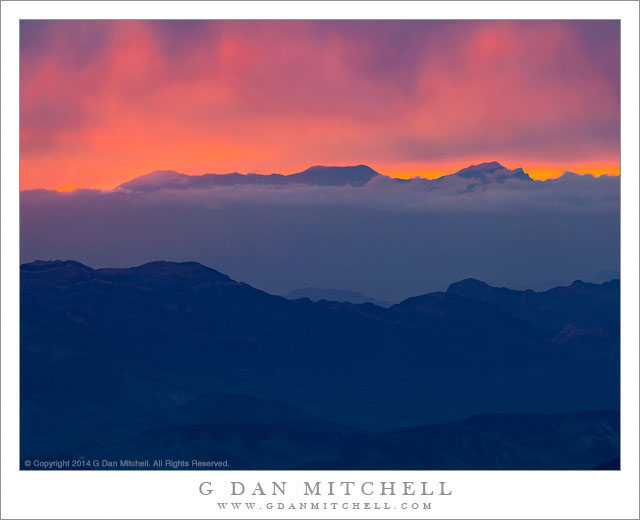
Base of the Panamint Range

Base of the Panamint Range

Base of the Panamint Range. Death Valley National Park, California. April 1, 2014. © Copyright 2014 G Dan Mitchell – all rights reserved.

The lower reaches of the Panamint Range drop to the floor of Death Valley

The stillness of this image belies what was actually happening when I made the exposure. It was late afternoon, and the sun was just above the ridge of the Panamint Range as we drove down through Death Valley, past the Mustard Hills and towards Furnace Creek. As often happens in the spring, the winds were rising. I saw the scene and immediately knew I wanted to stop and photograph it, with the backlit hills rising across the far side of the Valley. I grabbed my tripod, camera, and one lens and headed across the side of a nearby hill that looked like it might provide me with a higher vantage point, and immediately recognized that wind was going to be a real problem.

The same wind that had filled the atmosphere with the beautiful haze that was glowing in the backlight was also making it nearly impossible to photograph. There are some winds that are strong enough that almost no tripod can hold a camera still, and this was that sort of situation. I set up, hanging onto the tripod to prevent it from blowing over, and waited for a lull in the wind. The wind momentarily diminished enough for me to make a few exposures as a cloud shadow darkened the foreground salt flats.

G Dan Mitchell is a California photographer and visual opportunist whose subjects include the Pacific coast, redwood forests, central California oak/grasslands, the Sierra Nevada, California deserts, urban landscapes, night photography, and more.
Blog | About | Flickr | Twitter | FacebookGoogle+ | 500px.com | LinkedIn | Email

Text, photographs, and other media are © Copyright G Dan Mitchell (or others when indicated) and are not in the public domain and may not be used on websites, blogs, or in other media without advance permission from G Dan Mitchell.
High Desert, Rock and Sage

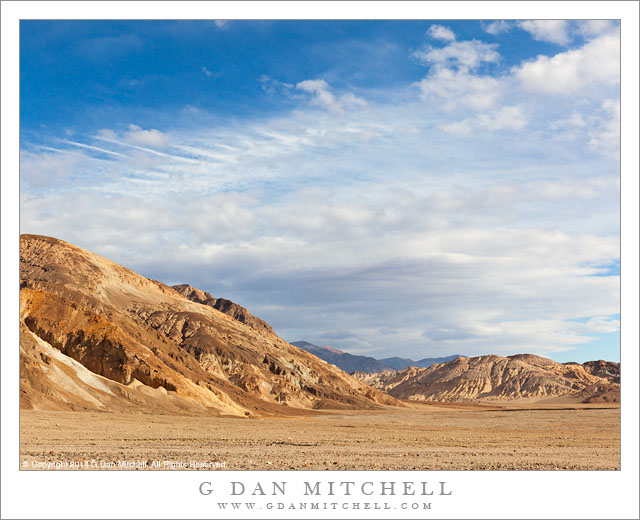
High Desert, Rock and Sage

High Desert, Rock and Sage. Death Valley National Park, California. April 2, 2014. © Copyright 2014 G Dan Mitchell – all rights reserved.

An upturned boulder stands in a wash below high desert mountains, Death Valley National Park

This was not a day like most that you would expect to experience in Death Valley National Park, although in this spring transitional season such days are not completely unexpected. Early in the morning we had been at a very high promontory from which we had expansive views of a huge area of the desert mountain landscape, though an incoming storm muted the colors and blocked the sunrise light. Soon after that it began to snow, and we spent several hours photographing in desert mountain snow. Oddly, a portion of this time was spent photographing copious spring wildflowers!

By early afternoon the main body of the storm was passing and the clouds began to break in some places, and while it continued to rain or snow in other nearby mountains we had sun where we were. We took advantage of this to visit an old historic site high in the mountains, and then we began our drive back to the Valley itself, where I had an evening subject in mind. Along the way we pulled over at a spot where I often like to stop and look at and perhaps photograph certain things. While there I looked back across this valley, with hills briefly green from spring moisture, and noticed the juxtaposition of the shape of this layered rock in the foreground and those soft hills with moving cloud shadows in the distance.

G Dan Mitchell is a California photographer and visual opportunist whose subjects include the Pacific coast, redwood forests, central California oak/grasslands, the Sierra Nevada, California deserts, urban landscapes, night photography, and more.
Blog | About | Flickr | Twitter | FacebookGoogle+ | 500px.com | LinkedIn | Email

Text, photographs, and other media are © Copyright G Dan Mitchell (or others when indicated) and are not in the public domain and may not be used on websites, blogs, or in other media without advance permission from G Dan Mitchell.
Curves, Desert Canyon

Curves, Desert Canyon

Curves, Desert Canyon. Death Valley National Park. April 1, 2014. © Copyright 2014 G Dan Mitchell – all rights reserved.

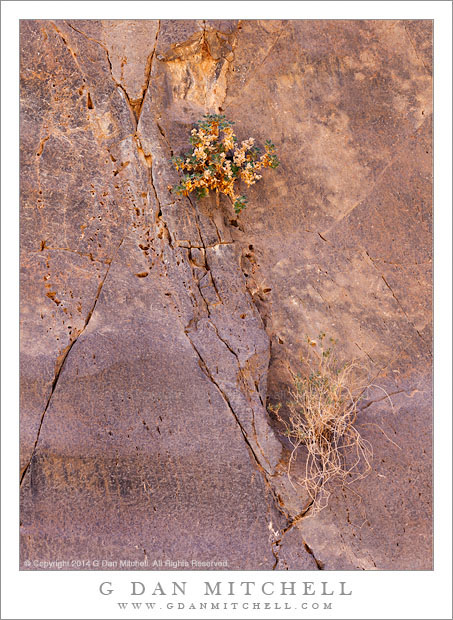
Small dry plants grow in a curving crack in a two-toned desert canyon, Death Valley National Park

Passing through this deep and narrow canyon, I always watch the rock walls for little odds and ends of shape and form and color and occasional surprising bits of vegetation. If you had asked me about this section of canyon after my first passage some years ago, I might well have mentioned how narrow and deep it is and perhaps how dusty. I might have commented on the way the bottom remains in shade even in the midday heat. But repeated visits have shown me that there is much more to see, and the fact that I still see new things on every visit tells me that there is far more yet to be discovered.

On one hand this is a pretty plain photograph of some rocks with cracks running through them. On the other hand, I think there are some stories behind the scent that are interesting to contemplate. At least I think so! If you look closely you will see some very dry plants that have grown in this curving crack. It is hard to imagine a more inhospitable place for a plant to grow—perhaps a dozen feet up the nearly solid rock wall of an arid and hot desert canyon. Yet somehow these plants found a way, as did and do many other plants throughout this desert landscape. Behind the small, delicate, and even intimate element of these plants is the backdrop of a small section of a massive rock wall that towers out of sight above the frame of the photograph. Here is a boundary between two sorts of rock—I’m not enough to a geologist to make technical observations, but I do note that the upper layer is darker and more solid while the lower is lighter and has more cracks in its surface. From the upper left a crack follows the junction of the two rock layers, but for some reason the crack leaves the junction and curves back upwards into the darker rock, and it is in this surprising bit of geological dissonance that the small plants took root.

G Dan Mitchell is a California photographer and visual opportunist whose subjects include the Pacific coast, redwood forests, central California oak/grasslands, the Sierra Nevada, California deserts, urban landscapes, night photography, and more.
Blog | About | Flickr | Twitter | FacebookGoogle+ | 500px.com | LinkedIn | Email

Text, photographs, and other media are © Copyright G Dan Mitchell (or others when indicated) and are not in the public domain and may not be used on websites, blogs, or in other media without advance permission from G Dan Mitchell.

Desert Holly, Black Formation

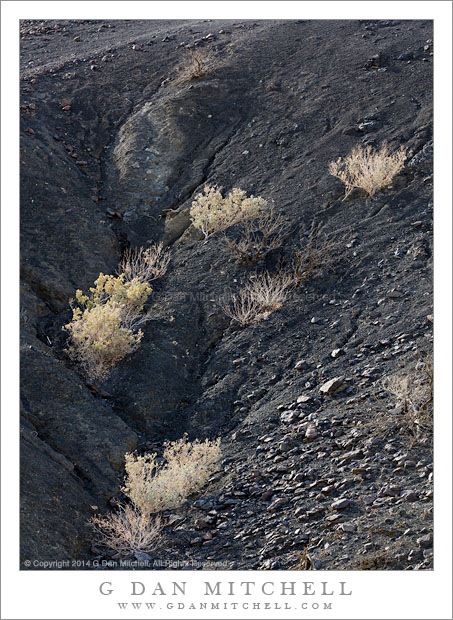
Desert Holly, Black Formation

Desert Holly, Black Formation. Death Valley National Park, California. April 3, 2014. © Copyright 2014 G Dan Mitchell – all rights reserved.

Desert Holly plants grow on a black formation, Death Valley National Park

This area of Death Valley National Park, not far from the popular Zabriskie Point overlook, shares some of the same geology with that often crowded location. However, you don’t have to go too far from that parking lot to find locations where you can be almost alone, especially early in the morning. This area is one such spot—easily accessible but not marked in any sort of obvious way. Yet it is a great place to spend hours looking at geological forms, sparse plants, and spare effects of light and color.

The desert holly plants grow in some of the most arid locations, and often appear to be the only plants that are able to survive where it grows. You might find a plant or two in a rocky wash, growing out of a crack in a rock wall, or on this dark (volcanic?) material. One can only imagine how hot this black earth must get in the heat of the Death Valley summer! Besides often being the only visible living thing in some very stark areas, desert holly also can change its appearance depending upon how the leaves are doing and on where the light comes from. Light from behind the plant can make it take on an almost golden glow.

G Dan Mitchell is a California photographer and visual opportunist whose subjects include the Pacific coast, redwood forests, central California oak/grasslands, the Sierra Nevada, California deserts, urban landscapes, night photography, and more.
Blog | About | Flickr | Twitter | FacebookGoogle+ | 500px.com | LinkedIn | Email

Text, photographs, and other media are © Copyright G Dan Mitchell (or others when indicated) and are not in the public domain and may not be used on websites, blogs, or in other media without advance permission from G Dan Mitchell.