
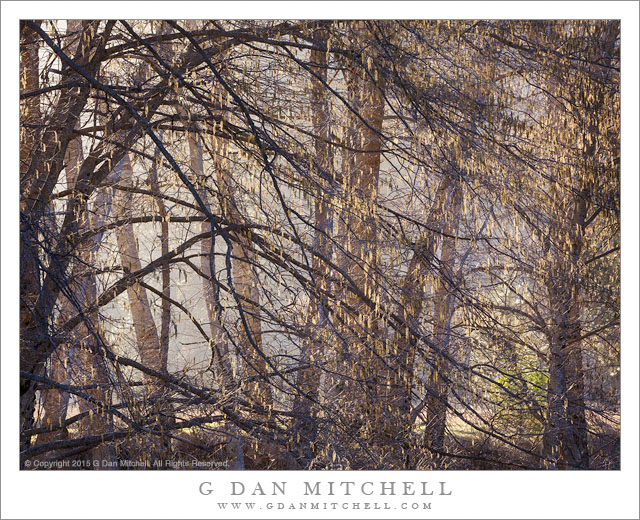
Forest, Afternoon Light

Forest, Afternoon Light

Forest, Afternoon Light. Yosemite National Park, California. February 13, 2015. © Copyright 2015 G Dan Mitchell – all rights reserved.

Hazy afternoon winter light in a Yosemite Valley hardwood forest

This may have been just about the briefest visit to Yosemite Valley that I have ever made. We drove up from the Bay Area for two days and one night so that we could attend the opening reception for an art exhibit (Sierra Art Trails) in Oakhurst. We had thought that we might visit one of the Central Valley wildlife refuges on the way — and we ended up spending enough time there that it was after 3:00 when we got to the Yosemite Valley. We briefly stopped to watch people setting up to try to photograph Horsetail Fall, which we did not intend to do, and then headed up to one of the large meadows where I thought that I could photograph trees backlit by the low angle afternoon light.

I started out in a meadow, photographing trees to my west silhouetted against the hazy backlight. Finishing with this subject I wandered over to the banks of the Merced River to look for closer subjects, and as I looked west I saw this tangle of trees which gradually resolved into patterns of downward curving branches superimposed on taller tree trunks leaning to both sides. One challenge was trying to find a composition in this complexity, and another was shooting straight toward the sun without ending up with lens flare. The first took some careful thought, while the second required some contortions to shade the lens with my hand.


G Dan Mitchell is a California photographer and visual opportunist whose subjects include the Pacific coast, redwood forests, central California oak/grasslands, the Sierra Nevada, California deserts, urban landscapes, night photography, and more.
Blog | About | Flickr | Twitter | FacebookGoogle+ | 500px.com | LinkedIn | Email

Text, photographs, and other media are © Copyright G Dan Mitchell (or others when indicated) and are not in the public domain and may not be used on websites, blogs, or in other media without advance permission from G Dan Mitchell.
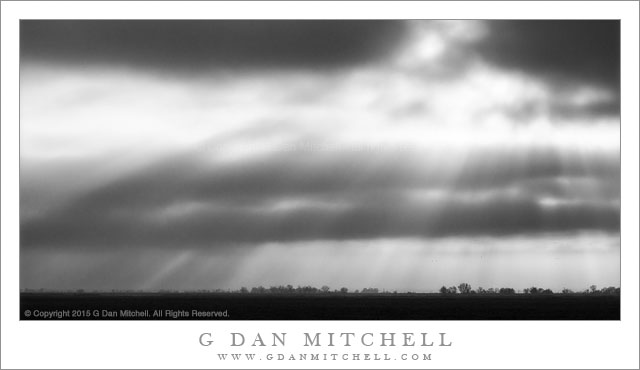
Sun Beams, Clearing Fog

Sun Beams, Clearing Fog

Sun Beams, Clearing Fog. San Joaquin Valley, California. January 25, 2015. © Copyright 2015 G Dan Mitchell – all rights reserved.

Afternoon sun breaks through clearing fog in the farm country of the San Joaquin Valley

This photograph, made late on a day spent photographing migratory birds and the landscape they inhabit, illustrates a bunch of things that seem important to me. Each one might be the subject of a short article, but I’ll try to keep it short in this post. One theme might be persistence or patience: This was not the easiest day of photography, with interesting thick fog early in the day, but a midday that seemed to be a bit aimless and included an unsuccessful visit to a nearby area, and a conclusion that was glorious in several ways. Another might be flexibility: I was there primary to photograph wildlife, but I was ready to switch gears and become a landscape photographer when the clouds began to break up in the very late afternoon. It also reminds me to the value of not focusing on the literal depiction of what passes for the objective reality of the landscape, and the importance of focusing on the mood of the place in a subjective way. And it provides an example of how two photographers, working from nearly the same spot, will make quite different photographs and come away with different kinds of successes.

A few days earlier I had photographed at this same location, and late that day I had convinced myself that there would be no great evening light, and I left early. Who knows what I missed as a result of that decision! This time, shooting with a group of friends, I was back on track and eager to shoot until the light was gone. It was an unusual day — great but challenging photography conditions early in the morning, followed by less exciting conditions later in the day. Then in the early evening a large flock of Ross’s geese assembled in a familiar spot and a few of us headed there and positioned the flock between ourselves and the sky to the west, where the clouds were finally starting to break up. During the last portion of the day we were treated to this cloud and light show as the sun played peak-a-boo with the clouds and to one of the most spectacular mass take-offs of geese that I have seen.


G Dan Mitchell is a California photographer and visual opportunist whose subjects include the Pacific coast, redwood forests, central California oak/grasslands, the Sierra Nevada, California deserts, urban landscapes, night photography, and more.
Blog | About | Flickr | Twitter | FacebookGoogle+ | 500px.com | LinkedIn | Email

Text, photographs, and other media are © Copyright G Dan Mitchell (or others when indicated) and are not in the public domain and may not be used on websites, blogs, or in other media without advance permission from G Dan Mitchell.
Reader Question: About Depth of Field

Lupine, Upper Sabrina Basin

I recently received an email from David, who has some questions about depth of field:

As you have a lot of experience of using the Fuji X-E1, may I please ask you for some advice regarding landscape focusing.

My aim is to use the 18-55mm kit lens with the majority of shots taken at the widest end. I have in mind setting the lens at Hyperfocal distances, based on a crop factor of 1.5 and a circle of confusion of 0.02. I think the first figure is reliable, but I’m not sure about the second in relation to the X-E1 – perhaps you could confirm.

I have already done some testing at home using the attached table (which come from the well respected DOFmaster site).

In my experiment I carefully measured distances at apertures of f8 and f11 using a tripod and a printed card as the subject. I set the lens manually at the hyperfocal distance, using the EVF distance scale. I was disappointed to find that the closest point of focus was not as sharp as I had hoped. Have you any idea why this may be?

I did a further test on aperture f11 and this time set the distance scale at 4 feet (2/3 of the way between 3 and 5 feet). This resulted in a sharp image from 3.5 feet. This would suggest that the distance scale is not accurate.

Any suggestions you have to overcome the problem would be much appreciated.

Let me preface my response on the depth of field (DOF) issue by congratulating you for taking the time to conduct your own experiments. One of the great things about digital cameras is that we don’t have to trust what we read — we can easily and quickly conduct the experiments ourselves. In addition to getting the answer to the question at hand, we end up knowing our gear at a much deeper and even intuitive level, which is extremely important when we are in the field and we don’t have time to ponder and calculate, but must instead make a photograph in the moment.

The rest of this post is going to be somewhat involved, so let me share a quick thought right at the beginning:

The usefulness of DOF calculators is very limited, as they are based on subjective assumptions that may not match what you are doing with your photographs. The best way to align your expectations with exposure choices is to test them yourself and evaluate images in the form that you most often produce — and not just at 100% magnification on a computer screen.

What is DOF? Essentially the depth of field is the distance range in front of and behind (unless you focus at infinity) the focus point within which subjects are likely to sharp enough to seem in focus when the photograph is viewed at some arbitrary magnification. This size of this range increases as we stop down (for example, going from f/2.8 to f/8 expands the DOF) and decreases as we open the aperture (going from f/8 to f/2.8 contracts DOF). This is a source of creative control for the photographer. A smaller aperture can allow subjects across a greater distance range to appear relatively sharp, while a larger aperture can keep the primary subject in focus while pleasingly “un-focusing” elements in front of and behind the primary focus point. Continue reading Reader Question: About Depth of Field

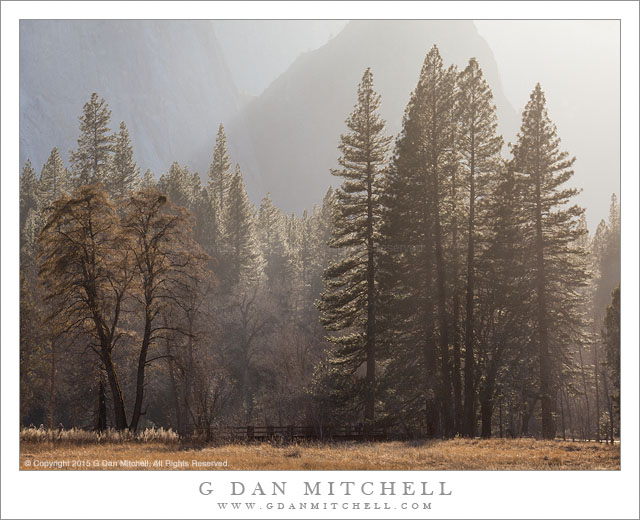
Afternoon Light, Forest and Cliff

Afternoon Light, Forest and Cliff

Afternoon Light, Forest and Cliff. Yosemite Valley, California. © Copyright 2015 G Dan Mitchell – all rights reserved.

Yosemite Valley forest and cliffs in hazy late afternoon light

This past weekend I had time to visit Yosemite Valley for a couple of hours. That doesn’t sound like much time, but it is enough to see a few things and make a few photographs. (We would have had more time, but we were distracted by migratory birds as we crossed the Central Valley, and by the time we arrived in the park it was mid afternoon.) Coming into the Valley we spotted the first evidence of the annual migration of the Horsetail Fall photographers, lined up in a spot along the Merced River a few hours before sunset. (We saw more of them on the way out of the Valley later in the evening.)

For me, photography in the Valley is often about the light, with the quality of the atmosphere being close to the light in importance. Given that there were no clouds I was not too optimistic about the prospects, but when we arrived at a meadow late in the afternoon I saw some beautiful haze that was starting to be backlit by the lowering sun. I found some trees — the group in this photograph and others in a pair of photographs I’ll share later — and I looked for a composition that eliminated the bright sky, that put the sun close to directly behind the trees, and which put some of the valley walls and towers in the frame in order to provide some form and textural relief to the haze. Then it was a matter of lining up the elements of the photograph so that the tallest trees were within the outline of a large tower. Shooting almost straight into the sun (and engaging in interesting gymnastics in order to shield the front element of my lens from flare-producing direct light), I made a few exposures.


G Dan Mitchell is a California photographer and visual opportunist whose subjects include the Pacific coast, redwood forests, central California oak/grasslands, the Sierra Nevada, California deserts, urban landscapes, night photography, and more.
Blog | About | Flickr | Twitter | FacebookGoogle+ | 500px.com | LinkedIn | Email

Text, photographs, and other media are © Copyright G Dan Mitchell (or others when indicated) and are not in the public domain and may not be used on websites, blogs, or in other media without advance permission from G Dan Mitchell.

Photographer and visual opportunist. Daily photos since 2005, plus articles, reviews, news, and ideas.