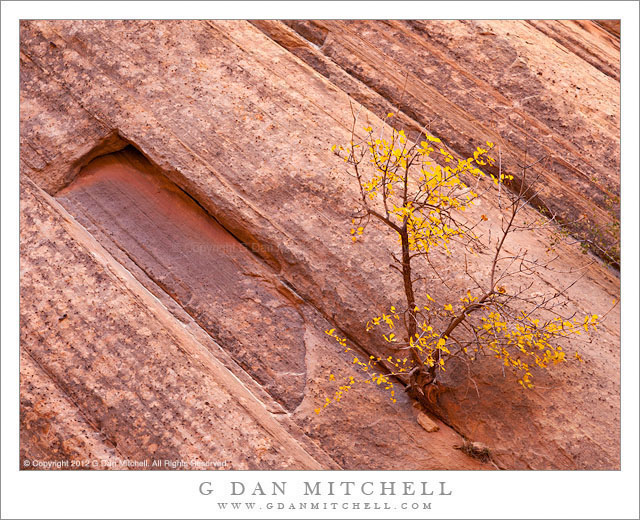
Autumn Tree, Sandstone Strata

Autumn Tree, Sandstone Strata - An autumn tree grows from a precarious crack in sandstone strata, Capitol Gorge
An autumn tree grows from a precarious crack in sandstone strata, Capitol Gorge

Autumn Tree, Sandstone Strata. Capitol Reef National Park, Utah. October 7, 2012. © Copyright 2012 G Dan Mitchell – all rights reserved.

An autumn tree grows from a precarious crack in sandstone strata, Capitol Gorge

I’m often fascinated by places where the huge and ancient strata descend under (or ascend from, depending upon your point of view) the flat earth. In the bottom of this canyon, there is a section where, as we walked further into it, the strata angled down quite steeply. Given what I understand of the geology of Capitol Reef, it should be no surprise to find such a feature here.

Another thing that continues to amaze me is the seemingly impossible places in which life springs up. Here this small tree (perhaps a single-leaf ash?) seems to be doing OK in a very tiny crack in solid rock and a few feet up the canyon wall from the wash at the bottom. The pink color comes both from the rock itself and the light reflected down into the canyon, bouncing off of other rock faces high above.

G Dan Mitchell is a California photographer and visual opportunist whose subjects include the Pacific coast, redwood forests, central California oak/grasslands, the Sierra Nevada, California deserts, urban landscapes, night photography, and more.
Blog | About | Flickr | Twitter | FacebookGoogle+ | 500px.com | LinkedIn | Email

Text, photographs, and other media are © Copyright G Dan Mitchell (or others when indicated) and are not in the public domain and may not be used on websites, blogs, or in other media without advance permission from G Dan Mitchell.

First Light, Red Rock Cliffs

First Light, Red Rock Cliffs

First Light, Red Rock Cliffs. Zion National Park, Utah. October 14, 2012. © Copyright 2012 G Dan Mitchell – all rights reserved.

First morning light shines on plants along a red rock ridge at the base of a cliff-lined amphitheater in the Kolob Canyons area of Zion National Park

This photograph was made in the Kolob Canyon area of Zion National Park, a less-developed area of the park, accessed by a dead-end road and with virtually no services aside from a small ranger station near the entrance. Being a good distance from the main, popular destination of Zion Canyon, far fewer people seem to visit this area. We visited on a very cold fall morning, arriving well before the sun light had worked its way down into the canyons.

In may places there are very tall cliffs to the east, and sometimes, as here, they form amphitheaters of red rock. As we came to this part of the canyon, the sun had risen high enough that some of its light was able to find a way down into the canyon and begin to pick off ridges, aretes, and bit of vegetation – though the main cliffs still remained in shadow.

G Dan Mitchell is a California photographer and visual opportunist whose subjects include the Pacific coast, redwood forests, central California oak/grasslands, the Sierra Nevada, California deserts, urban landscapes, night photography, and more.
Blog | About | Flickr | Twitter | FacebookGoogle+ | 500px.com | LinkedIn | Email

Text, photographs, and other media are © Copyright G Dan Mitchell (or others when indicated) and are not in the public domain and may not be used on websites, blogs, or in other media without advance permission from G Dan Mitchell.

Creosote Shadows, Morning Tracks in Sand

Creosote Shadows, Morning Tracks in Sand

Creosote Shadows, Morning Tracks in Sand. Death Valley National Park, California. March 28, 2010. © Copyright 2012 G Dan Mitchell – all rights reserved.

A clump of creosote brush casts a morning shadow across tracks in the sand, Mesquite Dunes, Death Valley National Park

While reviewing some old raw files near the end of 2012, I went back to some Death Valley photographs made during the past few years. I came upon this photograph that I had more or less forgotten. I wonder if at the time I was distracted by other photographs that appealed to me more, or if I perhaps just wasn’t sure how to treat it at the time. In any case, it still surprises me – even though I should know better by now – that I find photographs that I like among images that I thought I had finished with several years ago!

Looking through the other photographs that were part of the series that this one comes from, I recalled that I had gone out into dunes in Death Valley before dawn to photograph pre-dawn, dawn, and early morning conditions. As I often do, I approached these dunes by a roundabout route, not only to make the walk a bit easier but also to avoid other photographers and to have a better chance of finding sand that had not yet been tracked up by other human visitors. This small clump of creosote was growing in shallow sand, and its roots had slowed the windblown sand enough to create a very small hill. In turn, this let the low angle sun cast a shadow that led downhill into lower sand and which crossed the tracks of some wildlife that had passed this way the night before.

G Dan Mitchell is a California photographer and visual opportunist whose subjects include the Pacific coast, redwood forests, central California oak/grasslands, the Sierra Nevada, California deserts, urban landscapes, night photography, and more.
Blog | About | Flickr | Twitter | FacebookGoogle+ | 500px.com | LinkedIn | Email

Text, photographs, and other media are © Copyright G Dan Mitchell (or others when indicated) and are not in the public domain and may not be used on websites, blogs, or in other media without advance permission from G Dan Mitchell.

Reader Question: One Lens for Landscape and Wildflowers on Hikes?

From time to time blog readers email me questions about photography subjects. When possible I like to answer them here so that I can share the answer with others who might be interested. Here is a recent question:

“If you were going on a hike to capture landscape and wildflowers, and you could only take one lens, which one and why?”

In some ways that is  a very simple question, but it other ways the answer can be quite involved. Since the question did begin with, “If you were…”, let me start out by literally saying a bit about my own photography – but reminding readers that my approach is individual and idiosyncratic and may not match up with your preferences at all.

If the goal was to cover as much ground as possible in a single lens, and accept some photographic limitations in exchange for carrying less gear, with my Canon full-frame DSLR system I would most likely use my Canon EF 24-105mm f/4 L. On full-frame, the 24mm focal length covers a pretty decent wide angle range, and 105mm is long enough for many subjects. The lens also focuses reasonably close – though not macro-close – and the image stabilization feature is useful in situations where I might want to hand-hold the camera. On a week-long backpacking trip through a high and remote section of the Sierra a few years ago, I used only this lens (and tripod, remote release, a few filters, etc) and came back with good results. To extend the usefulness of the lens for close-up flower photography I sometimes carry an extension tube, though others might just bring along a close-up “filter” or two.

There are things that I would miss with this single-lens setup. A personal preference in my shooting is to work with longer focal lengths, so for me having nothing longer than 105mm would seem like a bit of a restriction. And while this lens plus the extension tube works pretty well, it won’t be as good as a dedicated macro lens.

Another alternative that I’ve thought about but have not yet tried (since I haven’t had the gear long enough just yet) would be to use my small Fujifilm X-E1 (seen”Fujifilm X-E1: From DSLR to Mirrorless“) with the 60mm macro and perhaps the fine little 18-55mm zoom. I know that is more than one lens, but the total kit size is smaller/lighter than my full-frame DSLR. You could go with just the excellent little zoom plus a close up filter or two as an alternative. I use this particular brand/model and like it a lot, but there are alternatives from other manufacturers that also have a lot of fans.

Moving on from what I might use, let’s briefly consider some other options that might appeal to other photographers.

If you are primarily interested in the wildflowers and are a very serious photographer, you might prefer to simply carry a dedicated macro lens of whatever focal length seems best for you. This will be your best bet for close-up wildflower photography and, accepting the limitations of having only a single focal length, will produce excellent image quality for non-macro subjects as well.

Another option that would work well for a lot of people is one of the entry-level DSLRs (like the Canon t1i-t5i series or alternatives) with the “kit” lens in the 18-55mm range plus one or more close-up filters. These can produce quite decent image quality and the package is small, light, versatile, and not too costly.

This begins to lead to the question of what your primary goals are in your hiking photography. Are you a very serious photographer who regularly produces large and high quality prints? Or, at the opposite end of the spectrum, are you a much more casual photographer who wants to bring back some beautiful records of your experience and share them with friends and family, perhaps mostly online? More than likely, you might have to determine where you fit between the extreme ends of this spectrum. How important is the weight/bulk of the equipment? Are you going to grab shots handheld or stop and use a tripod?

For some who are more concerned with the weight/bulk issues and perhaps not likely to make 20″ x 30″ prints, there are lots of smaller, lighter and often less expensive options that can be very good choices. These include some of the smaller and lighter mirrorless cameras such as the Fujifilm model I mentioned above (at the high end), and also some of the point and shoot cameras, many of which can produce excellent photographs.

Good luck with your choice… and with your photography!

Articles in the “reader questions” series:


G Dan Mitchell is a California photographer and visual opportunist whose subjects include the Pacific coast, redwood forests, central California oak/grasslands, the Sierra Nevada, California deserts, urban landscapes, night photography, and more.
Blog | About | Flickr | Twitter | Facebook | Google+ | 500px.com | LinkedIn | Email

Text, photographs, and other media are © Copyright G Dan Mitchell (or others when indicated) and are not in the public domain and may not be used on websites, blogs, or in other media without advance permission from G Dan Mitchell.

Photographer and visual opportunist. Daily photos since 2005, plus articles, reviews, news, and ideas.