
The Significance of Very Small Things

I thought that I would use today’s photograph (posted lower on the home page if that is where you are reading this) to again illustrate an observation or two about certain types of photographs. The photograph is a of a landscape scene in California’s Central Valley, photographed during in the evening during the winter migratory bird season. Its primary feature is a group of trees silhouetted against an evening sky, with the sky and the silhouette reflected in the water of a pond. The tree is centered, for several reasons perhaps, but largely to create a sense of stillness and balance.

But there is a small element in the scene that, I think, makes a huge difference – two small owls perched high in the branches along the right side of the trees. To see what I mean, take a look at the photograph, and then place a finger so that it just covers the owls without hiding much else in the frame. Think about how the absence of the owls transforms the scene… and then uncover the owls and think about how this very tiny bit of black changes the effect of the photograph. (I could also say something about how the fact that there are two tiny owls is also significant. And on Valentine’s Day, no less… ;-)

Don’t get me wrong – I’m not arguing that landscape images should necessarily include people or other creatures in this way. Sometimes that is appropriate and at other times it would not be, and most of my photographs do not include them. However, I continue to be amazed by how significantly a very small figure of an animal or a human can completely alter the way we respond to the scene.

G Dan Mitchell is a California photographer whose subjects include the Pacific coast, redwood forests, central California oak/grasslands, the Sierra Nevada, California deserts, urban landscapes, night photography, and more.
Blog | About | Flickr | Twitter | FacebookGoogle+ | 500px.com | LinkedIn | Email

Text, photographs, and other media are © Copyright G Dan Mitchell (or others when indicated) and are not in the public domain and may not be used on websites, blogs, or in other media without advance permission from G Dan Mitchell.
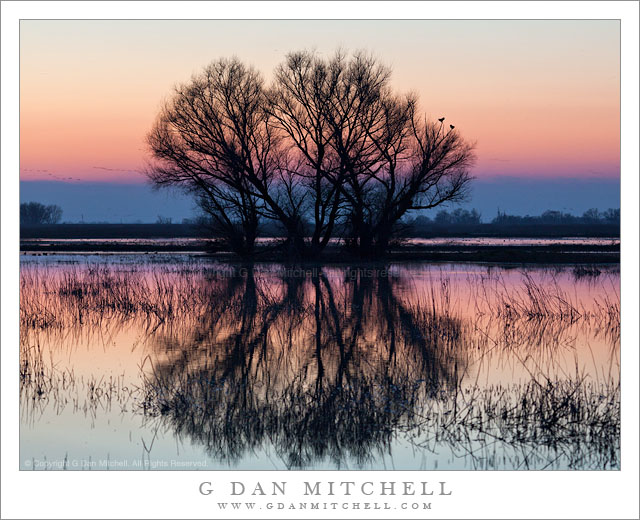
Two Owls, Trees and Ponds, Dusk

Two Owls, Trees and Ponds, Dusk  - Two owls in the branches of a group of trees at dusk, reflected in the waters of a pond at the Merced National Wildlife Refuge
Two owls in the branches of a group of trees at dusk, reflected in the waters of a pond at the Merced National Wildlife Refuge

Two Owls, Trees and Ponds, Dusk. Merced National Wildlife Refuge, California. February 4, 2012. © Copyright 2012 G Dan Mitchell – all rights reserved.

Two owls in the branches of a group of trees at dusk, reflected in the waters of a pond at the Merced National Wildlife Refuge.

I originally posted this in an impromptu manner and out of sequence back on SuperB owl Sunday – but now it comes up “officially” in the queue. At the very end of a winter day that had begun well before dawn back up the Central Valley closer to Sacramento (in the Cosumnes River area, to be precise) we had headed south to Merced National Wildlife Refuge in search of somewhat different subject for the evening. We arrived to find some geese on the pond, but most were a bit too far off for good photography. But while we settled in to wait for whatever else might show up, I turned my attention to the beautiful and wide-open Central Valley landscape.

This little group of trees grows on a small levee between a couple of ponds in this agricultural area. (Over the past few weeks I have come to know this exact spot very well, as I have been back three times now to photograph there, with better and better luck each time.) After the sun set, some of the most beautiful light appeared – the soft and pink/purple/blue atmospheric light of dusk, when there is still some brighter color in the sky. I saw a single bird high in one of the branches of this tree and soon figured out it was an owl. I set up a composition that centered the tree – creating, I hope, a sense of quiet and stillness – and which included a bit of the sky and the beautiful reflection of the tree’s silhouette in the water. As I shot, a second owl showed up for a few seconds and I was able to get a frame with the couple together.

G Dan Mitchell is a California photographer whose subjects include the Pacific coast, redwood forests, central California oak/grasslands, the Sierra Nevada, California deserts, urban landscapes, night photography, and more.
Blog | About | Flickr | Twitter | FacebookGoogle+ | 500px.com | LinkedIn | Email

Text, photographs, and other media are © Copyright G Dan Mitchell (or others when indicated) and are not in the public domain and may not be used on websites, blogs, or in other media without advance permission from G Dan Mitchell.
Migratory Birds in Twilight, Central Valley

Migratory Birds in Twilight, Central Valley - Migratory birds flly though the twillight winter sky above California's Central Valley and the Coast Range.
Migratory birds flly though the twillight winter sky above California's Central Valley and the Coast Range.

Migratory Birds in Twilight, Central Valley. Merced National Wildlife Refuge, California. February 8, 2012. © Copyright 2012 G Dan Mitchell – all rights reserved.

Migratory birds flly though the twillight winter sky above California’s Central Valley and the Coast Range.

I made this photograph when it was almost too dark to see clearly. In fact, when I packed up and drove away a few minutes later, it was so dark that I momentarily got mildly lost on my way out of the refuge! Long after the sun had set, and at the time when perhaps the most intense sky colors appear, the migratory birds were still in flight above the Central Valley, often silhouetted against the colorful dusk sky just above the horizon.

This photograph is going to get a bit more technical explanation than usual. I had a 100-400mm telephoto on the camera at this point since I had been photographing the birds in a variety of ways, including trying to fill the frame with one or a few birds. While some might say that shooting a prime lens of this length could have some image quality advantages, this photograph wouldn’t have happened if I had been shooting, say, a 400mm prime. Since I wanted to move quickly from targeting small sections of the surroundings or even individual birds to making photographs that attempt to portray the larger landscape within which the birds are found, I frequently found myself moving quickly to much shorter focal lengths. Here, I realized that I might be able to “zoom out” and include some of the birds in flight high above the valley and the distant mountains in the context of their surroundings. So I shot this at something like 130mm. In addition, because the scene includes subjects that are not that far away (like the trees) and those at much greater distances (like the hills), depth of field was an issue with the longer focal lengths. I couldn’t shoot wide open without some excessive focus issues, so I stopped down to f/11. Think about that for a moment: shooting in extremely low light, stopped down to try to maintain some depth of field… and needing use a shutter speed allowing me to get some definition out of birds flying through the scene. This is essentially being caught between a rock and a hard place… and another rock. With the camera on the tripod, but still aimed manually, I used a shutter speed of 1/13 second and turned image-stabilization on. With all of this stuff pushing boundaries of shutter speed and aperture… my only option was to increase the ISO to 1600. For landscape work. Here’s the thing… in the end, while there was more noise in this photograph than if ISO 100 were possible, it isn’t that bad and probably wouldn’t even be visible to viewers of a print. While I’m usually persistent in my view that little technical differences among cameras don’t amount to much, in this case it was because current cameras make it possible to shoot in ways that were essentially impossible a decade ago that I could get this photograph at all.

G Dan Mitchell is a California photographer whose subjects include the Pacific coast, redwood forests, central California oak/grasslands, the Sierra Nevada, California deserts, urban landscapes, night photography, and more.
Blog | About | Flickr | Twitter | FacebookGoogle+ | 500px.com | LinkedIn | Email

Text, photographs, and other media are © Copyright G Dan Mitchell (or others when indicated) and are not in the public domain and may not be used on websites, blogs, or in other media without advance permission from G Dan Mitchell.

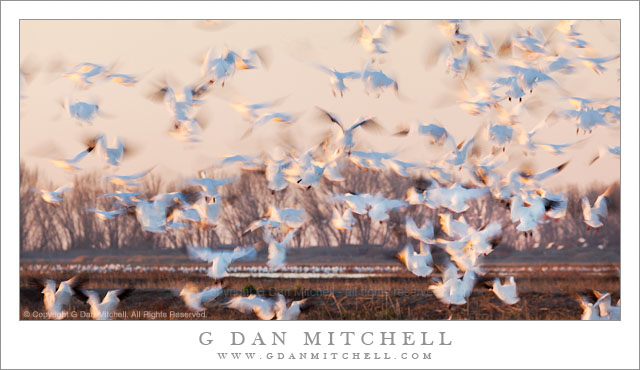
Ross’s Geese, Winter Evening

Ross's Geese, Winter Evening - Motion-blurred photograph of low-flying Ross's geese on a winter evening in California's Central Valley.
Motion-blurred photograph of low-flying Ross's geese on a winter evening in California's Central Valley.

Ross’s Geese, Winter Evening. Merced National Wildlife Refuge, California. February 8, 2012. © Copyright 2012 G Dan Mitchell – all rights reserved.

Motion-blurred photograph of low-flying Ross’s geese on a winter evening in California’s Central Valley.

From time to time I experiment with longer exposure photographs of birds in flight. The idea is that allowing the image to blur as the birds move might suggest their constant motion more effectively than the more typical approach of stopping the motion. Here not only was the exposure relatively long (I think it was 1/30 second) but I was shooting with a long telephoto which also amplifies the motion of subject and camera.

I’m thinking of this as a “study” for future photographs of these Ross’s geese and similar birds that will work with this idea of motion blur. Making this shot let me get a bit closer to understanding the most likely times to find the birds lifting off in the evening, and the best time to try to catch this with a bit of the last sunlight before sunset. I was also able to slightly better establish the shutter speed I would like to work with for this kind of image. The idea is to keep just barely enough shape in the birds that you can recognize what they are, but to allow the motion to blur things enough to eliminate the hyper-sharp realistic quality of the scene and to let the motion blur imply something about the actual flying motion of the birds.

G Dan Mitchell is a California photographer whose subjects include the Pacific coast, redwood forests, central California oak/grasslands, the Sierra Nevada, California deserts, urban landscapes, night photography, and more.
Blog | About | Flickr | Twitter | FacebookGoogle+ | 500px.com | LinkedIn | Email

Text, photographs, and other media are © Copyright G Dan Mitchell (or others when indicated) and are not in the public domain and may not be used on websites, blogs, or in other media without advance permission from G Dan Mitchell.

Photographer and visual opportunist. Daily photos since 2005, plus articles, reviews, news, and ideas.