Every December Jim M. Goldstein takes on the task of collecting the annual “best of” lists of many photographers. His project started modestly a few years back, picked up steam quickly… and I can only imagine the huge number of entries he is fielding this year! You can get more information about Jim’s project in a post at his blog. There is still time to put together your list and submit it.
My own “2010 Favorites” page is nearing completion, and I hope to post it later this evening. This year I tried something new – I invited readers to chime in with their feedback on my initial list of over 50 photographs. The response was wonderful and I’m very grateful to participants for their very kind words about my photography and for the time they took to look carefully through a much too large set of images and then post helpful lists and comments.
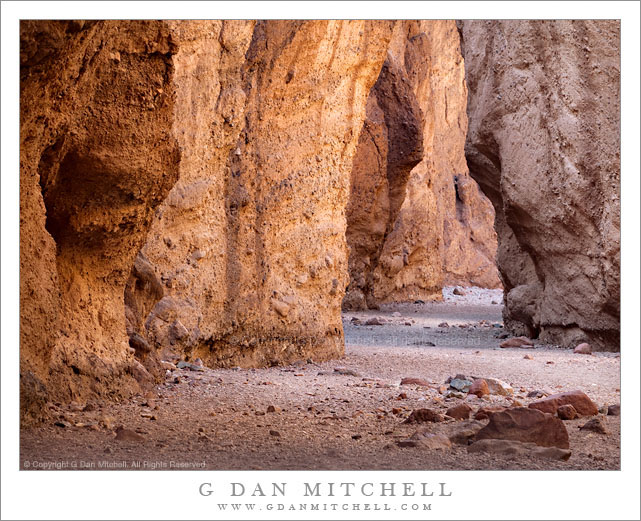
A gravel wash in the bottom of the narrow confines of Natural Bridge Canyon, Death Valley National Park.
These narrow canyons, of which there are a number of great examples in Death Valley, can provide some interesting photographic opportunities, but they also can pose some real challenges. Much of the rock in these places is, frankly, rather drab and of low contrast. However, at the right time of day and on a day with the right light and in the right parts of these canyons, the glowing light reflected down into the canyons from overhead rock walls can produce warm and diffused light and bring interesting colors to the place.
I made an unusual decision to use a very long focal length for this photograph – it was shot with a 100-400mm zoom at 330 mm. More typically I would probably tend to use wide angle focal lengths in the confines of such a canyon. However, because I wanted to juxtapose the different colors and shapes of the sections of canyon wall along the narrow and twisting wash, I chose the long lens to compress the distance. Although I think the photograph creates a feeling that I’m positioned very close to the foreground rocks and the darker bit of canyon wall on the left, I was actually quite a distance back from this spot.
I’m so impressed by and grateful to the blog readers who took the time to go through my (way too large!) collection of photographs under consideration for inclusion in my upcoming 2010 Favorites page – many mentioning a favorite image or several, taking the time to post lists, making personal comments, and more. I’ve noted before that I am perhaps the person least able to view my photographs objectively, in that I cannot help but connect them with my personal recollections of the circumstances of their creation. Your insights help me better understand how the photographs affect others as photographs.
I hope to finalize my selections very soon, but if anyone else wants to take a look and provide some feedback the draft page will be available for another 24 hours or so.
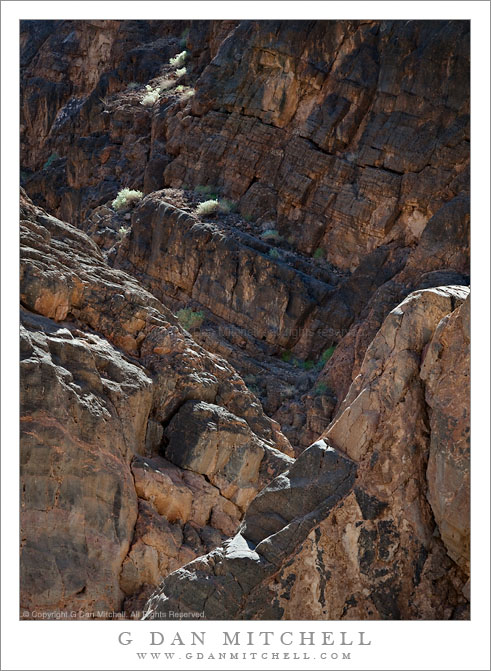
Details of the rugged cliffs and walls rising above lower Titus Canyon in Death Valley National Park.
Titus Canyon Road is one of the marvels of Death Valley National Park. It begins in high desert of Amargosa Valley near the town of Beatty and the ghost town of Rhyolite, winds over the summit of the Grapevine Mountains, drops precipitously into upper Titus Canyon, passes a number of historically interesting sites, passes through a very narrow and deep section in the lower canyon, and then suddenly emerges into the vastness of Death Valley.
In the lower section of the canyon, the wash becomes very narrow, passing through a twisty slot canyon and is, in places, barely wide enough for the one-lane gravel road. Here the walls of the canyon press tightly together and rise steeply for hundreds of feet. Some places are so deep that the sun rarely penetrates to the bottom.
Fortunately for the preservation of the canyon the road is horrible, at least if you are used to more civilized driving. It is a one-way road and the whole thing is gravel. Sections are in decent shape, but it other places the road passes over narrow and twisty sections next to precipitous drop-offs and then dives steeply into deep canyons. At times the route is closed after heavy rains or other conditions that make the route impassable.
Fortunately, the section that is perhaps the most impressive in many ways – the deep slot canyon near the bottom – is easily accessible by foot from Death Valley. After a short drive up to the canyon entrance on a gravel road to a parking area, you can enter the canyon on foot and walk up as far as you want. This photograph was made within the lower mile of the canyon during the late morning, when the light penetrates more deeply into the canyon and creates a glow on the canyon walls.
(Basic EXIF data may be available by “mousing over” large images in posts. Leave a comment if you want to know more.)
Photographer and visual opportunist. Daily photos since 2005, plus articles, reviews, news, and ideas.
Manage Consent
To provide the best experiences, we use technologies like cookies to store and/or access device information. Consenting to these technologies will allow us to process data such as browsing behavior or unique IDs on this site. Not consenting or withdrawing consent, may adversely affect certain features and functions.
Functional
Always active
The technical storage or access is strictly necessary for the legitimate purpose of enabling the use of a specific service explicitly requested by the subscriber or user, or for the sole purpose of carrying out the transmission of a communication over an electronic communications network.
Preferences
The technical storage or access is necessary for the legitimate purpose of storing preferences that are not requested by the subscriber or user.
Statistics
The technical storage or access that is used exclusively for statistical purposes.The technical storage or access that is used exclusively for anonymous statistical purposes. Without a subpoena, voluntary compliance on the part of your Internet Service Provider, or additional records from a third party, information stored or retrieved for this purpose alone cannot usually be used to identify you.
Marketing
The technical storage or access is required to create user profiles to send advertising, or to track the user on a website or across several websites for similar marketing purposes.