
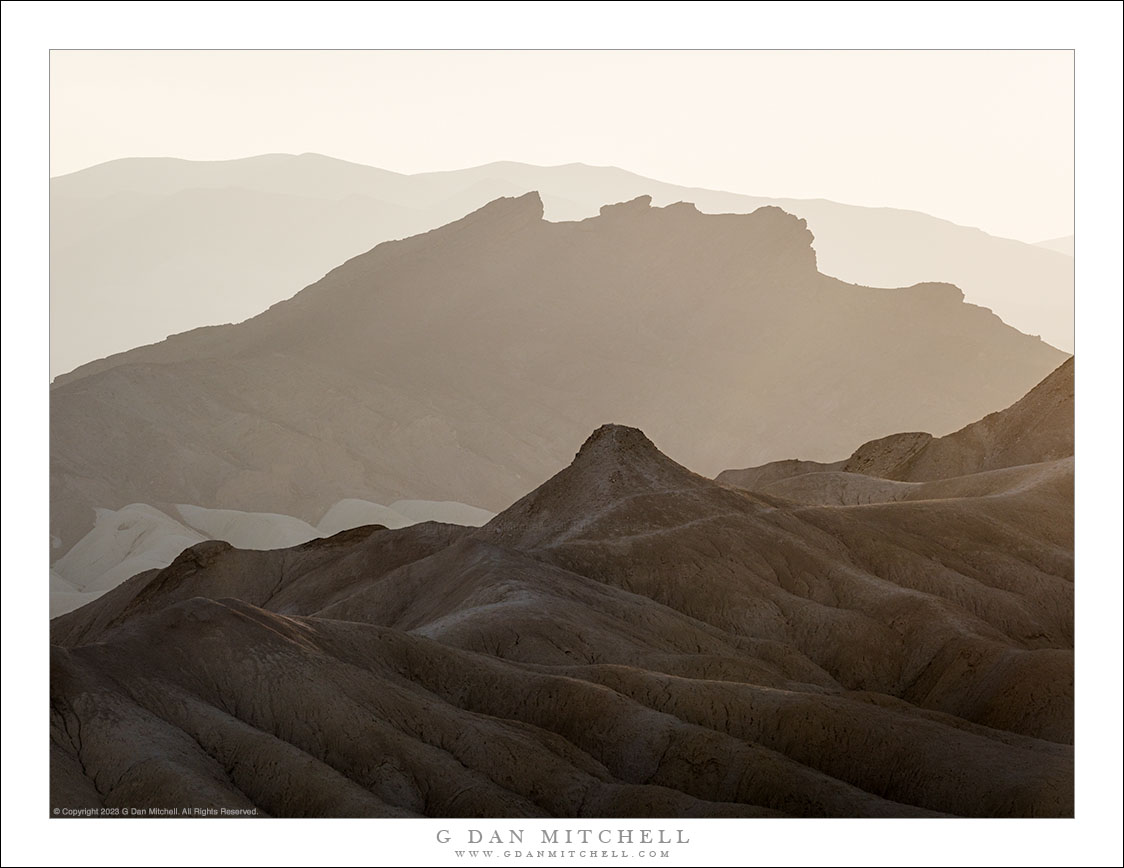
Desert Mountains, Morning Haze

Desert Mountains, Morning Haze
Morning haze obscures the details on a series of desert mountains, Death Valley National Park.

Desert Mountains, Morning Haze. © Copyright 2023 G Dan Mitchell.

Morning haze obscures the details on a series of desert mountains, Death Valley National Park.

This is another serendipitous photograph, and if you compared it to many of the other photographs I made at this location you would never guess that they came from the same place, same time, and same conditions. I was there to photograph dawn light on some nearby geological features. Dawn arrived with beautiful saturated light and clear air. When I finished with that I turned around to face the rising sun… and found the landscape’s details almost obliterated by the glowing, back-lit haze.

I’m not sure what, exactly, typifies a “typical” Death Valley photograph — but I know that these conditions were somewhat unusual. The haze made the successive hills fade into the distance, and the foreground area with the clearest details was in shadows. In the end, I think it has a mood that is different from any of my other photographs from Death Valley.


G Dan Mitchell is a California photographer and visual opportunist. His book, “California’s Fall Color: A Photographer’s Guide to Autumn in the Sierra” is available from Heyday Books, Amazon, and directly from G Dan Mitchell.

Blog | About | Twitter | Flickr | FacebookEmail

Links to Articles, Sales and Licensing, my Sierra Nevada Fall Color book, Contact Information.

Scroll down to leave a comment or question. (Click this post’s title first if you are viewing on the home page.)


All media © Copyright G Dan Mitchell and others as indicated. Any use requires advance permission from G Dan Mitchell.

From Valley To Peaks

From Valley To Peaks
In morning light, he Panamint Range rises from below sea level in Death Vally to over 11,000 feet at Telescope Peak.

From Valley To Peaks. © Copyright 2023 G Dan Mitchell.

The Panamint Range rises in morning light from below sea level in Death Vally to over 11,000 feet at Telescope Peak.

Earlier I shared another photograph of this series of impressive ridges, rising in the dawn light from the below-sea-level playa of Death Valley to the 11,000’+ summit of Telescope Peak. The other photograph took in a wider view of the landscape. In this one I narrowed the focus to emphasize the immense mass of these mountains and their astonishingly tall escarpment.

It is very hard to get an accurate sense of scale for this scene. This was true when I was there, and I suspect it is even more true when looking at the photograph. The base of the mountains is many miles away — I don’t have an accurate measurement, but it must be more than ten miles. If you look closely, you may notice that it takes four ridges to reach that highest summit, whose distance is likely something like 25-30 miles. And if you look closely you can pick out a series of four ridges as the mountains rise to the summit.


G Dan Mitchell is a California photographer and visual opportunist. His book, “California’s Fall Color: A Photographer’s Guide to Autumn in the Sierra” is available from Heyday Books, Amazon, and directly from G Dan Mitchell.

Blog | About | Twitter | Flickr | FacebookEmail

Links to Articles, Sales and Licensing, my Sierra Nevada Fall Color book, Contact Information.

Scroll down to leave a comment or question. (Click this post’s title first if you are viewing on the home page.)


All media © Copyright G Dan Mitchell and others as indicated. Any use requires advance permission from G Dan Mitchell.
Evening Overlook

Evening Overlook
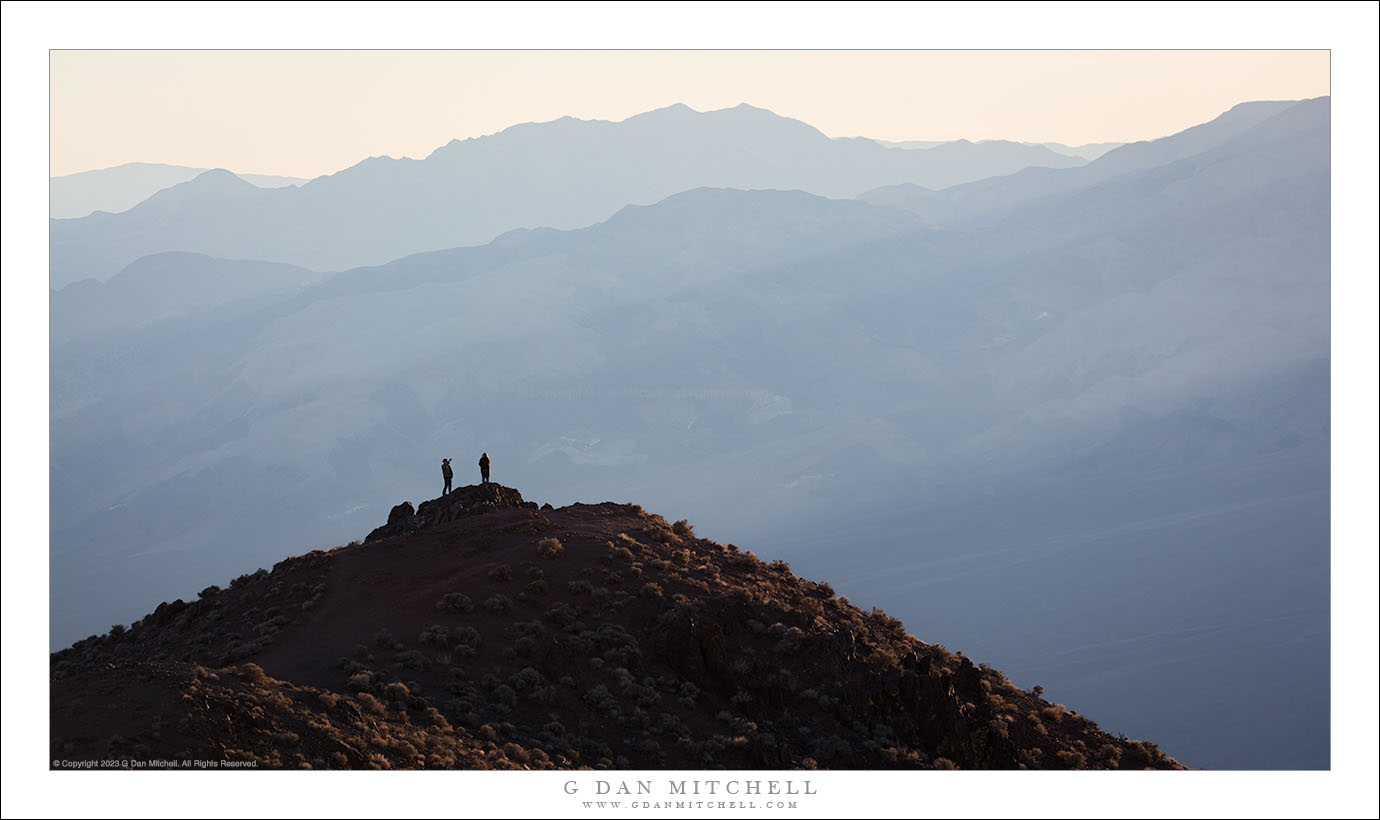
Two people watching the early evening view of immense desert mountains from a high overlook.

Evening Overlook. © Copyright 2023 G Dan Mitchell.

Two people watching the early evening view of immense desert mountains from a high overlook.

Late in the day during my recent Death Valley visit I went to this overlook. It is more typically a place to photograph the sunrise, which comes from camera-left and illuminates the big ridges in the distance. But I had a free evening, not a morning, so I figured it was worth a shot. I arrived before sunset, and I made this photograph before the sun had dropped behind the western ridge, though the haze and high clouds softened the light a bit.

I’ve never been able to quite describe in words the experience of standing on a very high point in such a vast landscape. From here one can look 5000′ down into Death Valley or look 6000′ up toward the highest peak in the Panamint Range and simultaneously feel “on top of the world” and very, very small in the presence of such immensity.


G Dan Mitchell is a California photographer and visual opportunist. His book, “California’s Fall Color: A Photographer’s Guide to Autumn in the Sierra” is available from Heyday Books, Amazon, and directly from G Dan Mitchell.

Blog | About | Twitter | Flickr | FacebookEmail

Links to Articles, Sales and Licensing, my Sierra Nevada Fall Color book, Contact Information.

Scroll down to leave a comment or question. (Click this post’s title first if you are viewing on the home page.)


All media © Copyright G Dan Mitchell and others as indicated. Any use requires advance permission from G Dan Mitchell.
Using Multiple Camera Systems

A reader noticed that my recent Death Valley photographs were made with two different systems — a Canon full frame system and a Fujifilm APS-C system. Apparently some people DO look at the EXIF data! ;-)

He wrote:

Hi Dan, I’ve been enjoying your recent posts and comps from your Jan visit to DV. After visiting your flickr site, I noticed that you use a Canon 5DSR with 100-400 telephoto lens for its reach across the terrain, and a Fuji XT-5 with a medium telephoto for the more intimate canyon shots. Is that your set up for convenience depending on the scene? I’m guessing the 5DSR is tripod mounted for shots, and the Fuji is handheld when hiking. I’m curious why you don’t pair the Canon with the same focal lens that you use on the Fuji. Thanks for your insights.

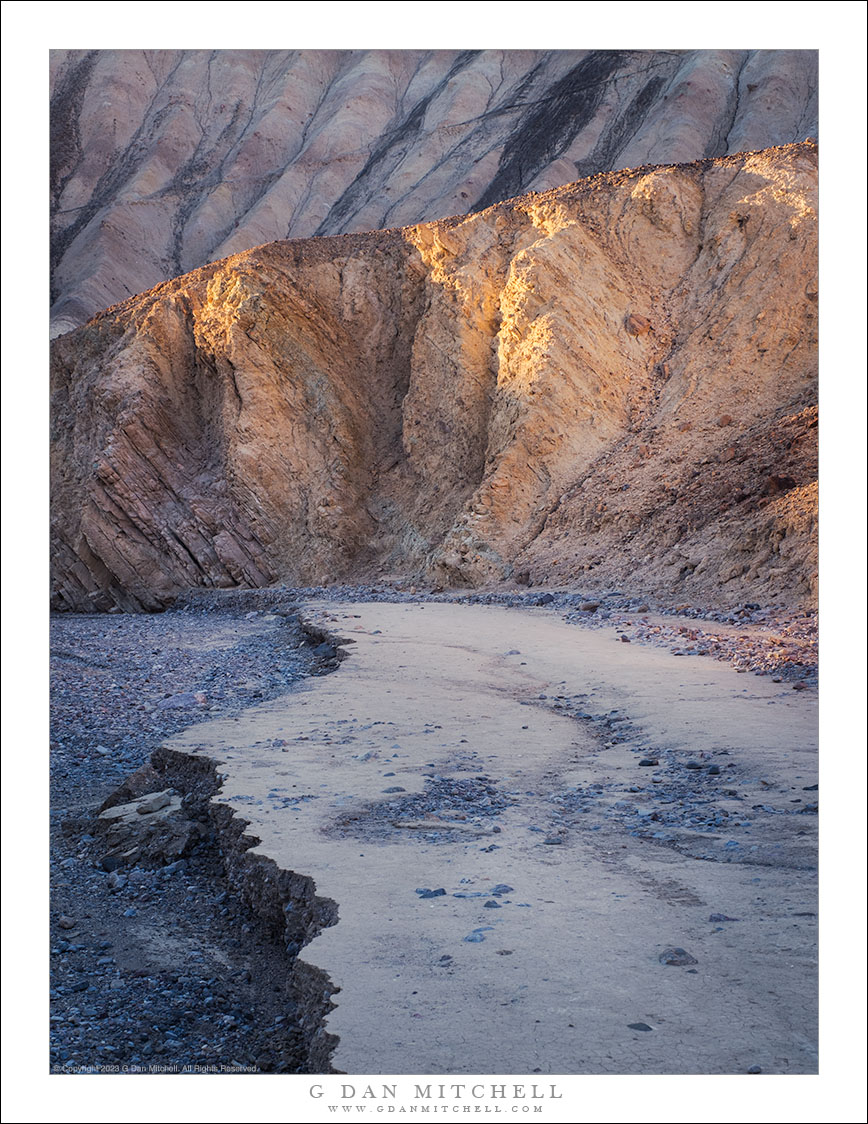
For example, this photograph was made with the little Fujifilm XT5 rather than with my much larger Canon system. If you are interested in my answer, read on!

Light in the Canyon
“Light in the Canyon” — Afternoon light strikes a hill in the lower reaches of a Death Valley canyon.

With his permission, I’m going to write a bit about why I use two systems, and how and when I use both of them together.

Continue reading Using Multiple Camera Systems

Photographer and visual opportunist. Daily photos since 2005, plus articles, reviews, news, and ideas.