Winter Green

Winter Green
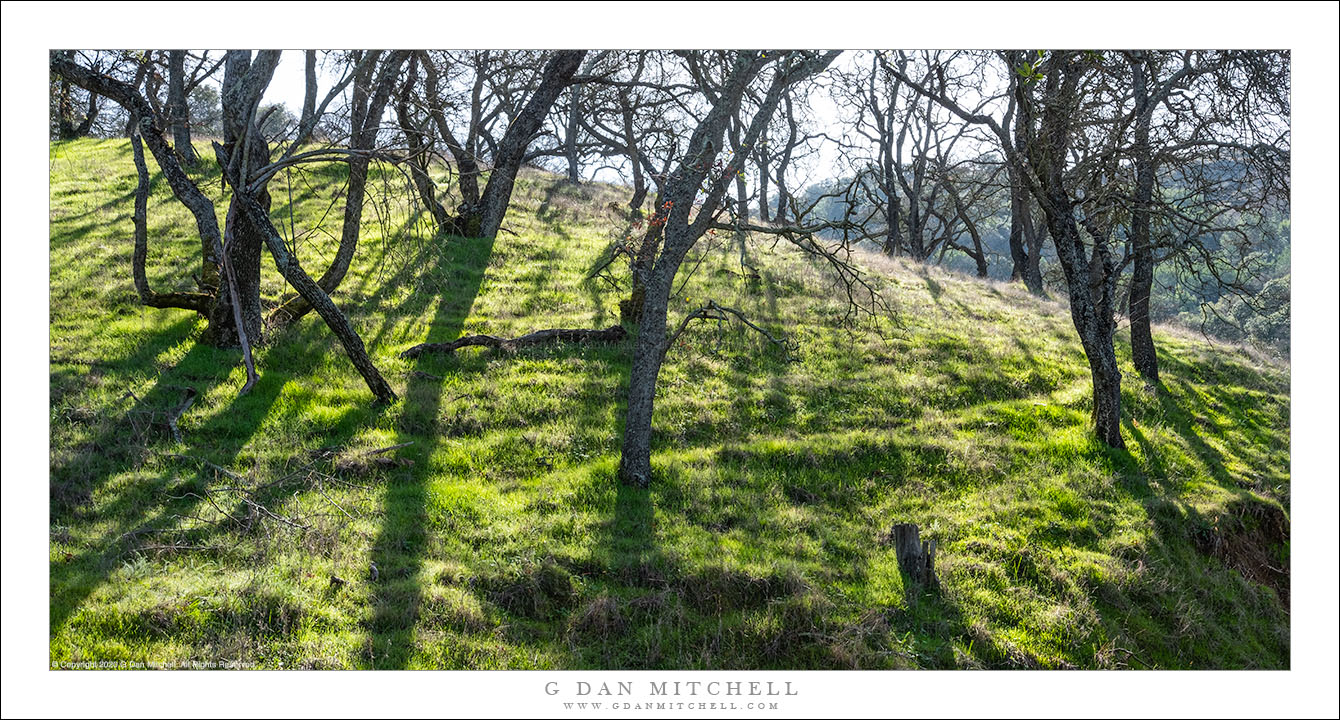
California winter grasses spout in January, San Francisco Bay Area

Winter Green. © Copyright 2020 G Dan Mitchell – all rights reserved.

California winter grasses sprout in January, San Francisco Bay Area.

Today I break up the stream of recent photographs from more far-flung travels to share a very local photograph that I made this week right in my “own backyard” here in the San Francisco Bay Area. I have hiked these local hills for decades, and these grasslands and oaks are in my blood by now — they are old friends. The specific location isn’t important, and you can find places like this all over California.

My reason for going out today was not photography — it was the hike. But like a good photographer I stuck a small camera and a lens in my pack. As I rounded a bend on the trail I was presented with this classic California winter scene of trees and shadows falling across a hillside with brand new grass — the very beginning fo California’s “impossible green season.” When much of the rest of the country is still deep in winter, here our terrain is just beginning to turn green.


G Dan Mitchell is a California photographer and visual opportunist. His book, “California’s Fall Color: A Photographer’s Guide to Autumn in the Sierra” is available from Heyday Books and Amazon.

Blog | About | Flickr | FacebookEmail

Links to Articles, Sales and Licensing, my Sierra Nevada Fall Color book, Contact Information.


Scroll down to leave a comment or question.

All media © Copyright G Dan Mitchell and others as indicated. Any use requires advance permission from G Dan Mitchell.

Dawn Clouds, Panamint Range

Dawn Clouds, Panamint Range
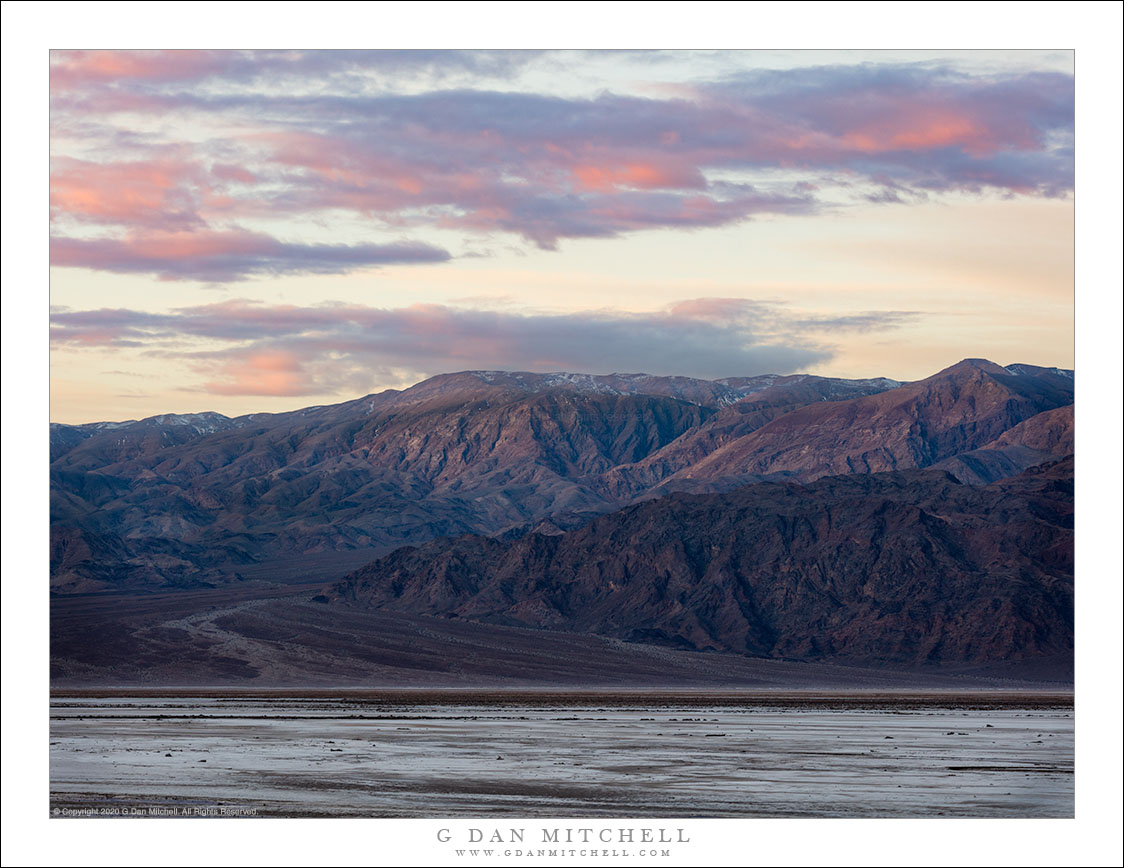
Dawn clouds above the Panamint Range and Death Valley.

Dawn Clouds, Panamint Range. © Copyright 2020 G Dan Mitchell – all rights reserved.

Dawn clouds above the Panamint Range and Death Valley.

On the final morning of a typical Death Valley visit, I get up well before dawn and squeeze in one more “shoot” before leaving. It typically is not too far from where I’m staying since my early wake-up call usually means that I can’t break camp before heading off to photography, and I know that I’ll need to head back, perhaps grab something to eat, and pack up before starting the long drive home. I was camped near Furnace Creek this time, so I selected a spot at the edge of the salt playa not too far from there.

I was up in darkness and it was still dark when I arrived at my location. I sat in my vehicle for a few minutes, and as the first faint light arrived I could see that much of the sky was overcast. This was not encouraging, but I finally decided to load up and walk out across the gravel fan and to the playa. If something was going to happen with the light I had to be in position — no waiting to find out! A short time later I was in position, and the light still wasn’t quite remarkable. But as the first faint sunrise light, filtered by clouds to the east, touched the face of the Panamint range it colored the thinning clouds and created subtle light on the face of the mountains.


G Dan Mitchell is a California photographer and visual opportunist. His book, “California’s Fall Color: A Photographer’s Guide to Autumn in the Sierra” is available from Heyday Books and Amazon.

Blog | About | Flickr | FacebookEmail

Links to Articles, Sales and Licensing, my Sierra Nevada Fall Color book, Contact Information.


Scroll down to leave a comment or question.

All media © Copyright G Dan Mitchell and others as indicated. Any use requires advance permission from G Dan Mitchell.
No More Posts About “That Thing”

Earlier this week I saw an article from a Southern California newspaper (and many links to it online) that promoted and glorified the annual late-February appearance of a particular conjunction of light and water in Yosemite Valley.

I first photographed it quite a few years ago, back before the 50-foot wave of the incoming digital camera revolution washed over everything, threatening to change such things forever, and not in good ways. Back then I was fortunate to join a few folks (maybe a dozen or a score?) standing quietly in one of a couple of places and hoping to see “the thing” happen. For many years I did an annual post about the subject that offered advice on when, where, and how to photograph it.

I’m not doing that any more.

I pretty much stopped photographing it several years ago when the whole event took on a circus-like atmosphere and got so out of control that it began to threaten the well-being of portions of the Valley. While I could share some positive aspects of it, the truth is that chasing after a photograph of something that has been built up and even distorted by too much publicity no longer interests me… and that it is now doing more harm than good.

This past week I also read that the Park Service has had to institute even more draconian (and necessary, I think) restrictions — closing traffic lanes, making it illegal to stop along portions of Valley roads, and completely closing one popular viewing area that had gotten to be so overrun that the forest, meadow, and river were damaged.

You’ve seen photographs of this subject. The photographs can be striking and sometimes remarkable. May I share another secret? If you go there to make your own photograph, the best most visitors can likely hope for is to maybe, if they are really lucky and really skillful and have the right equipment, get a “me too” photograph that looks pretty much like the others. There can be some value in that, but no longer enough to negate the downsides.

And what you are likely to see isn’t what you see in those select few remarkable photographs. The event, if it happens, is very high up on a tall cliff and a good distance from where you’l. be standing. In order to fill the frame the way you’ve seen it you are going to need a very long telephoto, a pretty good camera, probably a tripod. You’ll also need to take that “capture” and subject it to a fair amount of post-processing. The truth is that most of the photographs of the subject that you’ll see, including many of the most striking, have been enhanced to a considerable degree. during post-processing. (I’m not anti-post-processing at all. I’m just being honest.)

Short story: you aren’t going to get “that photo” on your iPhone.

And all of this assumes that the event actually happens. It depends on the conjunction of a number of uncertain conditions — a small stream that must receive enough February snow melt from a very small drainage to start it flowing, a clear line of sight between the location and the horizon far to the west. This doesn’t happen every night. In fact, of all the times I did try to photograph it, more often than not it did not happen.

But I have good news, too! Further afield in the famous Valley where this happens, this is my favorite season of the year, and there are loads of other astonishingly beautiful attractions that are equally worth photographing: morning mists in meadows, snow-topped cliffs ringing the Valley, the potential for spectacular winter storms, clouds floating among cliffs and towers, quiet forests, waterfalls that may come back to life, ice, and much more.

UPDATE: As of 2020 I am no longer posting annual updates concerning the annual Horse Tail Fall event. I also no longer recommend going to the Valley to see it. Unfortunately, too much exposure (yes, I played a part in it, unfortunately) has led to absurd crowds, traffic jams, littering, destruction of areas in the Valley where too many people go to see it… and the park has increasingly — and appropriately — cracked down. Parking options have been eliminated, at least one viewing location has been closed. Good news! The rest of Yosemite Valley is still there and often exceptionally beautiful at this time of year.


G Dan Mitchell is a California photographer and visual opportunist. His book, “California’s Fall Color: A Photographer’s Guide to Autumn in the Sierra” is available from Heyday Books and Amazon.

Blog | About | Flickr | FacebookEmail

Links to Articles, Sales and Licensing, my Sierra Nevada Fall Color book, Contact Information.


All media © Copyright G Dan Mitchell and others as indicated. Any use requires advance permission from G Dan Mitchell.
Waiting For The Light

Waiting For The Light
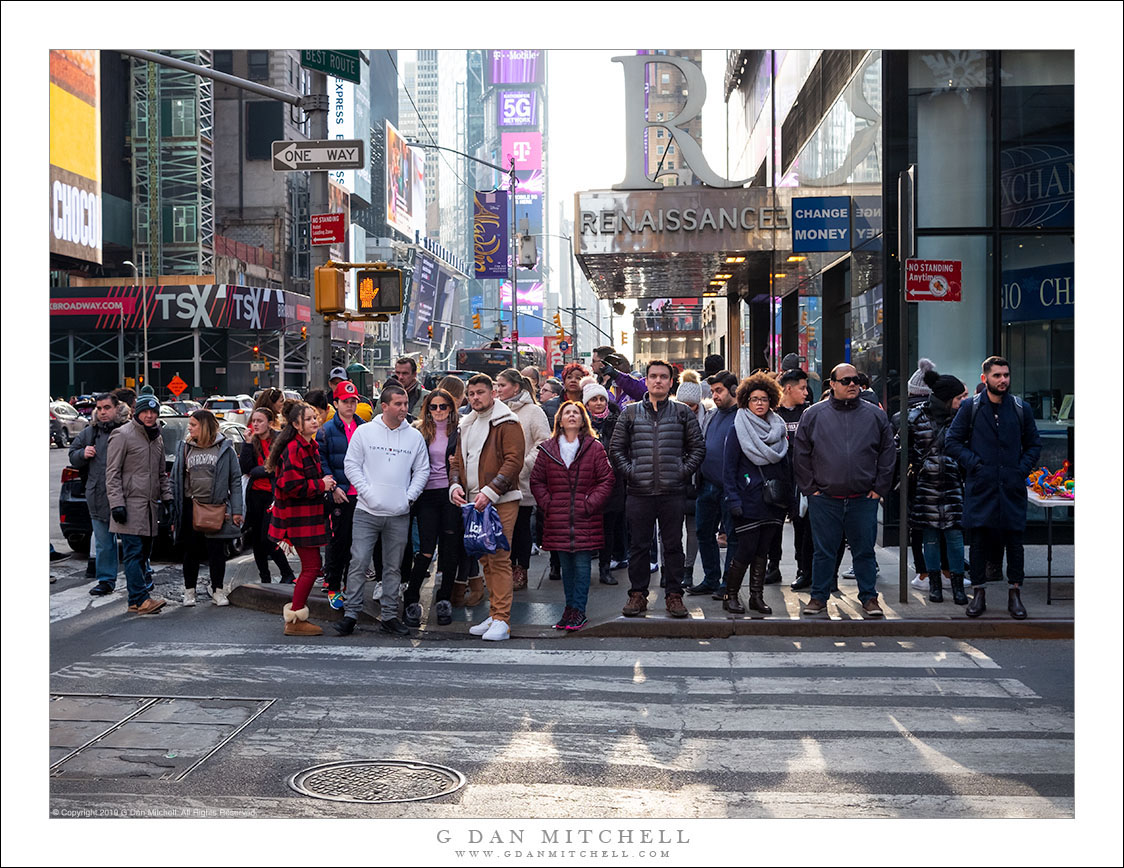
A crowd queues up for the green light at a busy Manhattan interection

Waiting For The Light. © Copyright 2020 G Dan Mitchell – all rights reserved.

A crowd queues up for the green light at a busy Manhattan interection.

Perhaps you thought that I was finished with the photographs from our December visit to Manhattan. You’d be wrong! As I’ve written in the past, I love photographing in the dense urban world of Manhattan. In many ways it is the opposite of what I do most often when I head out to photograph in California and the west, where I tend to focus on the more-or-less natural world (though not entirely!) and work at a generally slower and more contemplative pace. Manhattan is intense, with people everywhere, and tons of stuff to see. Much of it happens so quickly that it is “shoot now or miss it!”

I made this photograph in a busy part of Manhattan — Broadway not far below Central Park if I recall correctly — and during the busy holiday period when tons of people are on the streets. I love the great American diversity of Manhattan, where you rub shoulders with just about everyone — rich and poor, locals and tourists, young and old, every language and ethnicity.


G Dan Mitchell is a California photographer and visual opportunist. His book, “California’s Fall Color: A Photographer’s Guide to Autumn in the Sierra” is available from Heyday Books and Amazon.

Blog | About | Flickr | FacebookEmail

Links to Articles, Sales and Licensing, my Sierra Nevada Fall Color book, Contact Information.


All media © Copyright G Dan Mitchell and others as indicated. Any use requires advance permission from G Dan Mitchell.
Photographer and visual opportunist. Daily photos since 2005, plus articles, reviews, news, and ideas.