It can be difficult to figure out what gear will work well for photography while traveling, what kind of camera and what lenses to take. I do a fair amount of travel photography, and I’ll going this use this article to summarize a few approaches that can work. (Article updated April 25, 2026.)
“Je Suis Bleu” — Sidewalk, graffiti covered wall, and women (virtual and real) on a Paris street
A starting assumption: There is no one “right” or “best” approach to photography while traveling, and what works for me may be far from ideal for you. I’m hopeful that this article may help you figure out about what fits your approach to travel.
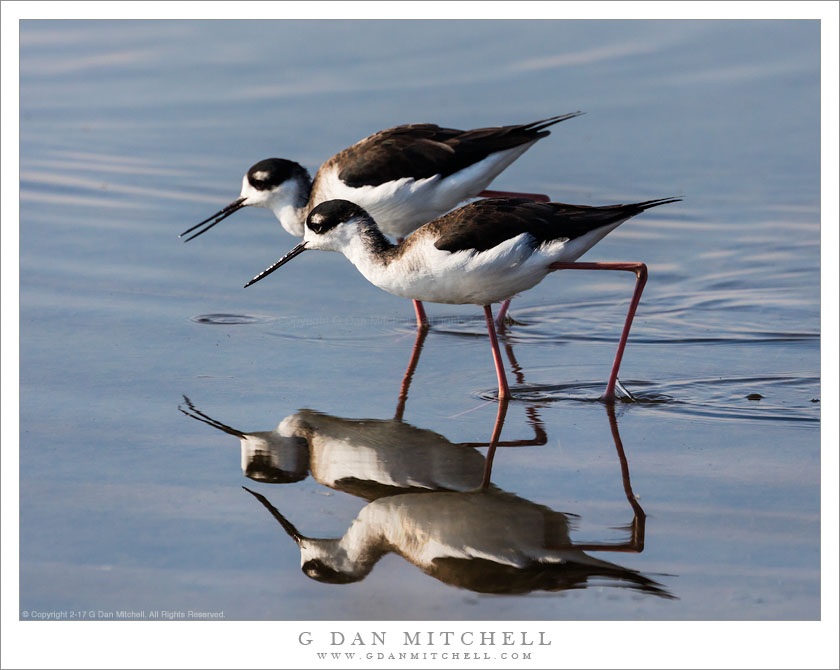
A pair of wading black-necked stilts and their reflections
For decades I did not think of myself as a “bird person,” much less a “birder.” I’m still no birder — I’m not great at identifying the critters and I don’t necessarily seek out new sightings as much as photographic opportunities. However, my fascination with them has increased as I have spent more time photographing them. The first time I intentionally went out to photograph birds, I had basically no idea what I was seeing — it was just, “Wow! Lots of birds!” And that was exciting. This led to a focus on photographing migratory birds, and ,ore recently I’ve become more aware of some of the smaller birds, too.
One of the first to these “smaller birds” was the black-necked stilt. At first I only noticed them tangentially while looking for other things. On a few occasions when those “other things” were nowhere to be found, I turned my camera toward the stilts. They are attractive, though sometimes gangly, birds, with their stark contrast of black and white feathers. They often permit a relatively close approach, and they frequently work their way slowly around a small area, making it easier to photograph them. But getting somewhat unusual photographs of them requires patience and some luck. They do fly, but when they do it is often sudden and very quick… and not at all easy to keep them in the viewfinder. And while one feeding stilt is interesting, that is a pretty common sight. It is more challenging to try to photographs groups of them in ways that are visually linked and interesting. This pair obliged for a moment to two, coming close together and moving in parallel before separating and going their separate ways.
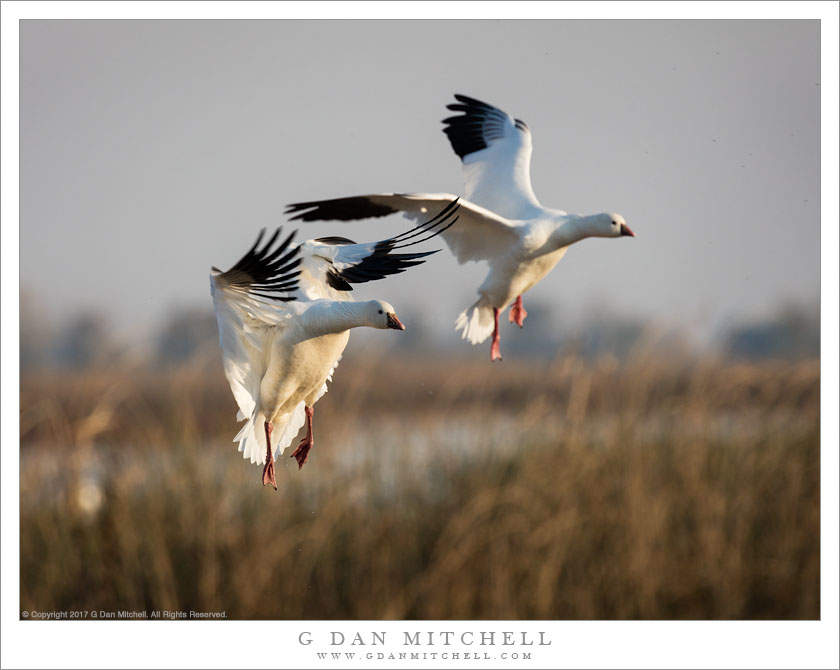
Since we’re well into my “bird season,” focused on migratory and other birds, I’ll stick with that theme a bit longer. I photographed this pair of geese (I’m pretty sure they are Ross’s geese) back at the beginning of December. Near the end of the day I moved to where the light would come in from the right, highlighting light and shadow and the textures of the birds features. Not too long before sunset, geese began to arrive and land in the pond, and I was able to photograph their descent.
I often marvel at the contortions of these birds during the final instants of their flights. In the air they are often graceful, but the landings vacillate between that grace and nearly-out-of-control clumsiness as they transform from creatures of the to earthbound animals. They glide in, instinctively facing into the breeze, and can sometimes then seem to almost drop right out of the sky. Wings go upwards, feet extend down, and necks stretch forward, and quickly they are on the ground.
For those who don’t know the term, “blue hour” is that twilight period when the light tends to become soft and blue, most likely because the primary illumination is from the blue sky itself, with no assistance from direct sunlight. You might not notice the depth of the blue color of the light if you don’t think about it carefully or look at a photograph. Our eyes adjust to the color and see things as being “normal,” but the camera records (more or less) “what is.” Most often when people refer to blue hour they are referencing that period of early twilight — just after the red sunset tones have faded, but before it becomes extremely dark. Of course, there are two “blue hours” every day – one before sunrise and one after sunset.
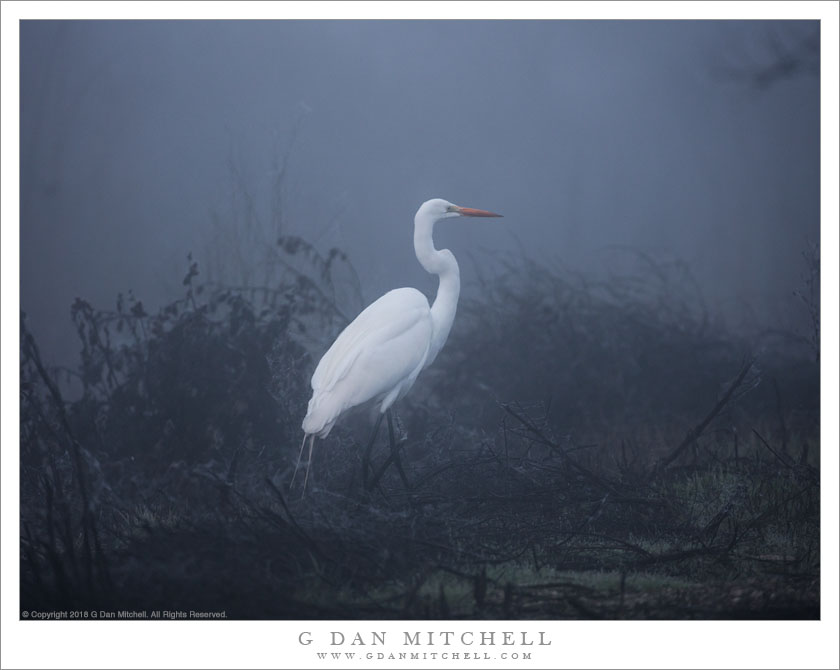
I usually start my bird photography before it becomes light, and I frequently have to wait a bit before starting to photograph. On this morning it was exceptionally murky — not only was it still dark, but the tule fog was very thick. Eventually I looked for subjects that I could photograph in this challenging light. You are never far away from an egret in places like this, and it wasn’t long before I came upon one that was hunting in the nearby vegetation. In many cases I might try to compensate for the blue tones and the darkness, but here I instead decided to “go with the blue” and produce a photograph that feels more like such mornings actually feel.