For those who don’t know the term, “blue hour” is that twilight period when the light tends to become soft and blue, most likely because the primary illumination is from the blue sky itself, with no assistance from direct sunlight. You might not notice the depth of the blue color of the light if you don’t think about it carefully or look at a photograph. Our eyes adjust to the color and see things as being “normal,” but the camera records (more or less) “what is.” Most often when people refer to blue hour they are referencing that period of early twilight — just after the red sunset tones have faded, but before it becomes extremely dark. Of course, there are two “blue hours” every day – one before sunrise and one after sunset.
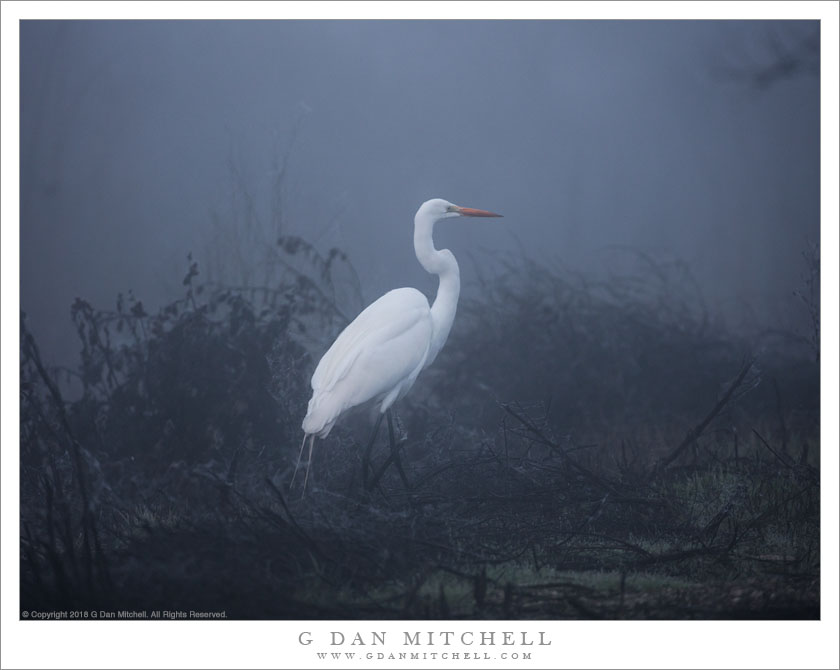
I usually start my bird photography before it becomes light, and I frequently have to wait a bit before starting to photograph. On this morning it was exceptionally murky — not only was it still dark, but the tule fog was very thick. Eventually I looked for subjects that I could photograph in this challenging light. You are never far away from an egret in places like this, and it wasn’t long before I came upon one that was hunting in the nearby vegetation. In many cases I might try to compensate for the blue tones and the darkness, but here I instead decided to “go with the blue” and produce a photograph that feels more like such mornings actually feel.
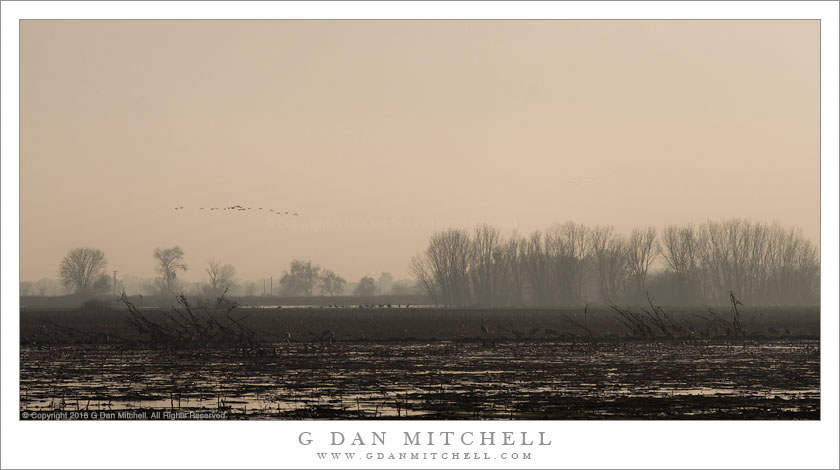
A flock of sandhill cranes flies through an evening winter sky about the San Joaquin River
During winter I travel to California’s Central Valley somewhat frequently, ostensibly to photograph birds but, to be honest, also to photograph the landscape — one that often features fog, fields and trees on the trajectory between winter and spring, unusual effects of light, and those birds. In mid-January I was there one afternoon, on my way to an opening reception at the Carnegie Arts Center in Turlock. The drive would usually take me about two hours, but I left early to create some time to explore areas along the San Joaquin River as it approaches the delta and eventually San Francisco Bay.
It was an interesting weather day. It was range when I left the San Francisco Bay Area, but I got ahead of the front as I crossed into the valley, and it was partly sunny as I headed east on country roads towards this destination. Out here by the river it was hazy and foggy, as it so often is this time of year, and before long the clouds of that front caught up with me and produced an interesting and evocative “atmospheric soup” that was occasionally illuminated subtly when the clouds above the fog to the west thinned. The photograph looks across fallow and muddy fields where sandhill cranes were collecting and towards the scattered trees that grow nearer to the river, above which a flock of cranes flies past.
UPDATE: As of 2020 I am no longer posting annual updates concerning this subject — and I am editing older posts on the subject in light of the need to be more responsible about not encouraging the onslaught. I also no longer recommend going to the Valley to see it. Unfortunately, too much exposure (yes, I played a part in it, unfortunately) has led to absurd crowds, traffic jams, littering, destruction of areas in the Valley where too many people go to see it… and the park has increasingly — and appropriately — cracked down. Parking options have been eliminated, at least one viewing location has been closed. Good news! The rest of Yosemite Valley is still there and often exceptionally beautiful at this time of year.
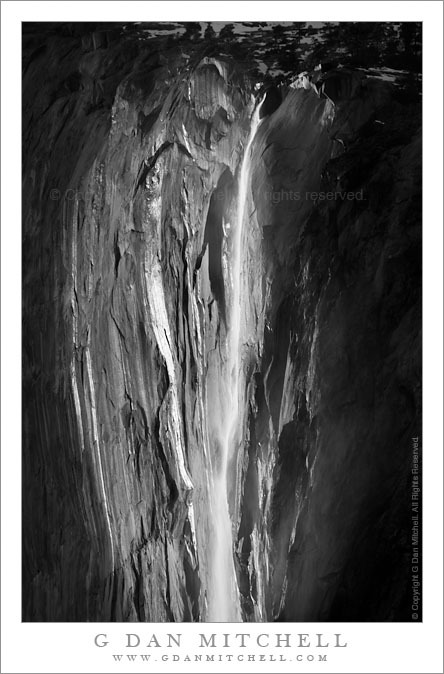
Horsetail Fall, Early Evening
Every winter, for roughly a week or so starting just after mid-February, the sun and various geological features line up so that sunset light falls on the seasonal and ephemeral Horsetail Fall near the east end of the face of El Capitan. Sometimes the light of the setting sun may illuminate this waterfall from behind and briefly make the waterfall and its misty spray glow in sunset colors.
Since it is that time of year again, I’m going to briefly share a few bits of information and perspective about Yosemite Valley’s Horsetail Fall. For more, see an earlier article.
But before you get too excited…
This is another extremely dry winter in California, with Sierra snowpack far below normal. There is very little snow in the drainage the feeds the fall, and forecasts suggest that it will remain dry. In other words, there probably won’t be enough water to start the fall.
The “event” has gotten out of control as thousands of people showed, parking everywhere and trampling through forests. The park service decided that something has to change. This year access to the typical viewpoints will be more difficult, with extremely limited parking (by advance permit only), and roads near the viewing area will be closed to parking or shut down completely. If you don’t have one of those permits, you have a long walk ahead of you… and probably a long return walk in the dark.
Third, what you see in photographs (including my own) is not what you are likely to see in person.
My best advice this year? Probably don’t bother. Between the uncooperative weather and the access restrictions, you are perhaps more likely to experience a #HorseFailFall than Horsetail Fall.
Also, while seeing this phenomenon can be special, it is but one of many, many special experiences to be found in the Sierra. Too often these days, social media convinces use that such experiences are Super Mega Peak Astonishing Ultra Wonders. This poses some dangers, and you should consider resisting. It falsely transforms quiet, contemplative experiences into the equivalent of a sports event, unfortunately creating greater distance between observers and the experience they crave. It also brings crowd that threaten the very places that they come to see.
Perhaps consider something else?
Fortunately, winter in Yosemite Valley has a whole lot to offer besides this event. Fog often forms in quiet meadows at dawn, clouds frequently float among cliffs and peaks, you might get lucky and see some snow, some wildlife is much easier to see in winter, the crowds are generally a lot smaller, and some interesting events take place, such as the Yosemite Renaissance Exhibit opening near the end of the month in the Visitor Center Museum Gallery. (I’ll be in the park during this period as a Yosemite Renaissance “artist in residence,” photographing and attending the opening of the exhibit.)
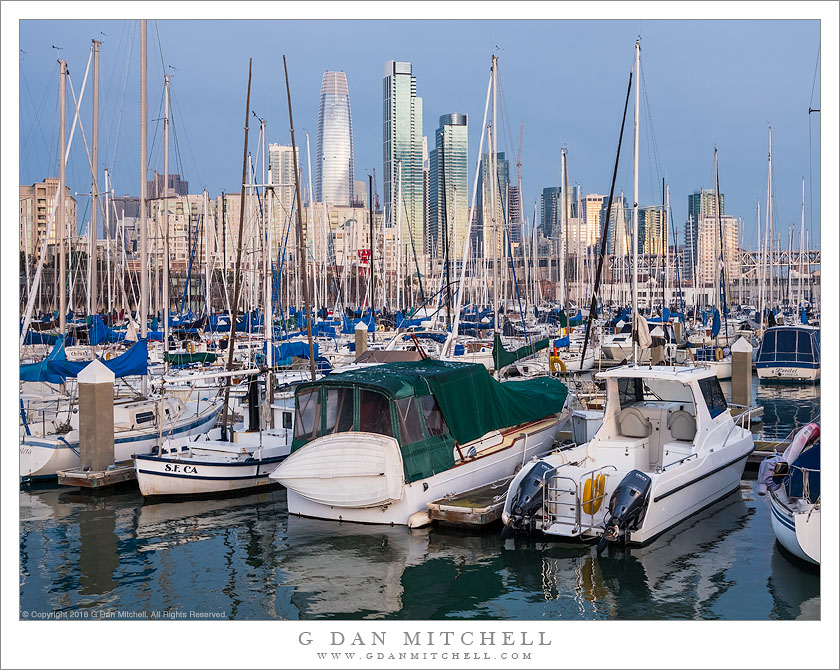
Morning light on South Beach Harbor and buildings of downtown San Francisco
On this late-January morning I was up — you know the drill… “hours before dawn” — to catch a train up the Peninsula to San Francisco for a morning of street photographer and a visit to the San Francisco Museum of Modern Art, where an extensive show of Walker Evans photography was nearing the end of its run. (At some point I should write a bit about my response to the show. A quick summary: great show, some brilliant work, some work I identify with personally, some work that makes me wonder why it is on the wall.) For these trips I’m usually up around 4:00 AM, giving me a half hour for coffee and a quick breakfast before I walk to catch a bus to the train station, where I catch one of the “baby bullet” express trains that has me in San Francisco an hour later.
The weather was in flux, and when by the time I arrived it was clear that a dome of solid high clouds was over San Francisco. However, as I left the train just before sunrise I was able to see some light on the underside of the clouds that was apparently coming from a gap in the cloud cover across the Bay to the east. I quickly headed over to the nearest shoreline location and ended up at the South Beach Harbor. I found some unusual light here as the sun rise. The light was coming through a narrow gap between the western edge of the cloud shield and the low, East Bay hills. Meanwhile, the clouds over and to the north of San Francisco kept the sky there somewhat dark. As the light hit the shoreline area where I had gone, the foreground boats and buildings and so forth were lit by this lovely filtered light and set off against that darker sky. The conditions did not last long — soon the sun rose above that cloud gap and the light soon became gray and flat.

 G Dan Mitchell is a California photographer and visual opportunist. His book, “California’s Fall Color: A Photographer’s Guide to Autumn in the Sierra” is available from Heyday Books and Amazon.