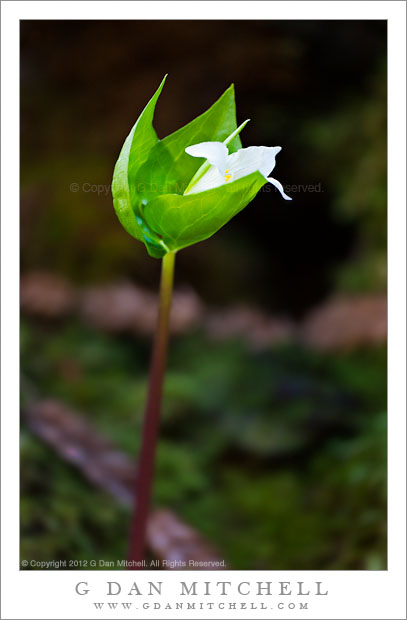
A new trillium plant emerges and begins to blossom beneath the redwood forest canopy.
With enough time to observe these plants – and a few return visits to fill in observational gaps – it is possible to see the full process of their unfolding. Though I still haven’t spotted the very earliest sprouts – probably because I didn’t look quite closely enough – I can spot the newly emerging plants that are about to open up and blossom. The leaves wrap around the incipient flower, and when they begin to open the appearance of the flower itself isn’t far behind.
On this visit to Muir Woods National Monument I found trillium plants in all stages from tiny plants with small leaves to those that had already blossomed and even lost the flowers. A few were at this wonderful stage when the cradling outside leaves are just opening to reveal the new flower. Soon the leaves will drop and flatten to produce the familiar three-part shape and the flower will stand (or droop!) above the leaves.
G Dan Mitchell is a California photographer whose subjects include the Pacific coast, redwood forests, central California oak/grasslands, the Sierra Nevada, California deserts, urban landscapes, night photography, and more. Blog | About | Flickr | Twitter | Facebook | Google+ | 500px.com | LinkedIn | Email
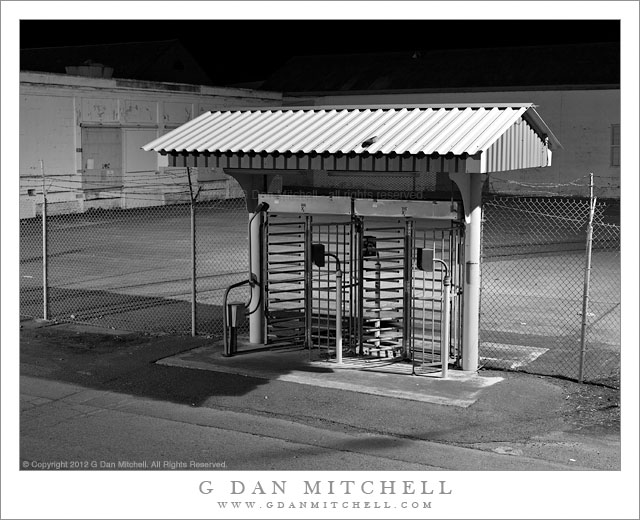
Night photograph of abandoned turnstiles in the industrial area of the historic Mare Island Naval Ship Yard, Vallejo, California.
Early this month I had the opportunity to join my friends from The Nocturnes, the San Francisco Bay Area night photography group, for (yet another) return visit to the historic Mare Island Naval Ship Yard for an evening of nocturnal photography, along with a chance to share work and pizza! I have been photographing Mare Island at night for something like a half dozen years now, yet I still find new and interesting subjects every time I go there.
These turnstile structures are found throughout the facility, and they are a frequent topic of conversation and subject of photography among the night photographers I know. They are intriguing features and there is something compelling about them as potential subjects. Standing along at night they seem forlorn, perhaps in contrast to the knowledge that thousands of ship yard employees must have passed through them at one point. They also seem almost disconnected from the rest of the industrial landscape here. While it is obvious that they must have once been the only entry way to certain areas of the facility, not it is quite possible to simply walk around them. In addition, some mysterious electrical “stuff” has clearly been removed – time card readers? Something else?
It also turns out that they are a surprisingly difficult photographic subject, and I have had many discussions with other night photographers about this. Up close they present an amazing density of interlocking metal features… that are very difficult to assemble into a good composition. I’ve managed once or twice. Oddly, one of my favorite photographs of the turnstiles is almost the very first photograph I made at Mare Island, a black and white close-up photograph of a gate by the island’s museum. For this shot I decided to work from a bit of elevation, setting up on a raised landing in front of a nearby building so that I could look down on the structure and create a sort of surround out of the background area and further buildings.
G Dan Mitchell is a California photographer whose subjects include the Pacific coast, redwood forests, central California oak/grasslands, the Sierra Nevada, California deserts, urban landscapes, night photography, and more. Blog | About | Flickr | Twitter | Facebook | Google+ | 500px.com | LinkedIn | Email
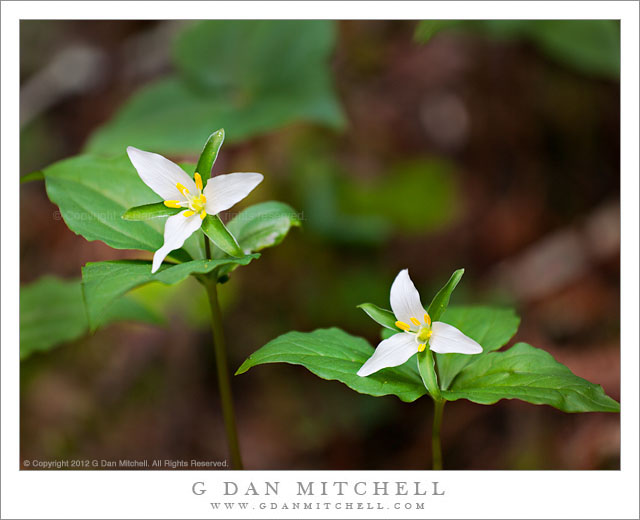
Two trillium blossoms in the redwood forests of the Golden Gate National Recreation Area, California.
It is probably obvious by now that I’m a trillium fanatic. Early March is “trillium season” in the redwood forests around the San Francisco Bay Area, so I have been out photographing these flowers during the past couple of weeks. I was originally concerned that this might be a very poor year for them since we are in the midst of a serious drought in California, but some early March rain seems to have provided enough water to get them to sprout. In fact, this past weekend I saw lots of new plants just starting to emerge, so it seems to me that there may be some life left in the this year’s bloom. (And now we are looking hopefully at an upcoming week of much-needed rain.)
I photographed this pair along a trail that traverses a hillside above a valley filled with coast redwoods. I arrived in this spot just as morning light was beginning to filter down through the tall canopy of this forest and, in spots, hit the ground and the new plants. The trick is is to get some of the brighter color of this sunlight but to avoid the direct sun – the latter is far too harsh for photographing these flowers. So I worked in the shaded areas or, at times, in those spots that were right on the sun/shade boundary. I probably most often photograph single flowers, but when I can find a group I like to see how I can make a composition out of them. It is a bit trickier than it might seem, as there are a bunch of elements that must work together. First, the two flowers need to be fairly close together, and they both need to be at roughly the same point in their development – it isn’t so wonderful to get one beautiful flower and one half-dead, dried hulk. Then they must both be illuminated in roughly the same way – it won’t work so well if one is in brighter light than the other. The background is a tricky thing, too. If it is too bright or too busy (or too well focused) it can easily distract from the flowers themselves, so I usually look for something in shadow and without any very bright objects. While I may be able to find a camera position that accomplishes this, sometimes I need to move a small, bright leaf or twig. And once all of this is worked out, the flowers must be roughly in a plane parallel to the camera’s sensor so that both will be in focus – and this must happen while shooting at the large apertures necessary to throw the background out of focus. And last, but not least, exposure can be slightly tricky – it is very easy to over-expose the bright but delicate form of the flower’s petals, and end up losing detail.
G Dan Mitchell is a California photographer whose subjects include the Pacific coast, redwood forests, central California oak/grasslands, the Sierra Nevada, California deserts, urban landscapes, night photography, and more. Blog | About | Flickr | Twitter | Facebook | Google+ | 500px.com | LinkedIn | Email
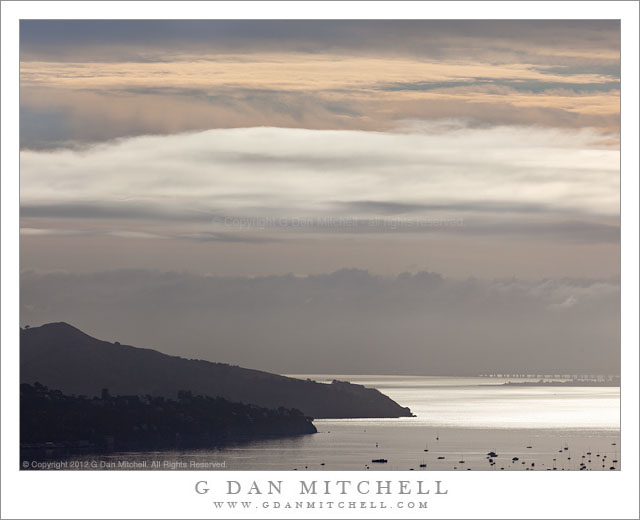
Light shining through layers of morning clouds over San Francisco Bay silhouettes the hills of Angel Island near Richardson Bay.
I can be a bit of a creature of habit when it comes to shooting in certain locations that I’m very familiar with. But the habit isn’t so much shooting the same thing – though that can be part of it – as it is being attentive to how the familiar thing might present itself in ways I have not previously seen. This photograph is a case in point.
I was on my way to a location north of the Golden Gate where I frequently photograph, so I know the route well and have a routine that I frequently follow – it involves where I’m heading, what time I plan to get there, and the route I typically follow. Along the way there are several places where I almost always pause long enough to look around and see if a familiar scene might look different. At a location where my route follows a short ridge line, I often stop and look back across Richardson Bay towards Angel Island and, beyond that, the waterfront of Oakland and then the East Bay hills. On this recent morning, a weak weather front was washing out as it arrived in the Bay Area and, as a result, there were many layers of clouds stacked up to the east. While the sun was able to shine through and light the surface of San Francisco Bay beyond the boats anchored in Richardson Bay, there was haze in the atmosphere that obscured details even on relatively close Angel Island, and in the sky above and beyond there were layers of fog, lower clouds, and the highest clouds of the weather front.
G Dan Mitchell is a California photographer whose subjects include the Pacific coast, redwood forests, central California oak/grasslands, the Sierra Nevada, California deserts, urban landscapes, night photography, and more. Blog | About | Flickr | Twitter | Facebook | Google+ | 500px.com | LinkedIn | Email
Photographer and visual opportunist. Daily photos since 2005, plus articles, reviews, news, and ideas.
Manage Consent
To provide the best experiences, we use technologies like cookies to store and/or access device information. Consenting to these technologies will allow us to process data such as browsing behavior or unique IDs on this site. Not consenting or withdrawing consent, may adversely affect certain features and functions.
Functional
Always active
The technical storage or access is strictly necessary for the legitimate purpose of enabling the use of a specific service explicitly requested by the subscriber or user, or for the sole purpose of carrying out the transmission of a communication over an electronic communications network.
Preferences
The technical storage or access is necessary for the legitimate purpose of storing preferences that are not requested by the subscriber or user.
Statistics
The technical storage or access that is used exclusively for statistical purposes.The technical storage or access that is used exclusively for anonymous statistical purposes. Without a subpoena, voluntary compliance on the part of your Internet Service Provider, or additional records from a third party, information stored or retrieved for this purpose alone cannot usually be used to identify you.
Marketing
The technical storage or access is required to create user profiles to send advertising, or to track the user on a website or across several websites for similar marketing purposes.