
Tag Archives: atmosphere

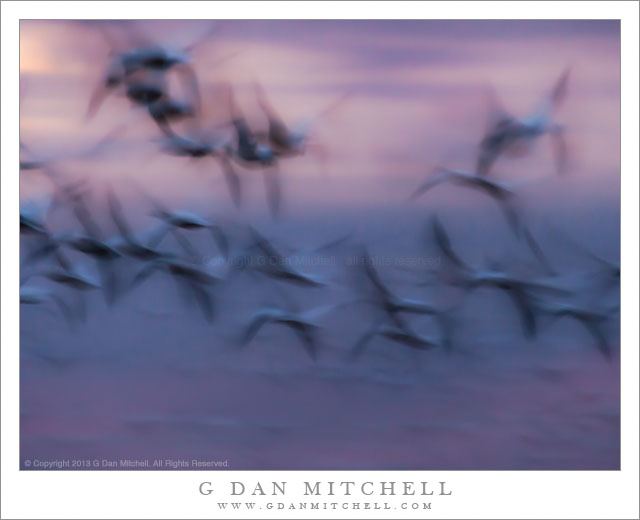
Geese, Dusk

Geese, Dusk
Geese, Dusk

Geese, Dusk. San Joaquin Valley, California. December 18, 2013. © Copyright 2013 G Dan Mitchell – all rights reserved.

Geese take flight into dusk haze and clouds

A group of us – Patty Mitchell, Michael Frye, Claudia Welsh, David Hoffman, Charlotte Hoffman, and I – spent a day photographing migratory birds and the landscape of California’s San Joaquin Valley recently. I hope that it is obvious that this photograph does not attempt an objectively realistic presentation of geese! The facts include… these are almost certainly Ross’s geese, they are passing quickly as they fly between two close flocks in the early dusk light, the clouds in the distant sky are colored blue and pink and purple by post-sunset light. By the time I made this photograph it was almost too dark to clearly make out much of anything in this scene, and certainly not to see clearly the individual birds rising into the air, flying past, or landing among other birds already on the ground.

From a certain point of view, this photograph does everything “wrong” when it comes to wildlife photography in general and bird photography in particular. The shutter speed was something like 1/8 of a second, and kept that “short” only by underexposing by nearly a full stop and shooting at ISO3200. The shot was hand-held with a 400mm focal length. Geese, barely visible in the twilight gloom, where coming and going in almost unpredictable ways, yet getting an interesting arrangement of birds in the frame required quickly responding to what they did and then panning while shooting. I had positioned myself to the east of the flock in the hope of getting some interesting sky behind them, so I was also trying to remain aware of the background while tracking the birds. Clearly, this is not a recipe for razor-sharp, carefully and thoughtfully composed images! Additional work was done in the post-processing phase – to deal with the inevitable noise and with balancing out the luminosities of various parts of the frame and bringing out details that might otherwise be lost. Yet, with enough shots and some intuition from photographing these birds in these conditions before, it is possible to make something happen. In the end, for me a photograph like this can evoke the mystery of what happens in the deepening twilight – the sudden unpredictable motion, the sounds of the geese, the hazy atmosphere, and the gathering darkness.

G Dan Mitchell is a California photographer and visual opportunist whose subjects include the Pacific coast, redwood forests, central California oak/grasslands, the Sierra Nevada, California deserts, urban landscapes, night photography, and more.
Blog | About | Flickr | Twitter | FacebookGoogle+ | 500px.com | LinkedIn | Email

Text, photographs, and other media are © Copyright G Dan Mitchell (or others when indicated) and are not in the public domain and may not be used on websites, blogs, or in other media without advance permission from G Dan Mitchell.
Ross’s Geese, Dusk

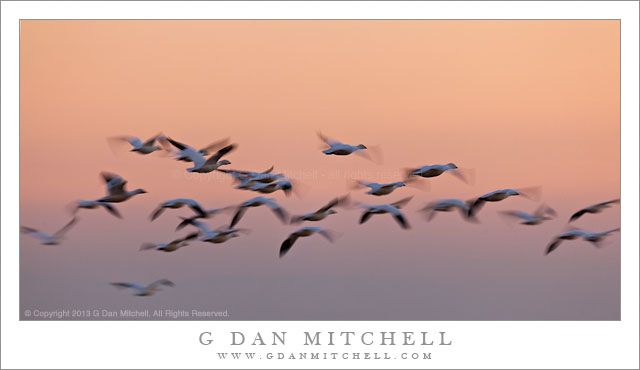
Ross's Geese, Dusk
Ross’s Geese, Dusk

Ross’s Geese, Dusk. San Joaquin Valley, California. December 13, 2013. © Copyright 2013 G Dan Mitchell – all rights reserved.

A group of Ross’s geese takes flight in hazy dusk light

I try to visit California’s San Joaquin Valley as often as possible during the fall, winter, and early spring months when migratory birds settle in for the cold season. The sounds of the birds and the sight of flocks of them setting in or flying overhead is addictive – so much so that I’m willing to go to somewhat great lengths to experience this. Most often this means getting up way before dawn, often on very cold mornings, and driving a couple of hours into the foggy landscape of the valley and then photographing for hours in the cold. I’m not complaining – I love doing this! I also have what has become an annual routine connected to my periodic Death Valley photography trips. I try to arrange my schedule on the last day in Death Valley so that I can do a morning shoot there, quickly strike camp and pack up, and leave soon enough that I can stop to photograph birds on the way home. (The two worlds – the dry, austere world of Death Valley, and the cold, damp, and bird-filled Central Valley – could not be more different.)

This photograph is one of several (well, OK, more than “several”) I made during a one hour stop at some valley wetlands at the end of the day on the long drive home. I arrived, did a quick reconnaissance around the area, discovered a large flock settled in along a gravel road in a pasture, and settled in to watch the evening’s events. I recall a time when I was disappointed when the light faded, since it eventually became too dark to maintain shutter speeds that would stop the motion of the geese as they flew in, out, and around. But it didn’t take long to discover that continuing to shoot in the fading light and accepting the slower shutter speeds led to motion blur would let me present the birds in a more abstract way, but one that is in many ways as true as isolating a moment of seeming stillness in a scene that is actually full of motion. I now look forward to this time of low light, when I can make photographs that might possess a bit more mystery.

G Dan Mitchell is a California photographer and visual opportunist whose subjects include the Pacific coast, redwood forests, central California oak/grasslands, the Sierra Nevada, California deserts, urban landscapes, night photography, and more.
Blog | About | Flickr | Twitter | FacebookGoogle+ | 500px.com | LinkedIn | Email

Text, photographs, and other media are © Copyright G Dan Mitchell (or others when indicated) and are not in the public domain and may not be used on websites, blogs, or in other media without advance permission from G Dan Mitchell.
Forest and Cliffs, Autumn

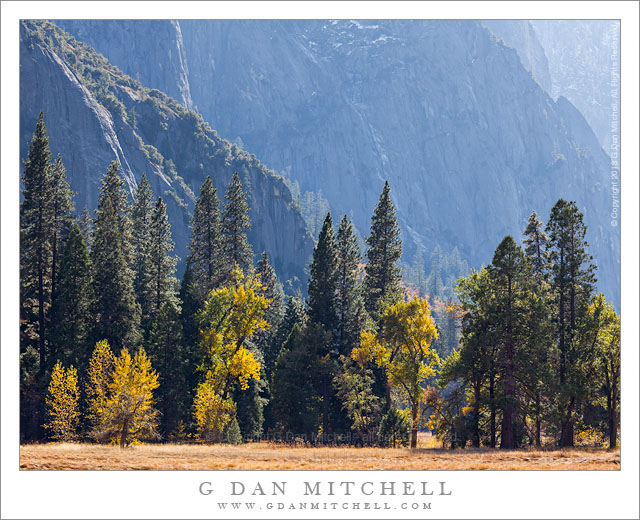
Forest and Cliffs, Autumn

Forest and Cliffs, Autumn. Yosemite Valley, California. October 30, 2013. © Copyright 2013 G Dan Mitchell – all rights reserved.

Soft autumn light on Yosemite Valley forests and granite cliffs.

A typical day of shooting in normal weather in a place like Yosemite Valley starts early – though perhaps not as early as in some other locations, since the first light is somewhat muted by the tall cliffs and taller peaks to the east. I select subjects largely based on what the light is like and where I think it will be interesting, often focusing on places where I can get nice backlight, soft light in shadows, or perhaps atmospheric conditions such as fog. I may move around the Valley, shooting in one spot for a while and then moving on to another place where I suspect that conditions might be interesting. Depending upon the conditions and the season, this can go on for hours in the morning until eventually the light becomes “midday blah” and I’m exhausted and hungry! Time for a (very late) breakfast break and a pause in the photography on most days. After coffee and food I’ll usually take care of some business, for example breaking camp if it my final day there, and I’ll often wander around to visit familiar places – perhaps a gallery or a museum – and then it is probably time for a short nap. (Keep in mind that I’ve been up since well before dawn, and will likely shoot until dark and then possibly drive for four hours or more!)

At some point in the mid to early afternoon it feels like time to photograph some more – the angle of the light becomes less and backlight opportunities increase, afternoon haze may be increasing the sense of depth in the landscape, and I need to begin figuring where I’ll want to be at various times during the evolution of the light that will continue until after sunset. On this afternoon I went back into photography mode at about 2:30 or so, and this photograph was made at the “early” hour of around 3:00. But because it was fall, the sun angle was already low enough to backlight and highlight the cottonwood trees at the edge of the meadow and the textures and shapes of the granite cliffs rising above the Valley.

G Dan Mitchell is a California photographer and visual opportunist whose subjects include the Pacific coast, redwood forests, central California oak/grasslands, the Sierra Nevada, California deserts, urban landscapes, night photography, and more.
Blog | About | Flickr | Twitter | FacebookGoogle+ | 500px.com | LinkedIn | Email

Text, photographs, and other media are © Copyright G Dan Mitchell (or others when indicated) and are not in the public domain and may not be used on websites, blogs, or in other media without advance permission from G Dan Mitchell.

Rim Fire Zone, Morning

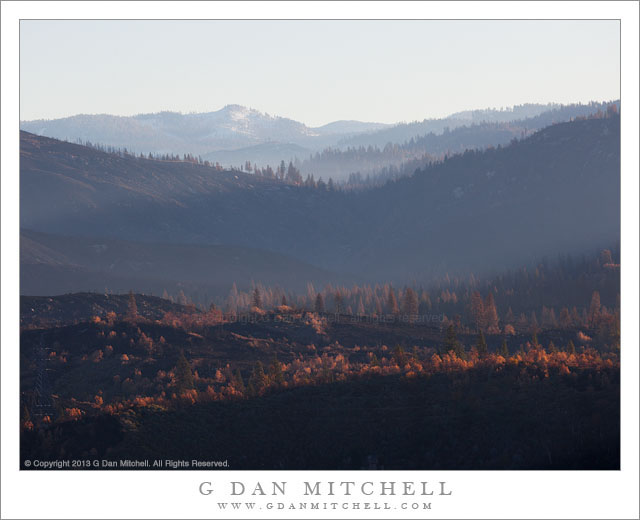
Rim Fire Zone, Morning

Rim Fire Zone, Morning. Rim of the World, California. October 30, 2013. © Copyright 2013 G Dan Mitchell – all rights reserved.

Hazy morning light filters across the burned hillsides in the area of the Rim Fire, California

In photographic terms this is perhaps not the most spectacular photograph, and the location is not quite a scenic icon – though it is a place that many stop and take a look on their way to Yosemite, the “Rim of the World” overlook along highway 120 between Groveland and the northern park entrance. However, this view is loaded with implications and connected to many stories.

Late this past summer, the state of California was tremendously dry after a second drought season. It wasn’t a question of whether there would be big wildfires, but more of where, when, and how many. Perhaps the biggest one of all started very near the Rim of the World overlook, and in the hot and dry conditions it quickly – some might say explosively – spread to the north, east, and south. While many think of it as “the Yosemite fire” – and it did burn a lot of terrain inside the park – it really was more of a “Yosemite area” fire. Because of the conditions – the long-term conditions of drought and the immediate conditions of heat and wind – the fire apparently did very serious damage to the forests in the are.

Shortly after the fire was contained, I thought that I might drive through the park on Tioga Pass Road to get to and from the eastern Sierra in early October. In fact, the roads had opened up again by that time, but snow closed Tioga Pass on my trip to the west and we ended up coming back over Sonora Pass. So the post-fire conditions of this area, which is very familiar to me after years of visits, were still an unknown when I drove to The Valley on October 30 for a few days of autumn photography. Passing into the first fringes of the burned areas along highway 120 things didn’t look all that different than they do after any wildfire – some areas badly burned, some singed, and others that mostly escaped the fire. I decided to stop at the Rim of the World overlook, which was pretty much the only place where stopping was allowed, and get out and take a look. I was floored by the scale of the fire. It had come from behind my position, burned down and across the deep canyon of the Tuolumne River, up the canyon walls on the far side, and then across a vast series of receding ridges. Some smoke and haze still seemed to be coming from the area, and early morning light glanced across the ridges, with their dead trees. In the far distance there is a low peak with a bit of early season snow.

I have seen quite a few fires in the park over the past few decades. One not far from here destroyed a large area of forest a few decades ago – and on this trip, ironically, I was noting that new evergreen trees are finally taking hold there. Later several very bad fires blew up from near Foresta, doing terrible damage to the section of Crane Flat Road descending towards The Valley. There have been others. In most of these cases – though I wondered in the case of the most recent Foresta fire, too – it seemed that I could watch the forest recover and return to something resembling what I remember. However, given the intensity and scale of this fire, I wonder if I’ll have that opportunity where the Rim Fire burned?

To end on a cheerier note, a couple of other observations. Even near badly burned areas, I did see sections where this fire only burned some of the vegetation and a few that seemed to have been completely spared. And when I got to a spot inside the park along highway 120 where I often stop to photography dogwood trees in the spring and fall, a spot that seemed like it might have been within the burn zone on the maps, I found my little spot completely intact, with the dogwoods turning to fall colors.

G Dan Mitchell is a California photographer and visual opportunist whose subjects include the Pacific coast, redwood forests, central California oak/grasslands, the Sierra Nevada, California deserts, urban landscapes, night photography, and more.
Blog | About | Flickr | Twitter | FacebookGoogle+ | 500px.com | LinkedIn | Email

Text, photographs, and other media are © Copyright G Dan Mitchell (or others when indicated) and are not in the public domain and may not be used on websites, blogs, or in other media without advance permission from G Dan Mitchell.