
Tag Archives: blue

Migratory Birds in Twilight, Central Valley

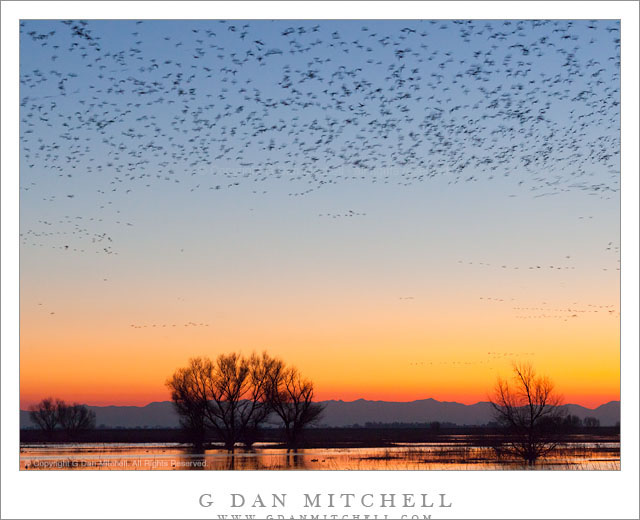
Migratory Birds in Twilight, Central Valley - Migratory birds flly though the twillight winter sky above California's Central Valley and the Coast Range.
Migratory birds flly though the twillight winter sky above California's Central Valley and the Coast Range.

Migratory Birds in Twilight, Central Valley. Merced National Wildlife Refuge, California. February 8, 2012. © Copyright 2012 G Dan Mitchell – all rights reserved.

Migratory birds flly though the twillight winter sky above California’s Central Valley and the Coast Range.

I made this photograph when it was almost too dark to see clearly. In fact, when I packed up and drove away a few minutes later, it was so dark that I momentarily got mildly lost on my way out of the refuge! Long after the sun had set, and at the time when perhaps the most intense sky colors appear, the migratory birds were still in flight above the Central Valley, often silhouetted against the colorful dusk sky just above the horizon.

This photograph is going to get a bit more technical explanation than usual. I had a 100-400mm telephoto on the camera at this point since I had been photographing the birds in a variety of ways, including trying to fill the frame with one or a few birds. While some might say that shooting a prime lens of this length could have some image quality advantages, this photograph wouldn’t have happened if I had been shooting, say, a 400mm prime. Since I wanted to move quickly from targeting small sections of the surroundings or even individual birds to making photographs that attempt to portray the larger landscape within which the birds are found, I frequently found myself moving quickly to much shorter focal lengths. Here, I realized that I might be able to “zoom out” and include some of the birds in flight high above the valley and the distant mountains in the context of their surroundings. So I shot this at something like 130mm. In addition, because the scene includes subjects that are not that far away (like the trees) and those at much greater distances (like the hills), depth of field was an issue with the longer focal lengths. I couldn’t shoot wide open without some excessive focus issues, so I stopped down to f/11. Think about that for a moment: shooting in extremely low light, stopped down to try to maintain some depth of field… and needing use a shutter speed allowing me to get some definition out of birds flying through the scene. This is essentially being caught between a rock and a hard place… and another rock. With the camera on the tripod, but still aimed manually, I used a shutter speed of 1/13 second and turned image-stabilization on. With all of this stuff pushing boundaries of shutter speed and aperture… my only option was to increase the ISO to 1600. For landscape work. Here’s the thing… in the end, while there was more noise in this photograph than if ISO 100 were possible, it isn’t that bad and probably wouldn’t even be visible to viewers of a print. While I’m usually persistent in my view that little technical differences among cameras don’t amount to much, in this case it was because current cameras make it possible to shoot in ways that were essentially impossible a decade ago that I could get this photograph at all.

G Dan Mitchell is a California photographer whose subjects include the Pacific coast, redwood forests, central California oak/grasslands, the Sierra Nevada, California deserts, urban landscapes, night photography, and more.
Blog | About | Flickr | Twitter | FacebookGoogle+ | 500px.com | LinkedIn | Email

Text, photographs, and other media are © Copyright G Dan Mitchell (or others when indicated) and are not in the public domain and may not be used on websites, blogs, or in other media without advance permission from G Dan Mitchell.

Ross’s Geese, Winter Evening

Ross's Geese, Winter Evening - Motion-blurred photograph of low-flying Ross's geese on a winter evening in California's Central Valley.
Motion-blurred photograph of low-flying Ross's geese on a winter evening in California's Central Valley.

Ross’s Geese, Winter Evening. Merced National Wildlife Refuge, California. February 8, 2012. © Copyright 2012 G Dan Mitchell – all rights reserved.

Motion-blurred photograph of low-flying Ross’s geese on a winter evening in California’s Central Valley.

From time to time I experiment with longer exposure photographs of birds in flight. The idea is that allowing the image to blur as the birds move might suggest their constant motion more effectively than the more typical approach of stopping the motion. Here not only was the exposure relatively long (I think it was 1/30 second) but I was shooting with a long telephoto which also amplifies the motion of subject and camera.

I’m thinking of this as a “study” for future photographs of these Ross’s geese and similar birds that will work with this idea of motion blur. Making this shot let me get a bit closer to understanding the most likely times to find the birds lifting off in the evening, and the best time to try to catch this with a bit of the last sunlight before sunset. I was also able to slightly better establish the shutter speed I would like to work with for this kind of image. The idea is to keep just barely enough shape in the birds that you can recognize what they are, but to allow the motion to blur things enough to eliminate the hyper-sharp realistic quality of the scene and to let the motion blur imply something about the actual flying motion of the birds.

G Dan Mitchell is a California photographer whose subjects include the Pacific coast, redwood forests, central California oak/grasslands, the Sierra Nevada, California deserts, urban landscapes, night photography, and more.
Blog | About | Flickr | Twitter | FacebookGoogle+ | 500px.com | LinkedIn | Email

Text, photographs, and other media are © Copyright G Dan Mitchell (or others when indicated) and are not in the public domain and may not be used on websites, blogs, or in other media without advance permission from G Dan Mitchell.
Rhyolite Ghost Town, Amargosa Valley and Mountains

Rhyolite Ghost Town, Amargosa Valley and Mountains
“Rhyolite Ghost Town, Amargosa Valley and Mountains” — The ruins of the ghost town of Rhyolite, Nevada stand above the Amargosa Valley, with the Amargosa Range and Death Valley National Park in the distance.

While there can be some moments of beautiful and colorful sunrise light at the ghost town of Rhyolite, Nevada – and I was there for it – this early morning light from a short time later probably gives a more true sense of what the place tends to look like during the winter months. (Even here, the high, thin clouds soften the scene a bit – it is often quite cloudless.)

From what I understand, Rhyolite sprang up in the very early 1900s after gold was discovered nearby. During the short life of the town, measured in no more than decades, it was reportedly the second largest city in southern Nevada. It featured banks (two of which are seen in this photograph), a railroad station (abandoned but still present and located behind my camera position), newspapers, an impressive school house, and thousands of residents. It was all largely abandoned in the first half of the 1900s and most of the buildings are gone, though traces of them and the old roads they lined can still be found here and there. A few large buildings in the center of the town still more or less stand, in varying states of decay. The building on the right was the Cook Bank. Another bank was located where the white walls are a bit further in the distance. The town school house is the furthest building. The whole town overlooked the Amargosa Valley, where the current boundary of Death Valley National Park lies. Beyond that, an inside the park, are the Amargosa Range and in the far distance the ridge of the Panamint Range and the summit of 11,000+’ Telescope Peak.


G Dan Mitchell is a California photographer and visual opportunist. His book, “California’s Fall Color: A Photographer’s Guide to Autumn in the Sierra” (Heyday Books) is available directly from him.

G Dan Mitchell: Blog | Bluesky | Mastodon | Substack Notes | Flickr | Email


All media © Copyright G Dan Mitchell and others as indicated. Any use requires advance permission from G Dan Mitchell.

Eureka Dunes and Last Chance Range, Morning

Eureka Dunes and Last Chance Range, Morning - Morning light on the Eureka Dunes and the hills of the Last Chance Range, Death Valley National Park.
Morning light on the Eureka Dunes and the hills of the Last Chance Range, Death Valley National Park.

Eureka Dunes and Last Chance Range, Morning. Death Valley National Park, California. January 6, 2012. © Copyright 2012 G Dan Mitchell – all rights reserved.

Morning light on the Eureka Dunes and the hills of the Last Chance Range, Death Valley National Park.

While I love – who doesn’t? – the golden hour light on the desert dunes and hills and valleys, I also like to seek out the subtler and more “atmospheric” effects that are often frequently seen in this terrain. I had spent the (very cold!) night alone out here in Eureka Valley. I woke up fairly early, though with the sun having to rise past the ridge of the Last Chance Range, the light did not come early. I soon packed up my camp – which largely meant rearranging stuff in my vehicle – and before long started the drive out toward Lone Pine and my trip back home over Tioga Pass.

But first I planned to stop just a ways away from the camping area so that I could use a long lens to photograph the dunes against the background of the higher surrounding peaks. By the time I did this it was after 9:00 a.m. and the early morning golden hour light was long gone, replaced by the soft and hazy bluish light that is more typical during daylight hours. However, the sun was still low enough to glance across the dunes at a fairly low angle and to backlight the dunes and the mountains behind them. The idea here was to juxtapose some of the different textures, lines, curves, and angles of this landscape – the curving forms of the dunes near the bottom of the frame, the sharply delineated sunlit ridges of the upper dunes, the faint view of jagged and stratified rocks in the low peaks beyond them, the further ridge inclining the opposite direction from the dunes, and the much fainter texture of the huge valley in the distance.

G Dan Mitchell is a California photographer whose subjects include the Pacific coast, redwood forests, central California oak/grasslands, the Sierra Nevada, California deserts, urban landscapes, night photography, and more.
Blog | About | Flickr | Twitter | FacebookGoogle+ | 500px.com | LinkedIn | Email

Text, photographs, and other media are © Copyright G Dan Mitchell (or others when indicated) and are not in the public domain and may not be used on websites, blogs, or in other media without advance permission from G Dan Mitchell.