“Stone Steps” — Stone steps in front of a San Francisco building
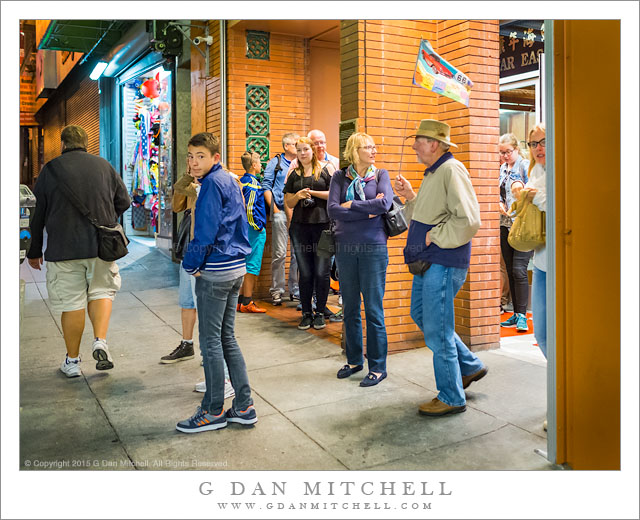
There was no particular plan that took me here this time — I was following a somewhat random route across The City, dictated by whims, which direction had the green light, and whatever seemed interesting. Starting at the CalTrain station, I worked my way along the Embarcadero and then heading up Market before cutting north and following a wandering route through Chinatown (studiously avoiding Grant), though part of North Beach and then nearly to the touristy Fisherman’s Wharf area.
I have walked past and photographed this building before, and I may have even photographed the steps, though in a very different way. This time the steps caught my attention. The photograph might seem monochromatic, but if you look closely you may spot a few small, brown autumn leaves on the steps.
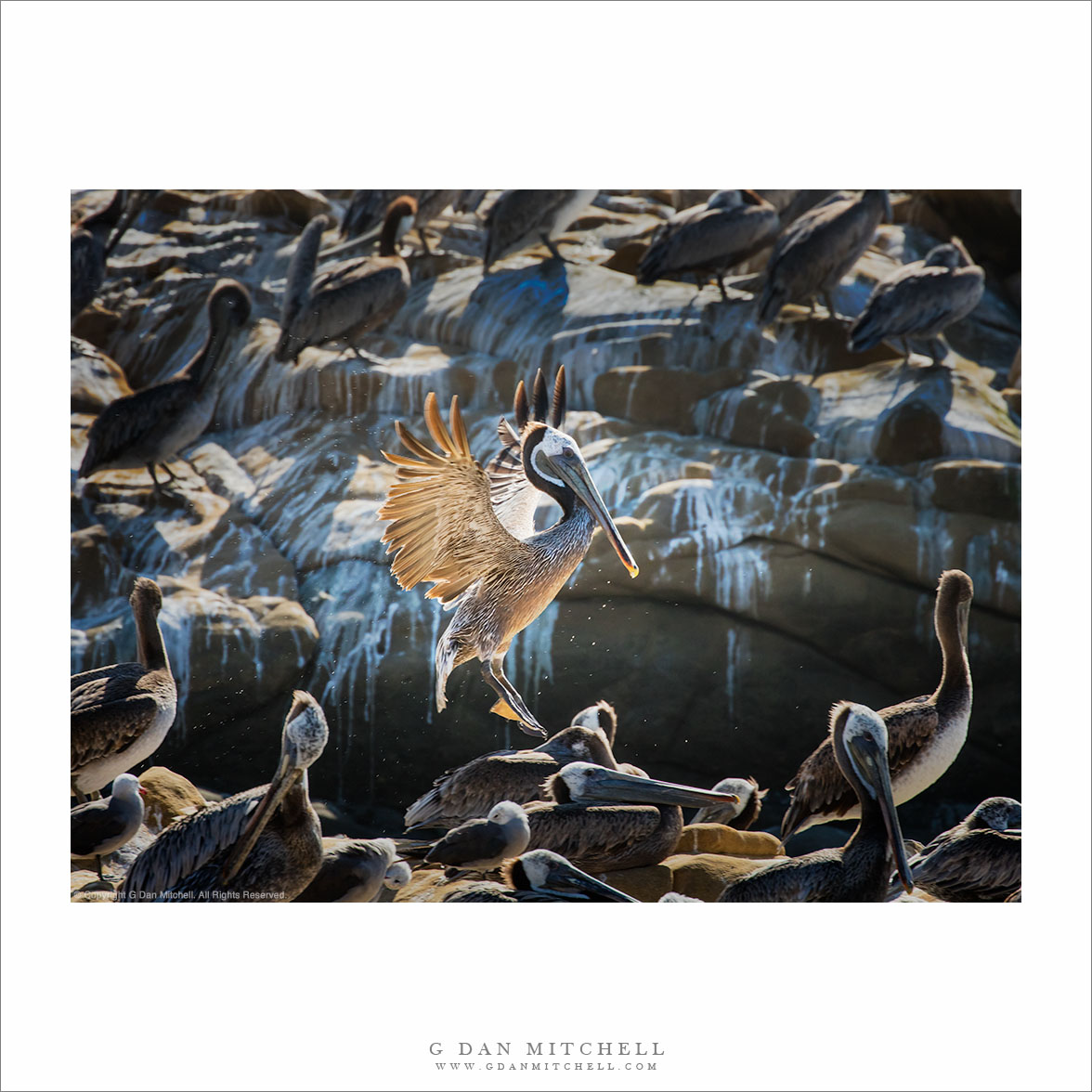
Brown pelican flight above the shoreline of Monterey Bay, Moss Landing, California
Rediscovering this photograph and a few of its buddies makes for a bit of an odd story. Earlier today I got a message telling me that one of the drives attached to my computer was nearly full. That seemed a bit surprising, but it also was clearly an issue I had to address, so I set about looking for unnecessary files on that volume. In doing so I “discovered” a folder full of raw files and a few Photoshop files that I had apparently transferred to the computer last year… and then forgot. Most of the files there turned out to be unneeded, and I reclaimed 5GB of disk space by deleting them. But among there were s small number of shorebird photographs that I had forgotten.
The photographs came from an amazing and surprising spur-of-the-moment visit to Monterey Bay last June. For weeks I had been hearing stories of whales coming very close to the shoreline, and I had even observed a few from the cliffs in the Big Sur area. A news story claimed that they were now inside Monterey Bay and even coming very close to the beaches an Moss Landing — and friends had photographs to prove it. So over the hill we went to go there ourselves. When we arrived we were, indeed, impressed by how close the whales came to the beach — I had no idea they did that. But as impressive was the huge collection of birds that was perhaps attracted to the same food sources that drew the whales. I had never seen such numbers of these birds along the coast. Among them were a large number of brown pelicans, so many that photographing them was almost too easy.
Fog and haze obscure the winter skyline of downtown San Francisco, California.
It is unlikely that any view of San Francisco will be entirely unique, but I haven’t seen many other photographs of the City’s skyline that look quite like this one. It isn’t unusual for people who see the photograph (especially as a print) to ask, “Is that real?” It is as real as a photograph gets, and the conditions actually occurred — the only time I have seen them quite like this, with quite this soft and subtle atmosphere and light. (The post-processing on this photograph was relatively minimal, and a lot of it was about controlling the brightness of that bright cloud high in the sky.)
Living in the San Francisco Bay Area, I frequently drive north over the Golden Gate Bridge to photograph in the redwoods, along the coast, or at Point Reyes National Seashore. This usually means leaving home well before the sun rises, and depending on where I’m headed, I usually cross the bridge right around dawn. The plan is to pause and look at the scene in the early light and decide if something really interesting might happen — and it that seems probable I’ll photograph here for a while before moving on.
Evening light on the playa of Death Valley, with lower slopes of the Panamint Mountains rising beyond
Since I’ve been traveling to and around Death Valley National Park for more than 15 years now, I’ve seen a lot of the park — but I most certainly have not see all of it, nor have I completely learned how to see everything in it. This is a huge place, varying greatly by location, terrain, season, weather and more. Frankly, the experience of coming to know such a place over time is one of the things I value most about such locations. While I love to “discover” a place that is completely new to me (and Death Valley was that place in the late 1990s for me), the longer process of learning the place and its rhythms more deeply is also, I think, more rewarding. It is wonderful to see a desert gully in evening light for the first time, but it may be even more beautiful to come back to it and recognize an old and familiar friend.
Along these lines, a few years ago, as I continued to push out my own boundaries of experience and knowledge in Death Valley, I began to think more about how to make photographs of things that I might have not thought worthy of a photograph before. I realized that many of these things that don’t scream “photograph me!” are otherwise a core part of the experience of this place: a vast and quiet “empty” landscape, midday sun, haze obscuring great distances, the edge between the last vegetation and a barren playa, a beam of light slanting across an alluvial fan. And if they are central to the sense of the place, it seems that there must be a way to photograph them. And that is a new challenge for me in my Death Valley photography.
G Dan Mitchell is a California photographer and visual opportunist whose subjects include the Pacific coast, redwood forests, central California oak/grasslands, the Sierra Nevada, California deserts, urban landscapes, night photography, and more. Blog | About | Flickr | Twitter | Facebook | Google+ | 500px.com | LinkedIn | Email