
Tag Archives: crack

Dry Mud and Sand

Dry Mud and Sand
Dry Mud and Sand

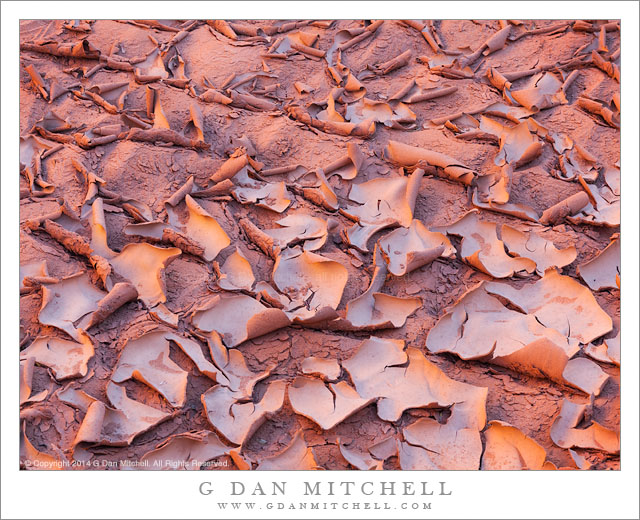
Dry Mud and Sand. Grand Staircase-Escalante National Monument, Utah. October 25, 2014.© Copyright 2014 G Dan Mitchell – all rights reserved.

A dry and curled layer of mud atop red sand in the bottom of a Utah canyon

It might be amusing for “normal people” to encounter a group of photographers in the bottom of a narrow Utah canyon, where the photographers might be found clustered attentively and enthusiastically around… dry mud. That was the case here, as a group of use suddenly halted our progress down a small (though much larger later on) canyon to set up tripods, fit just the right lenses, and spend about a half hour making photographs of mud.

However, as is often the case in landscape photography, it turns out that even dried mud may have a lot more going on than a casual glance would suggest. For people who are not particularly conscious of their “seeing,” it would be easy to walk past and think, “that curled mud is very interesting” and not pay much more attention to it. However, a bit of time spent in these narrow canyon walls teaches you to become alert to the possibility that you might be missing certain things. One bit of visual magic in these canyons happens during the middle part of the day, when the sun directly strikes the red rock canyon walls and reflects this red-saturated light down into the bottom of the canyon. Once you train yourself to see past what your visual system tells you it is seeing (brown mud) you can begin to see the intensely red coloration of this light and even begin to notice that there is a blue component where direct light from the open sky reflects off of some surfaces. And then, you may also find yourself intently focusing on making a photograph of a small patch of dry and cracked mud sitting atop red sand.


G Dan Mitchell is a California photographer and visual opportunist whose subjects include the Pacific coast, redwood forests, central California oak/grasslands, the Sierra Nevada, California deserts, urban landscapes, night photography, and more.
Blog | About | Flickr | Twitter | FacebookGoogle+ | 500px.com | LinkedIn | Email

Text, photographs, and other media are © Copyright G Dan Mitchell (or others when indicated) and are not in the public domain and may not be used on websites, blogs, or in other media without advance permission from G Dan Mitchell.
Plants, Canyon Wall

Plants, Canyon Wall
Plants, Canyon Wall

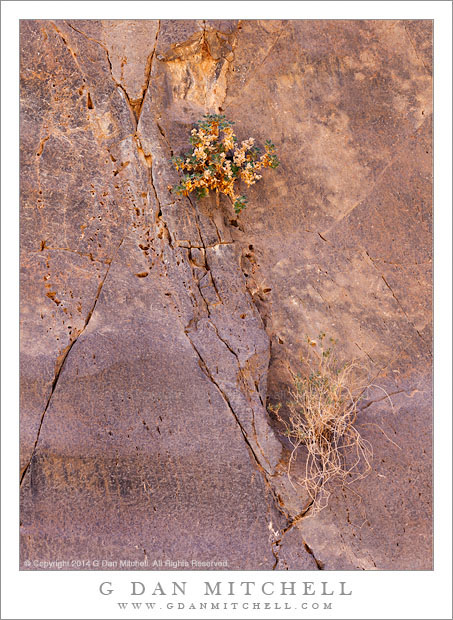
Plants, Canyon Wall. Death Valley National Park, California. April 1, 2014. © Copyright 2014 G Dan Mitchell – all rights reserved.

Plants grow from thin cracks in the rock wall of a desert canyon, Death Valley National Park

I found this little scene in a well-known Death Valley Canyon, where the walls become vertical, hundreds of feet high, and quite close together. Canyons like this are some strange combination of beautiful — with soft light, colorful rock, shade — and harsh — with the clear evidence of flooding that periodically sweeps through and rearranges everything, against a backdrop of more typical aridity, and a terrain almost entirely consisting of rock.

In these places I am always intrigued by where and how plant life manages to survive. This is nowhere more true than in such canyons in Death Valley National Park, where the usual challenges are made worse by extreme heat and dryness. Here two kinds of plants have managed to find a foothold, but in must be a very tenuous one. The grow from thin cracks in solid rock, a good distance above whatever water comes during the periodic flooding of the wash, in an environment in which the light is most often muted yet in which extreme temperatures are common for much of the year.

G Dan Mitchell is a California photographer and visual opportunist whose subjects include the Pacific coast, redwood forests, central California oak/grasslands, the Sierra Nevada, California deserts, urban landscapes, night photography, and more.
Blog | About | Flickr | Twitter | FacebookGoogle+ | 500px.com | LinkedIn | Email

Text, photographs, and other media are © Copyright G Dan Mitchell (or others when indicated) and are not in the public domain and may not be used on websites, blogs, or in other media without advance permission from G Dan Mitchell.
Curves, Desert Canyon

Curves, Desert Canyon

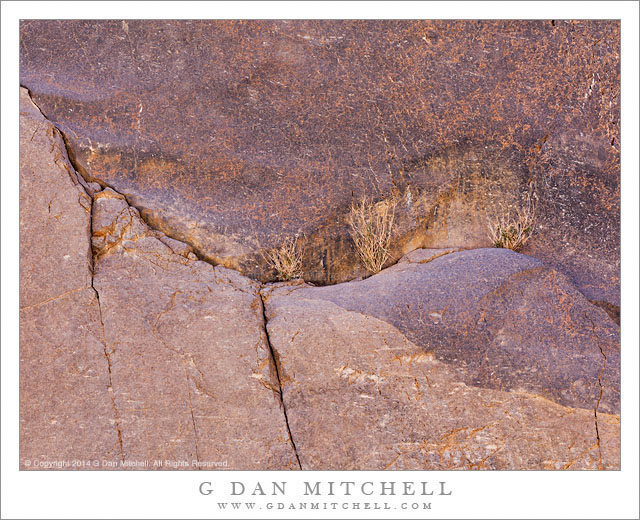
Curves, Desert Canyon. Death Valley National Park. April 1, 2014. © Copyright 2014 G Dan Mitchell – all rights reserved.

Small dry plants grow in a curving crack in a two-toned desert canyon, Death Valley National Park

Passing through this deep and narrow canyon, I always watch the rock walls for little odds and ends of shape and form and color and occasional surprising bits of vegetation. If you had asked me about this section of canyon after my first passage some years ago, I might well have mentioned how narrow and deep it is and perhaps how dusty. I might have commented on the way the bottom remains in shade even in the midday heat. But repeated visits have shown me that there is much more to see, and the fact that I still see new things on every visit tells me that there is far more yet to be discovered.

On one hand this is a pretty plain photograph of some rocks with cracks running through them. On the other hand, I think there are some stories behind the scent that are interesting to contemplate. At least I think so! If you look closely you will see some very dry plants that have grown in this curving crack. It is hard to imagine a more inhospitable place for a plant to grow—perhaps a dozen feet up the nearly solid rock wall of an arid and hot desert canyon. Yet somehow these plants found a way, as did and do many other plants throughout this desert landscape. Behind the small, delicate, and even intimate element of these plants is the backdrop of a small section of a massive rock wall that towers out of sight above the frame of the photograph. Here is a boundary between two sorts of rock—I’m not enough to a geologist to make technical observations, but I do note that the upper layer is darker and more solid while the lower is lighter and has more cracks in its surface. From the upper left a crack follows the junction of the two rock layers, but for some reason the crack leaves the junction and curves back upwards into the darker rock, and it is in this surprising bit of geological dissonance that the small plants took root.

G Dan Mitchell is a California photographer and visual opportunist whose subjects include the Pacific coast, redwood forests, central California oak/grasslands, the Sierra Nevada, California deserts, urban landscapes, night photography, and more.
Blog | About | Flickr | Twitter | FacebookGoogle+ | 500px.com | LinkedIn | Email

Text, photographs, and other media are © Copyright G Dan Mitchell (or others when indicated) and are not in the public domain and may not be used on websites, blogs, or in other media without advance permission from G Dan Mitchell.

Horsetail Fall

Horsetail Fall
Horsetail Fall

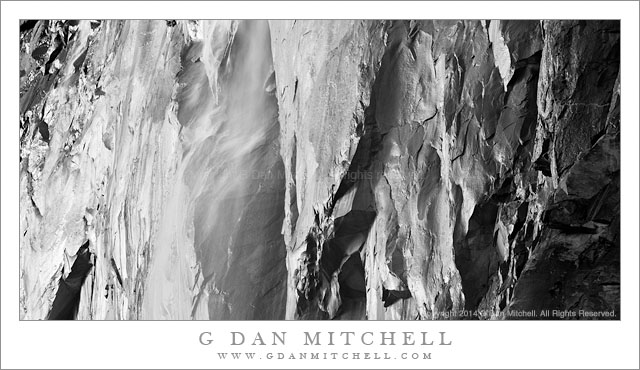
Horsetail Fall. Yosemite Valley, California. March 1, 2014. © Copyright 2014 G Dan Mitchell – all rights reserved.

Horsetail Fall in afternoon light, Yosemite Valley

As you may already know, Yosemite Valley’s Horsetail Fall draws visitors and especially photographers ever winter, roughly during the last half of February or so. During this period a miraculous conjunction of sunset light, a gap in the ridges to the west, and a wispy waterfall dropping over the edge of El Capitan may produce a momentary “natural firewall” for those positioned to the east of the waterfall. The sight is quite something… but in some ways it is almost more amazing to encounter hundreds of people who have traveled great distances to stand in cold or even snowy meadows to gaze upwards in hopes of seeing this ephemeral light.

I have photographed it in the past so I generally do not photograph it any more. In fact, I like to joke that one of the nice things about Horsetail Fall is that it clears the rest of the Valley of photographers in the evening! ;-) I must have confused at least a few people when I was there on the first day of March, at a time when people are still hoping to catch the phenomenon. We pulled into one of the two popular areas for viewing the fall, but in the late afternoon, well before the light was even hinting at what it could do later on. I looked up at the cliff high above and saw that recent rains had brought the fall to life, and that winds across the upper face of El Capitan were blowing the fall too and fro and carrying its wispy spray in all directions. The rock face was uniformly damp, and the late afternoon light was bright and silvery on the rock. I put a long lens on the camera and pointed it up toward this bright subject and made a few exposures as the wind whipped the falling water back and forth. Then I packed up and left… just as the evening throng of photographers was arriving and finding their positions to photograph what they hoped would be colorful sunset light.

G Dan Mitchell is a California photographer and visual opportunist whose subjects include the Pacific coast, redwood forests, central California oak/grasslands, the Sierra Nevada, California deserts, urban landscapes, night photography, and more.
Blog | About | Flickr | Twitter | FacebookGoogle+ | 500px.com | LinkedIn | Email

Text, photographs, and other media are © Copyright G Dan Mitchell (or others when indicated) and are not in the public domain and may not be used on websites, blogs, or in other media without advance permission from G Dan Mitchell.