Tag Archives: dead

Black Oaks and Ghost Trees

Black Oaks and Ghost Trees
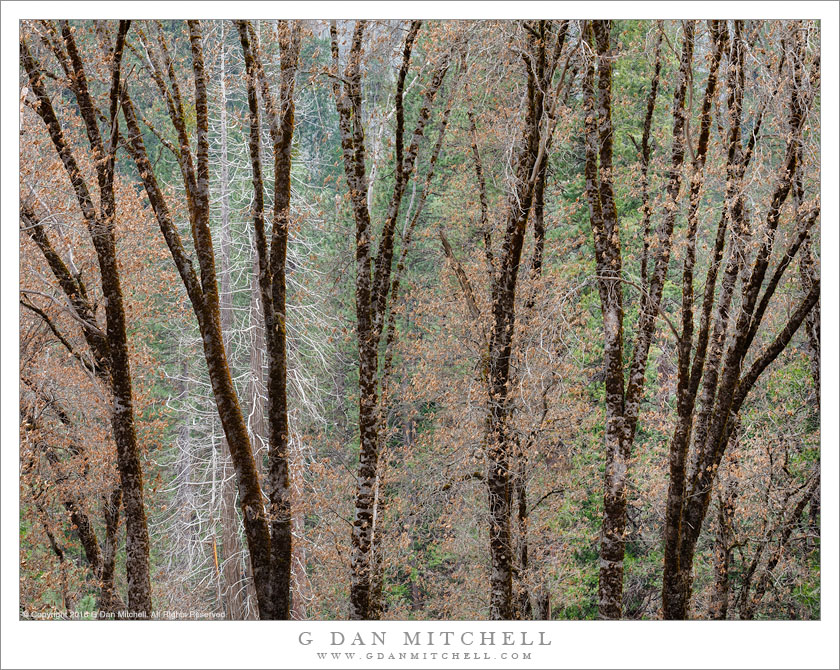
A pair of skeletal dead “ghost trees” behind a row of black oak trunks

Black Oaks and Ghost Trees. © Copyright 2018 G Dan Mitchell – all rights reserved.

A pair of skeletal dead “ghost trees” behind a row of black oak trunks

This is a subject familiar to virtually anyone who has spent much time in Yosemite Valley, and especially to photographers who have worked there. Generally, the black oaks of the Valley are one of its most characteristic features, tied to its relatively low elevation in the Sierra Nevada. Oaks are lowland trees, but they are still abundant at the elevation of the Valley. You’ll find them in warmer, open areas, often near meadows.

While they are not the most colorful trees, in the right light they can be fascinating. Early in the season the backlit leaves can be intensely colorful, and the same effect is possible in autumn light. Their curving, skeletal trunks can be quite beautiful in snow, where they contact with the near-perfect verticals of conifers. This group of trees grows unusually close together. As a result they have strongly vertical character, likely created as they compete with one another for access to sunlight. I photographed these in early spring, when brown autumn leaves remained on the branches and before the new spring growth appeared.


G Dan Mitchell is a California photographer and visual opportunist. His book, “California’s Fall Color: A Photographer’s Guide to Autumn in the Sierra” is available from Heyday Books and Amazon.
Blog | About | Flickr | Twitter | Facebook | LinkedIn | Email


All media © Copyright G Dan Mitchell and others as indicated. Any use requires advance permission from G Dan Mitchell.
Dead Trees, Clearing Storm, Sunset

Dead Trees, Clearing Storm, Sunset
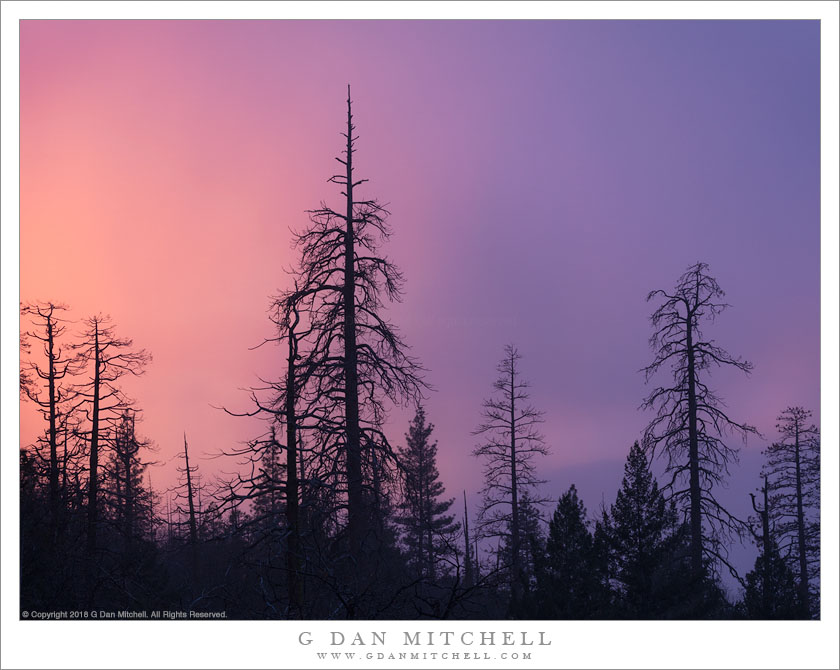
A winter storm clears to sunset light above forest of dead trees

Dead Trees, Clearing Storm, Sunset. © Copyright 2018 G Dan Mitchell – all rights reserved.

A winter storm clears to sunset light above forest of dead trees

The Sierra Nevada has been under stress for the past dozen years of so. (Technically speaking, some of these stresses have been building for longer than that, but the effects have become acute more recently.) Much of this is related to outlier weather/climate conditions and the secondary effects they have caused. The range has become much warmer. There are well-documents studies tracing the rising elevations of species of plants and animals adapting to this change. Recently the range has also experience some virtually unprecedented (at least in historical times) dry conditions, with a five-year period of tremendous drought broken by last years record precipitation, and then followed by what looks to be another very dry year this season. (We are getting some late rain, but not likely enough to make up for very dry December and February periods.) All of this affects forests it many ways, though two are obvious. The Sierra has always experienced wildfire, but recent fires have been extremely intense, going beyond the natural “pruning” effect to utterly destroy whole forests, and the areas affected by this destruction are huge. And in the wake of the drought conditions, beetle infestations have killed of tens of millions for trees.

This destruction is plain to see, and especially so to those of us who have visited the range for many decades. I sometimes imagine that new visitors driving through some denuded areas simply assume that this is “how it is” there, but others of us recall passing through deep forests in those places. As all of this has unfolded, I’ve tried to find beauty in such places — and it is there to find. These snags are on the side of a ridge, perhaps at the 5000′ level or so, on slopes facing west toward the foothills and the Central Valley beyond. It was snowing on this evening in the mountains, but I was near the western edge of the storm, and near sunset the snow diminished and the clouds thinned, and sunset light began to light the remains clouds and precipitation from behind, silhouetting these trees.


G Dan Mitchell is a California photographer and visual opportunist. His book, “California’s Fall Color: A Photographer’s Guide to Autumn in the Sierra” is available from Heyday Books and Amazon.
Blog | About | Flickr | Twitter | FacebookGoogle+ | LinkedIn | Email


All media © Copyright G Dan Mitchell and others as indicated. Any use requires advance permission from G Dan Mitchell.

Forest and Cliffs

Forest and Cliffs
Yosemite forest, with many dead and dying trees, and cliffs near Bridal Veil fall

Forest and Cliffs. Yosemite National Park, California. September 8, 2016. © Copyright 2016 G Dan Mitchell – all rights reserved.

Yosemite forest, with many dead and dying trees, and cliffs near Bridal Veil fall

In early September, about a week after returning from over a month of international travel — and missing the entire month of August in the Sierra! — I finally got to “go home” to the Yosemite high country for a few days. I camped in Tuolumne Meadows, traveled briefly to the East Side along US 395, and returned home via quick stops in Yosemite Valley, Oakhurst, and a favorite winter bird spot in the Central Valley. It was a quick trip, but just enough to get me back in contact with the mountains. (It also let me take an early look at the upcoming seasonal changes. The signs of fall in the Sierra are clear: corn lily plants dying off and falling over, bilberry reddening meadow edges, little spots of yellow on plants high up on rocky slopes, a few golden willow leaves here and there, and a general sense that everything is slowing after summer’s frantic burst of life.)

I rarely visit Yosemite Valley in the summer, preferring almost any other time to the crowds that go there during the vacation season. Although this was a post-Labor Day visit, and the biggest crowds had departed, there were still lots of people there. After a visit to the Ansel Adams Gallery, where a show celebrating the role of photography in the parks was close to concluding (it included five of my prints), I started to head out of the Valley. As I passed this spot I caught a glimpse of drought-killed trees (with the help of bark beetles), other trees standing tall, and the cliffs around Bridal Veil fall. I noticed it too late to stop… so I took one more loop around the roads of the lower valley and came back to make this photograph in the afternoon light and haze.


G Dan Mitchell is a California photographer and visual opportunist. His book, “California’s Fall Color: A Photographer’s Guide to Autumn in the Sierra” is available from Heyday Books and Amazon.
Blog | About | Flickr | Twitter | FacebookGoogle+ | LinkedIn | Email


All media © Copyright G Dan Mitchell and others as indicated. Any use requires advance permission from G Dan Mitchell.

A Dark Corner

A Dark Corner
A pathway ends at a dead end and cement walls, night photography at Mare Island

A Dark Corner. Mare Island Naval Ship Yard, Vallejo, California. November 7. 2015. © Copyright 2015 G Dan Mitchell – all rights reserved.

A pathway ends at a dead end and cement walls, night photography at Mare Island

Since I have photographed on this sprawling decommissioned ship yard for over a decade, I’m now more and more on the lookout for new subjects and locations there. Somehow I always seem to find them by poking around in (literally!) odd, dark corners. A first time visitor to the ship yard is most likely to be captivated by some of the larger and iconic subjects — the cranes, the old architecture, the tower at the old power plant, and more. But eventually one finds things missed on earlier visits.

I worked my way toward this odd little corner bit by bit. I first stopped to look at the front of a building that I not really spent much time with in the past. Near its front entrance I found a stairway leading up toward a dark terrace above. At first I spent some time making photograph of the stairs. Over the course of long exposures my eyes adapted to the darkness and I began to become aware of other shapes and textures and qualities of light nearby. The light in such places at night is often tremendously varied, coming from almost every kind of lightning imaginable. Sodium vapor lamps glow with an intense yellow color, led light can appear almost like daylight, fluorescent lamps can be greenish, and the glow of the city of Vallejo across the water has a reddish-brown quality. Here an overhead light sent beams of slightly blue-green light downwards, almost parallel to the surface of the concrete walls. That light from the town across the water found its way to these walls too, turning the close wall on the left an intense red-brown color and lending a faint glow to the back wall.


G Dan Mitchell is a California photographer and visual opportunist. His book, “California’s Fall Color: A Photographer’s Guide to Autumn in the Sierra” is available from Heyday Books and Amazon.
Blog | About | Flickr | Twitter | FacebookGoogle+ | 500px.com | LinkedIn | Email


All media © Copyright G Dan Mitchell and others as indicated. Any use requires advance permission from G Dan Mitchell.