
Tag Archives: dead

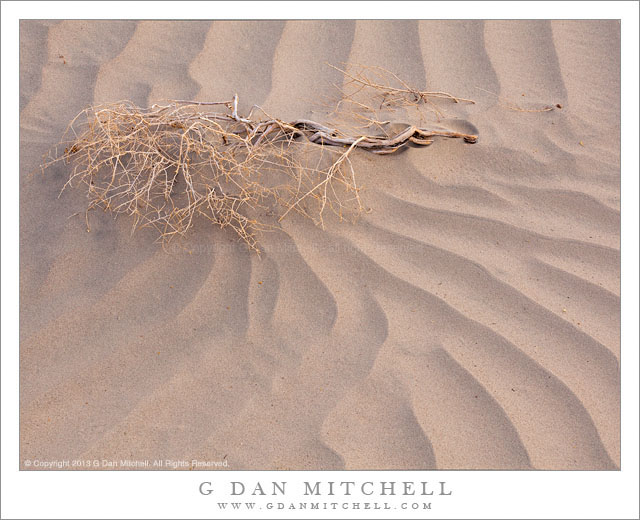
Dried Branch, Sand

Dried Branch, Sand
Dried Branch, Sand

Dried Branch, Sand. Death Valley National Park, California. April 5, 2013. © Copyright 2013 G Dan Mitchell – all rights reserved.

The dry remnants of a dead plant in recently wind-blown sand dune, Death Valley National Park

I have been visiting Death Valley regularly for perhaps fifteen years, typically photographing there for nearly a week every year for the past decade, and occasionally more. On my most recent trip, from which I returned only days ago, I was thinking about a number of thing regarding my experience with the place and how it has changed. On my first visits there was, of course, the excitement and wonder of discovering a place that was essentially completely new to me. I recall that on my first trip there I got close to the Race Track without going all the way to this location. We camped not far from that playa and I imagined this place that I had heard so much about and even envisioned it in a particular location – and when I did visit a year or two later I discovered that it was quite a bit different from what I imagined, though magical in different and perhaps more powerful ways. After a few years of visiting and photographing the best known iconic sites I began to find them less interesting, and though I continued to photograph them when the opportunity arose, I focused more on expanding the areas I knew about and on looking more closely at areas I thought I knew.

As I did this, I have to confess that portions of the Death Valley experience baffled me or even put me off a bit. While I found some of the terrain to be tremendously beautiful, there were other aspects that I just couldn’t quite relate to. As a person who has spent a lot of time in forested places with flowing water – mainly the Sierra Nevada – I found some areas of this desert to be, quite honestly, boring. I drove through or past them on my way to what I thought of as the more interesting places where I could find colors outside of the range from tan to gray and where some special object or formation might create an obvious center of interest. However, from time to time I would be surprised to find in some plain, nondescript, and even boring place an experience of stillness, immense space, and deep silence that I had rarely encountered elsewhere. More and more, I began to see this as a primary attraction of this landscape – more so in many cases that the specific features of this pinnacle or that formation or the other valley.

On this recent trip, conditions conspired to make me look more closely at some of these things that I had originally overlooked. The conditions were such that if I had experienced them a few years ago I might have simply left. (In fact, that thought did cross my mind once or twice on this trip.) The spectacular light really never came, skies were cloudy, the air was hazy, it was very hot, the winds blew strongly, and there was a dust storm. During the first couple of day, with the exception of shooting the dust storm, many of the subjects I had in mind simply didn’t work out the way I planned. A bit surprisingly, without the possibility of shooting yet another beautiful golden hour sunset image of a spectacular bit of geography (though I did do some of that still) I slowed down and looked more closely at some of those “boring” places that I had passed through more quickly in the past.

This photograph was made in one of those locations. It was not far from one of those iconic locations, but it wasn’t the iconic spot at all. An hour or so before sunset I simply wandered away from the road, past vegetation and into the sand, and started looking around. In the low spots between dunes, the world beyond was out of sight and the wind was blocked, and as the light faded I encountered again that deep and powerful and timeless silence that is so hard to find almost anywhere else.

G Dan Mitchell is a California photographer and visual opportunist whose subjects include the Pacific coast, redwood forests, central California oak/grasslands, the Sierra Nevada, California deserts, urban landscapes, night photography, and more.
Blog | About | Flickr | Twitter | FacebookGoogle+ | 500px.com | LinkedIn | Email

Text, photographs, and other media are © Copyright G Dan Mitchell (or others when indicated) and are not in the public domain and may not be used on websites, blogs, or in other media without advance permission from G Dan Mitchell.

Colorado River, Dead Horse Point

Colorado River, Dead Horse Point

Colorado River, Dead Horse Point. Deadhorse Point State Park, Utah. October 10, 2012. © Copyright 2013 G Dan Mitchell – all rights reserved.

The canyon of the Colorado River, from Dead Horse Point State Park, Utah

The light was a bit tricky when we drove out to Dead Horse Point to look at the famous view of the Colorado River as it loops below huge cliffs at the edge of Canyonlands National Park in Utah. It was nearing the middle of the day, so the soft morning and evening light was nowhere to be found. It was also hazy, with the slightly opaque air taking on distinctly blue colors. For all of these reasons, and also perhaps as a nod to old school landscape photography, I went with a black and white rendition of this photograph.

This is a truly remarkable bit of terrain. First, in the bottom of the canyon the Colorado River negotiates and abrupt horseshoe bend here beneath the tall cliffs leading up to the “Island in the Sky” portion of Canyonlands National Park. Above the river are a series of huge terraces form as the river eroded its way though the deep and old layers of sedimentary rock that characterize this area. Shooting with a slightly long focal length, I was able to eliminate most extraneous subjects and crop tightly around this area of massive cliffs and terraces.

G Dan Mitchell is a California photographer and visual opportunist whose subjects include the Pacific coast, redwood forests, central California oak/grasslands, the Sierra Nevada, California deserts, urban landscapes, night photography, and more.
Blog | About | Flickr | Twitter | FacebookGoogle+ | 500px.com | LinkedIn | Email

Text, photographs, and other media are © Copyright G Dan Mitchell (or others when indicated) and are not in the public domain and may not be used on websites, blogs, or in other media without advance permission from G Dan Mitchell.
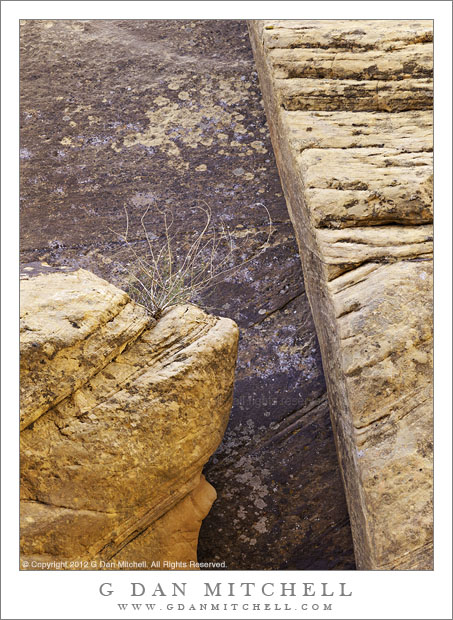
Sandstone Patterns, Dried Plant

Sandstone Patterns, Dried Plant - A dried plant and sandstone patterns in a southwest desert canyon, Utah
A dried plant and sandstone patterns in a southwest desert canyon, Utah

Sandstone Patterns, Dried Plant. Grand Staircase-Escalante National Monument, Utah. October 23, 2012. © Copyright 2012 G Dan Mitchell – all rights reserved.

A dried plant and sandstone patterns in a southwest desert canyon, Utah

I was in Utah twice this fall, most recently with my friends Charlie and Karl to photograph a range of desert canyons and similar terrain. I’ve written before that I’m very new to photographing Utah, having seriously shot there for the first time only this past spring. But I’m trying to make up for lost time! Overall, I have spent something like a total of more than five weeks there this year! Yes, I like shooting in Utah. :-)

On the previous visits, I went to quite a few of the well-known locations – largely the national parks – and began the process of getting to know and understand that place a bit. On the most recent visit I was fortunate to be traveling with people who have shot there for decades, and I benefited from their long experience. Getting a bit more off the beaten track, we barely touched national parks – passing through Zion and visiting some remote areas of Capitol Reef. Instead we poked into a range of little canyons and valleys and so forth that don’t have the prominence of the parks. The specific locations are perhaps not that important since the state seems to be filled with similar places. This was my first real experience with the intimate desert canyons and river/creek courses that carve deeply into the landscape, where midday light bounces and reflects into the deep landscape in ways that are utterly unlike the California locations where I most often photograph.

This photograph was made in such a place, the first narrow canyon that we visited. Parking in an inauspicious spot along a gravel desert road, we dropped into a wash and wandered upstream, soon entering a narrow canyon as the sandstone walls rose beside us. Before long the canyon was narrow enough that we had to continually cross back and forth across the creek or simply wade straight up its course. As the canyon narrowed, direct sunlight no longer made it down to the creek – instead the light reflected from the higher cliff faces and bounced down into the canyon, toning the light red from the sandstone surface. In this photograph the cliff and two large pieces of sandstone contain angled strata and reflect the light in various ways as a small and seemingly dead plant sits in a crack in the rock.

G Dan Mitchell is a California photographer whose subjects include the Pacific coast, redwood forests, central California oak/grasslands, the Sierra Nevada, California deserts, urban landscapes, night photography, and more.
Blog | About | Flickr | Twitter | FacebookGoogle+ | 500px.com | LinkedIn | Email

Text, photographs, and other media are © Copyright G Dan Mitchell (or others when indicated) and are not in the public domain and may not be used on websites, blogs, or in other media without advance permission from G Dan Mitchell.

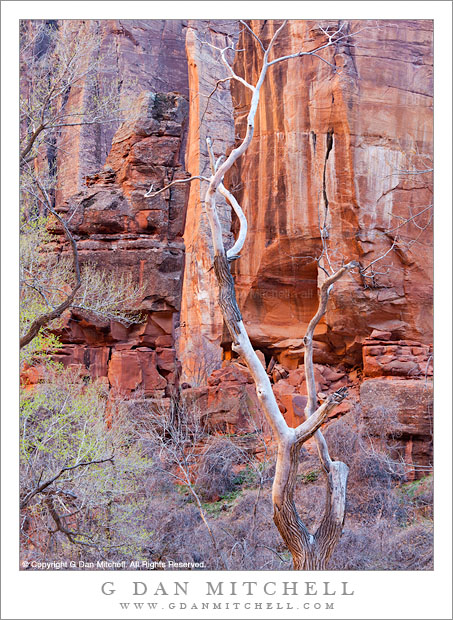
Skeletal Tree and Sandstone Cliff

Skeletal Tree and Sandstone Cliff - The skeletal remains of a dead tree stand in front of a sandstone cliff, Zion National Park
The skeletal remains of a dead tree stand in front of a sandstone cliff, Zion National Park

Skeletal Tree and Sandstone Cliff. Zion National Park, Utah. April 3, 2012. © Copyright 2012 G Dan Mitchell – all rights reserved.

The skeletal remains of a dead tree stand in front of a sandstone cliff, Zion National Park.

I’m a bit embarrassed to admit that I don’t recall exactly where I made this photograph. I’m pretty certain that I made it near the start of a walk up the Virgin River in Zion National Park in the afternoon, near the feature known as the Temple of Sinawava. Actually, I’m certain of all of that with the exception of knowing precisely where in the Temple of Sinawava area I made it. I do recall paying special attention to these red rock walls and looking for various subjects that I might combine with them to make photographs.

Speaking of the sandstone walls… on this side of the canyon and at this mid-afternoon time of day, little to no direct light makes it down to the floor of the canyon. So the lower walls are almost entirely in shade. However, the sun most certainly is still striking the upper canyon walls, and the reflected light from the sun-lit areas works like a giant light panel, reflecting softly diffused light down into the canyons and gently warming the colors that would otherwise be quite cool. (In other words, blue.) The diffused light causes even the shaded areas, such as recesses in the rock, to retain some details. And because the light is reflected from and into red sandstone canyon walls, the color of the light only gets warmer, and down in the canyon the color can be quite beautiful.

G Dan Mitchell is a California photographer whose subjects include the Pacific coast, redwood forests, central California oak/grasslands, the Sierra Nevada, California deserts, urban landscapes, night photography, and more.
Blog | About | Flickr | Twitter | FacebookGoogle+ | 500px.com | LinkedIn | Email

Text, photographs, and other media are © Copyright G Dan Mitchell (or others when indicated) and are not in the public domain and may not be used on websites, blogs, or in other media without advance permission from G Dan Mitchell.