
Tag Archives: desert

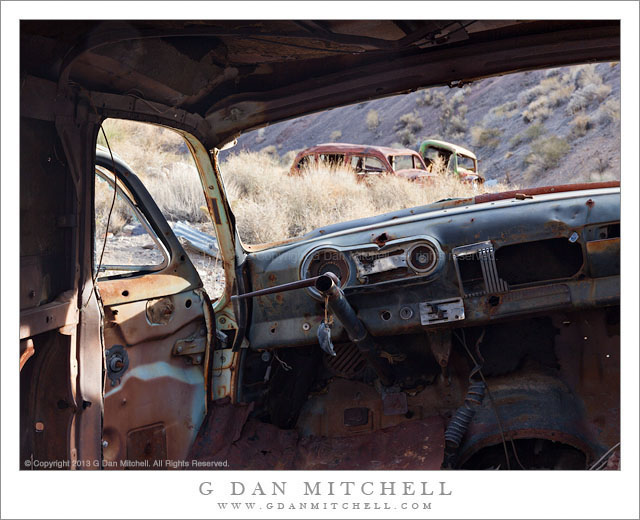
Desert Automobile Graveyard

Desert Automobile Graveyard

Desert Automobile Graveyard. Death Valley National Park, California. March 4, 2013. © Copyright 2013 G Dan Mitchell – all rights reserved.

A group of old automobiles abandoned and left to decay in a gully at an old desert mining site

I have passed this old mining site quite a few times, looked up at it, and kept going. On this morning I had a bit of extra time so I decided to pause and poke around a bit. Certain obvious signs of the presence of an old mine are clear from nearby, but a bit more exploration revealed a more extensive than expected site – as is often the case. Although an old gravel road headed into the area, I decided to first walk up the road, partly to avoid nasty surprises while driving and partly so that I would see a bit more – which is typically what happens when I’m on foot rather than inside my vehicle.

The gravel road twisted up a small gully and soon reached an area that revealed views of quite a bit more mining evidence than I had suspected. I’m certain that if I had continued to explore that I would have found even more, but I’ll save that for another visit. I often have this feeling that these sites should be much older than they really are, and I’m still somewhat surprised to find that some of them were electrified. The surprise at this location was the number of not-really-that-old vehicles that had been abandoned. They are decades old, but I’m guessing that they might date to roughly the WWII era or even a bit later which, in the grand historic scheme, isn’t all that long ago. Several of these vehicles had been abandoned, somewhat oddly, in the bottom of a wash that must flood at least occasionally, considering the amount of gravel that swamped their undersides. The back of this one was open, so I positioned my tripod just outside the car and shot through it toward the other abandoned vehicles. (If you find and explore such places, please be extremely careful to leave things as they are. The effects of our individual disruptions are cumulative and accelerate the destruction and eventual disappearance of these sites.)

G Dan Mitchell is a California photographer and visual opportunist whose subjects include the Pacific coast, redwood forests, central California oak/grasslands, the Sierra Nevada, California deserts, urban landscapes, night photography, and more.
Blog | About | Flickr | Twitter | FacebookGoogle+ | 500px.com | LinkedIn | Email

Text, photographs, and other media are © Copyright G Dan Mitchell (or others when indicated) and are not in the public domain and may not be used on websites, blogs, or in other media without advance permission from G Dan Mitchell.
Abandoned Buildings, Leadfield

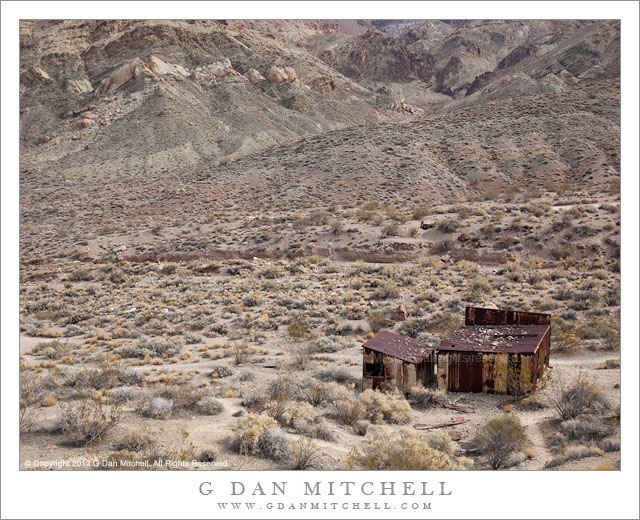
Abandoned Buildings, Leadfield

Abandoned Buildings, Leadfield. Death Valley National Park, California. April 6, 2013. © Copyright 2013 G Dan Mitchell – all rights reserved.

Abandoned buildings at the site of the Leadfield mines, Death Valley National Park

In a way there is really nothing that special about Leadfield. It is one of many, many abandoned outposts and mining sites found all over California and, for that matter, all over the West. These sites remain, though precariously in some cases, as a reminder of a number of things: history that is not all that distant, the people who must have been willing to come to such places and attempt to scratch out a living by mining, the human capacities for misleading others and for falling victim to those who would mislead, and the temporal nature of things that might seem permanent at the time.

I’m no historian, but I can share a few facts about this particular spot. In the 1920s the town – with some semi-permanent buildings and reportedly many tents – came into existence and died again in the span of less than a single year. Although the reports of ore in the area and situation that might allow it to be successfully mined were wild exaggerations or downright lies, a road was built into this rugged area, work was started on a mill, and today there is still plenty of evidence of mines all around the area. I made this photograph from the tailings pile at the entrance to what I think may be the main mine shaft, looking out over the site in what I imagine might be the direction that a person working that mine might have looked. I wonder it these people took as much notice as I did of the tiny and inconsequential appearance of the human landscape against the vast and rugged natural landscape beyond?

G Dan Mitchell is a California photographer and visual opportunist whose subjects include the Pacific coast, redwood forests, central California oak/grasslands, the Sierra Nevada, California deserts, urban landscapes, night photography, and more.
Blog | About | Flickr | Twitter | FacebookGoogle+ | 500px.com | LinkedIn | Email

Text, photographs, and other media are © Copyright G Dan Mitchell (or others when indicated) and are not in the public domain and may not be used on websites, blogs, or in other media without advance permission from G Dan Mitchell.
White Rim, Colorado River Valley

White Rim, Colorado River Valley

White Rim, Colorado River Valley. Canyonlands National Park, Utah. October 10, 2012. © Copyright 2013 G Dan Mitchell – all rights reserved.

The Colorado River winds through rugged country beyond the White Rim, Canyonlands National Park

On our second visit to Canyonlands National Park (the first had been back in April of the same year, when we briefly visited the “Island in the Sky” highlands of the park) we were somewhat stymied by less than astonishing light. Overall the skies were sort of partly cloudy, but that “partly” portion seemed to line up almost perfectly with where we were, and from afternoon on a large mass of clouds sat above us and to the west. For this photograph, that might have actually been a bit of a blessing, in that trying to photograph the tremendously intricate and detailed landscape visible from the “Grand View” overlook in full sun at this time of day would have been challenging, to say the least. This landscape, lit that way, would have contained some extremely bright features along with very deep shadows in the canyons, and the result probably would not have been all that great. The clouds, however, somewhat mute the contrasty light, making the bright areas a bit less bright and allowing diffused light down into areas that would otherwise be dark. At least there was a bit of light on the buttes in the far distance at the upper edge of the frame.

This scene is one of those “iconic” views that, well, everyone photographs. Generally, I’m not that much about photographing icons. In fact, often when I go to places like this I try to not know what the iconic shots are or where to find them, preferring to instead just sort of guess, follow hunches, poke around, and see what I discover. This may not be the most effective way to find the “cool stuff” in a new location, but it does let me start to develop my own relationship with a landscape from the very beginning. So when we went into Canyonlands the first time I basically had almost no idea what I was “supposed” to see and photograph. (For example, I had no idea that iconic “Mesa Arch” is in this park – drove past the road to it and said, “Ah, that’s where Mesa Arch is!” And, no, I did not photograph it.) However, as we wandered about and looked at stuff, we somehow managed to end up at several of “those places” – especially the Green River overlook (which I now recognize as one of the iconic views of this park) and Grand View. In addition, I’ve often advised others to not eschew icons in certain situations. One, of course, is when you find yourself in front of such an icon and have never photographed it before. But another is when one visits a location for the first time and does not yet have a deeper knowledge of the place. For example, I’ll occasionally get asked by first time visitors to Yosemite or Death Valley (places where I shoot a lot) about where the “secret spots” are that not everyone shoots. I tell them that getting to know a place to such an extent that you can find, “see,” understand and photograph the non-iconic subjects is not a reasonable goal for a first visit. Often that takes many visits, perhaps in different seasons, and the time to let the place “get under your skin” to the point that you have a real feel for it.* But everyone has to start somewhere, and photographing icons is a fine place to start when you are new to a place. They are, after all, usually quite spectacular spots – as I say, “They are icons for a reason.”

*For my part, during my first year photographing in Utah I spent over 30 days there during three long visits. It wasn’t until well into the third visit that I really began to feel that I was moving past the “Oh, wow, Utah!” state and starting to really understand the place.

G Dan Mitchell is a California photographer and visual opportunist whose subjects include the Pacific coast, redwood forests, central California oak/grasslands, the Sierra Nevada, California deserts, urban landscapes, night photography, and more.
Blog | About | Flickr | Twitter | FacebookGoogle+ | 500px.com | LinkedIn | Email

Text, photographs, and other media are © Copyright G Dan Mitchell (or others when indicated) and are not in the public domain and may not be used on websites, blogs, or in other media without advance permission from G Dan Mitchell.

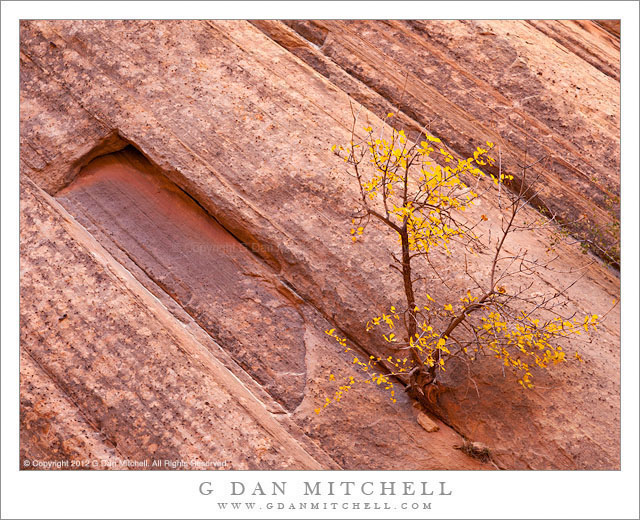
Autumn Tree, Sandstone Strata

Autumn Tree, Sandstone Strata - An autumn tree grows from a precarious crack in sandstone strata, Capitol Gorge
An autumn tree grows from a precarious crack in sandstone strata, Capitol Gorge

Autumn Tree, Sandstone Strata. Capitol Reef National Park, Utah. October 7, 2012. © Copyright 2012 G Dan Mitchell – all rights reserved.

An autumn tree grows from a precarious crack in sandstone strata, Capitol Gorge

I’m often fascinated by places where the huge and ancient strata descend under (or ascend from, depending upon your point of view) the flat earth. In the bottom of this canyon, there is a section where, as we walked further into it, the strata angled down quite steeply. Given what I understand of the geology of Capitol Reef, it should be no surprise to find such a feature here.

Another thing that continues to amaze me is the seemingly impossible places in which life springs up. Here this small tree (perhaps a single-leaf ash?) seems to be doing OK in a very tiny crack in solid rock and a few feet up the canyon wall from the wash at the bottom. The pink color comes both from the rock itself and the light reflected down into the canyon, bouncing off of other rock faces high above.

G Dan Mitchell is a California photographer and visual opportunist whose subjects include the Pacific coast, redwood forests, central California oak/grasslands, the Sierra Nevada, California deserts, urban landscapes, night photography, and more.
Blog | About | Flickr | Twitter | FacebookGoogle+ | 500px.com | LinkedIn | Email

Text, photographs, and other media are © Copyright G Dan Mitchell (or others when indicated) and are not in the public domain and may not be used on websites, blogs, or in other media without advance permission from G Dan Mitchell.