
Tag Archives: eastern

Aspen Trees, Conway Summit, Fall

Aspen Trees, Conway Summit, Fall

Aspen Trees, Conway Summit, Fall. Eastern Sierra Nevada, California. October 16, 2011. © Copyright 2011 G Dan Mitchell – all rights reserved.

Aspen trees in peak color at Conway Summit along highway 395 in the eastern Sierra Nevada.

I isolated this small bit of near-psychedelic color from the extensive aspen groves at Conway Summit, along highway 395 just north of Lee Vining and Mono Lake along the eastern edge of the Sierra Nevada range. When I visited the grove this past weekend the colors seemed to be essentially at their peak with alternating rows of red, orange, gold, and even a few lime green trees marching up the slopes toward the Dunderberg area high above.

If you hit it at the right moment, the aspen color at this location is second to none, and a bonus for many is that it is so accessible, being right alongside the highway. Brilliant colors can occur on both sides of the summit, but those on the north side seem to me to be more varied, and it is a bit easier and safer to find a place to stop alongside the road.

The lighting during my visit was “interesting” – which often means good but with some challenges. From my point of view, the best light at Conway Summit, at least when it comes to photographing aspen color, occurs fairly late in the afternoon when the sun gets low in the sky and can backlight the groves of trees. However, because of the backdrop of Sierra Nevada peaks the interval of good light can be short – and it is distinctly before actual sunset. The “interesting” element during this visit was that clouds were building over the crest. This produces some spectacular sky conditions at times, but it also cast shadows across the trees that dulled the colors and lowered contrast. Now a bit of this can be a good thing, and too much backlight can be a bit difficult to handle. By scoping out perhaps three of four possible compositions from my position, I could wait until the “good light” hit one or another of them, swing the camera around in that direction, and work quickly while the light lasted. For this detail shot of a colorful section of the aspen groves just below my position I had what can perhaps be the very best light for such subjects – a bit of directional light from behind filtered through clouds.

G Dan Mitchell Photography
About | Flickr | Twitter | FacebookGoogle+ | 500px.com | LinkedIn | Email

Text, photographs, and other media are © Copyright G Dan Mitchell (or others when indicated) and are not in the public domain and may not be used on websites, blogs, or in other media without advance permission from G Dan Mitchell.

(Basic EXIF data may be available by “mousing over” large images in posts when this page is viewed on the web. Leave a comment if you want to know more.)
Aspen Update 10/17/11

I’m back from my second trip to the eastern Sierra in as many weeks, and I’d like to share a bit of what I observed.

A week ago I visited and/or photographed several areas including Bishop Creek, Rock Creek, McGee Creek, a few areas around Mammoth Lakes, and Lee Vining Canyon. I also got reports from others who were there at the same time, and their reports tended to be in line with what I saw that week, namely that the trees that had been turning were interrupted by the early winter-like storm, dropping leaves or turning brown/black, and that lower elevation trees were mostly still green. At that time my hunch was that not much more was going to happen up high, but that the many green trees would provide color over the following couple of weeks.

This week I visited the portion of Bishop Creek in the South Lake drainage, areas on and near Glacier Lodge Road, the north section of the June Lakes loop near Parker Lake, Lee Vining Canyon, and Conway Summit. This visit confirmed some of my expectations from the previous week but also offered some surprises.

  • The thought that the loss of higher elevation leaves might mean that they were done for the season turned out to be not quite correct. This week I saw a surprising amount of color up high. In many places along the eastern escarpment I saw groves of brightly color trees marching right up many ridges.
  • Although I did not return to North Lake, I even heard reports that it had improved. (Though the person sharing the report pointed out that this would likely not be an exceptional year there.)
  • The color of the middle and lower level trees seems to be progressing very quickly. I was expecting middle elevation trees to turn by this week, but I was surprised by how low the color extended. If forced to make a prediction, I might guess that the season is going to run its course a bit faster than usual this year. (Stable weather this week – especially if the winds are light – might sustain things a bit longer.)

I feel like every aspen season has its own “personality” – whether it starts gradually or suddenly, early or a bit later, whether it is interrupted by weather events, and how long it lasts. The personality of this year’s eastern Sierra aspen season seems to include the storm that interrupted the early color up high, followed by a very rapid development of color about a week later.

I need to offer a few disclaimers. First, I only visited a small percentage of the places where aspen color may be found in a typical season. Second, while I can make some guesses about how things will evolve going forward, no one really knows. Third, if you are going to head out there to photograph the aspens this season, I urge you to check others sources of information on the conditions before you go.

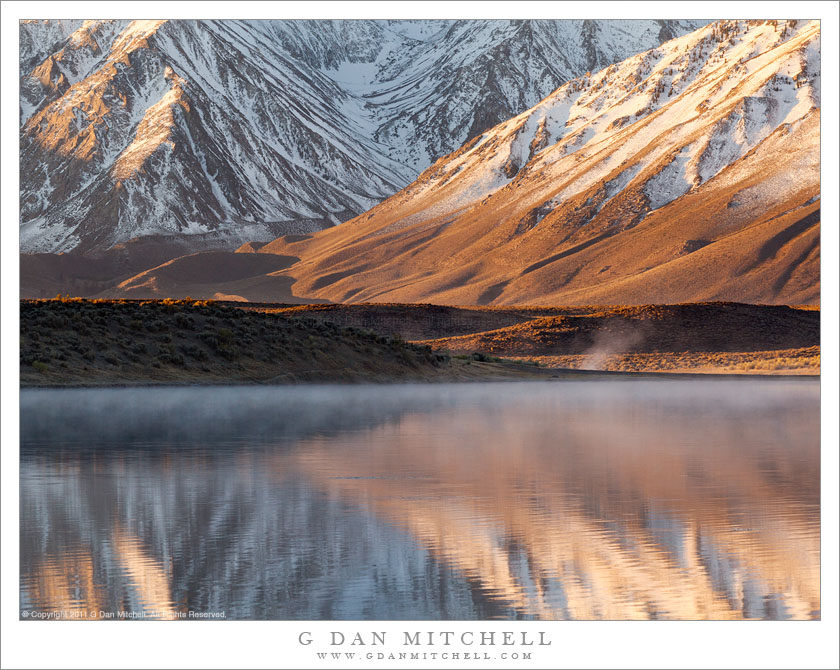
Desert Pond and Sierra Nevada Dawn

Desert Pond and Sierra Nevada Dawn
Morning mist rises above a high desert pond reflecting the lower slopes of the eastern Sierra Nevada near McGee Creek.

Desert Pond and Sierra Nevada Dawn. Owens Valley, California. October 9, 2011. © Copyright 2011 G Dan Mitchell – all rights reserved.

Morning mist rises above a high desert pond reflecting the lower slopes of the eastern Sierra Nevada near McGee Creek.

On the second morning of my first fall color to the eastern Sierra this autumn, having been less than astonished by this year’s color so far, I decided to head instead out into Owens Valley to shoot back toward the mountains and to shoot some subject in Owens Valley itself. I started at this little lake a few miles east of highway 395, where great reflections of the range lit by morning sun area often seen. This photograph looks across the small lake towards McGee Creek Canyon. (McGee Creek isn’t a bad place to look for aspen color…)

I arrived here before sunrise and was set up and ready to go before the first light hit the peaks in the area of Mt. McGee and Mt. Morgan. As I stood (freezing!) by the shore of this small lake, waiting for the light that I knew was coming, a truck came up the lonely road to this place, passed the pond, made a u-turn, and slowed down by my vehicle, which was parked along the main road. My first thoughts were “this is either another photographer or someone who is checking out my car… for purposes I don’t want to think about.” However the vehicle kept going. A few moments later I discovered that this was a photographer, and he and his dog took up a position along the far shoreline. A few days later I was looking through an online landscape photography forum and I came across a photograph that looked like it had been shot from about that photographer’s position, and in which the conditions looked darn near identical to what I saw that morning. I contacted the photographer and found out that, indeed, he was the person I had seen that morning. (If you wonder why we didn’t touch base on the scene… a) we were both busy shooting the entire time, b) we were on opposites sides of the lake, and c) even though I yelled a greeting he didn’t hear.)

G Dan Mitchell is a California photographer and visual opportunist. His book, “California’s Fall Color: A Photographer’s Guide to Autumn in the Sierra” is available from Heyday Books and Amazon.

Blog | About | Flickr | FacebookEmail

Links to Articles, Sales and Licensing, my Sierra Nevada Fall Color book, Contact Information.


All media © Copyright G Dan Mitchell and others as indicated. Any use requires advance permission from G Dan Mitchell.

Sierra Nevada Aspen Hunting and the Weather

Something to think about for photographers headed to the eastern Sierra to photograph aspen color next week: The seven-day Yosemite to Kings Canyon weather forecast is calling for snow (!) on Wednesday and Thursday, and things don’t look like they’ll totally clear out on Friday. This has some ramifications:

  • Those of us who get to the eastern Sierra by way of one of the trans-Sierra passes may encounter difficulties if the forecast pans out. I would not be at all surprised to see a temporary closure of Tioga Pass Road (highway 120) though Yosemite, and other passes to the north could be affected. This makes for a very long drive for those of us in the SF Bay area!
  • A storm can affect the aspen color display. A cold snap can, or so many of us believe, encourage the colors to change. But wind can also bring down many of the leaves in a hurry. (I once arrived before dawn at North Lake to see – just barely – incredible color conditions in the grove the runs up the hillside on the far side of the lake. Moments later a snow squall blew in, and as the wind began to blow I retreated to my car for a half hour. When it passed, half of the leaves had blown down!
  • On the plus side, an early winter storm can bring some opportunities and advantages as well. Overcast and rainy/snowy weather can intensify the colors and create some very compelling and moody scenes. New snow adds something special to the scene, whether only on the higher peaks above or down among the trees.

It could get interesting, so check those weather forecasts and the road conditions on the mountain highways. Fall in the Sierra is a time of change in many ways. Pacific winter-type weather systems start to move through, and they can range from very mild to virtually full-blown winter storms. While most of them pass quickly, some can last for a few days and close passes. It would be very unusual for such an early October storm to actually mark the beginning of the winter road closures, but mid-October storms have done so in the past.

More: