
Tag Archives: flow

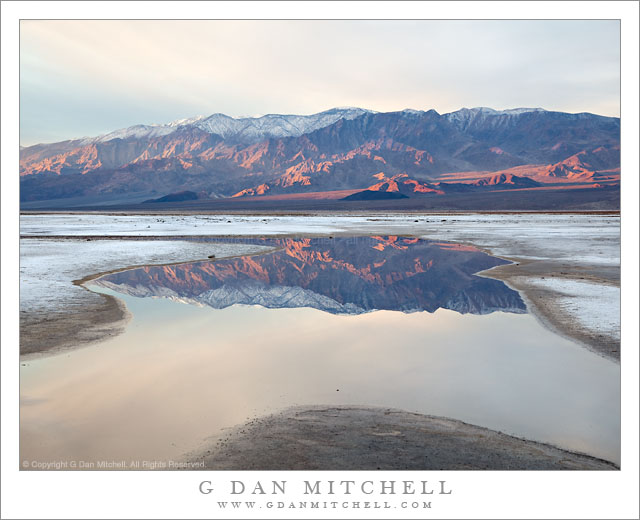
Desert Pool, Panamint Range, Morning

Desert Pool, Panamint Range, Morning

Desert Pool, Panamint Range, Morning. Death Valley National Park, California. February 21, 2011. © Copyright G Dan Mitchell – all rights reserved.

A salt spring pool on the salt flats in Death Valley reflects winter dawn light on the east face of the Panamint Range.

Sometimes I hear people describe how they think or imagine that landscape photography is done, and I wonder where they get their ideas. I will acknowledge that there are many ways to shoot landscape, ranging from working very slowly and carefully to produce a single image, to shooting like crazy and seeing what you end up with. But often people dismiss approaches closer to the latter and assume that the former is the “right way” to shoot landscape.

In my experience it isn’t quite that simple. Sometimes the experience is like certain others in which long stretches of time during which one seemingly accomplishes nothing or perhaps just looks and thinks are suddenly followed by quick and intense spurts of work that come almost as a surprise and may be over as quickly as they begin. This little morning shoot in Death Valley along the edge of a the salt/mud flats where the water from a small salt spring spreads across the flats and forms shallow pools was one of these. Very early in the morning, well before dawn, it was difficult to know what the best shooting option might be. There were clouds in the sky that promised to block the dawn light and everything seemed gray and flat. I wandered a bit, not sure where or what to shoot, and finally, more or less by chance, ended up at this spot that I had visited earlier on this trip. It occurred to me that even if the light wasn’t great I could possibly find a photograph that included this water. So I stopped and began to unpack in no particular hurry.

As I walked across the wash toward the area of the spring, much to my surprise it began to appear that there might be some interesting dawn light after all. I quickened my pace and headed toward the area of the shallow pools, and when I arrived there a moment later I could see some color on the top of the Panamint range. I quickly found a decent foreground pool and as the surprising light worked its way down the front of the range I began photographing. I first made several exposures at much shorter focal lengths, including a larger portion of the sky and the foreground. Then I quickly moved the tripod to place this pool in the center of the frame and hold the reflection of the range. I had little time to contemplate as the light was changing very quickly. I had just enough time to find my composition and make a few exposures, and within moments the light was gone.

G Dan Mitchell Photography | Flickr | Twitter | Facebook | Email
Text, photographs, and other media are © Copyright G Dan Mitchell (or others when indicated) and are not in the public domain and may not be used on websites, blogs, or in other media without advance permission from G Dan Mitchell.
Morning Sky Reflected in Desert Stream

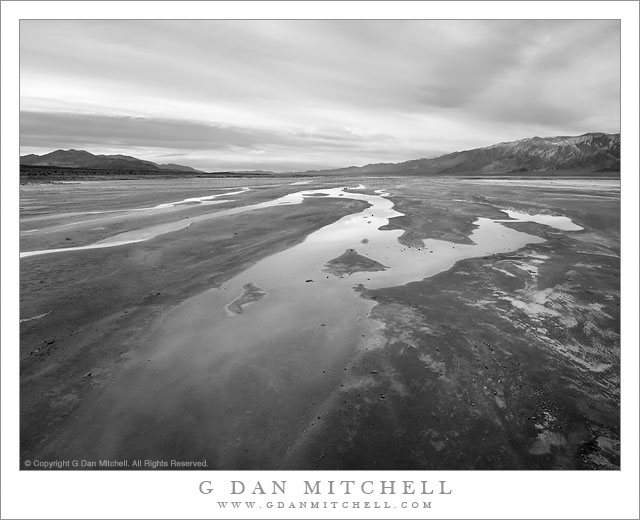
Morning Sky Reflected in Desert Stream

Morning Sky Reflected in Desert Stream. Death Valley National Park, California. February 21, 2011. © Copyright G Dan Mitchell – all rights reserved.

Black and white photograph of water from a salt spring reflecting cloudy morning sky above Death Valley.

Moments before I made this stark and, I think, desolate photograph of the shallow stream from a salt spring flowing slowly over the flats of Death Valley and reflecting the light from morning clouds, the Panamint Range mountains at the left side of the frame had been briefly lit by colorful sunrise light. But this light lasted only a couple minutes and shortly everything went largely gray.

The patterns of the very shallow and slowly flowing water as they spread out across the flats and reflected the light from the cloud filled sky intrigued me as soon as I arrived at this location. But before I made this photograph I had taken a different approach, positioning the camera down very low and very close to the water so that its reflective surface filled a larger portion of the frame and then lining things up to catch the first light on the Panamints and its reflection. But when that passed so quickly, it seemed like the flat and gray effect could also make an interesting photograph. When I made the exposure I wasn’t quite certain, but I think I was leaning towards a black and white rendition of the scene. Frankly, there wasn’t a lot of color to work with! The sky was mostly clouded over, though there was a hint of faded blue in a few spots. Any color in the Panamints was muted by the distance and haze. The mud is essentially gray and white (where salt has formed) and the water held less color than the sky!

G Dan Mitchell Photography | Flickr | Twitter | Facebook | Email
Text, photographs, and other media are © Copyright G Dan Mitchell (or others when indicated) and are not in the public domain and may not be used on websites, blogs, or in other media without advance permission from G Dan Mitchell.
Cascade, Reflected Sunlight

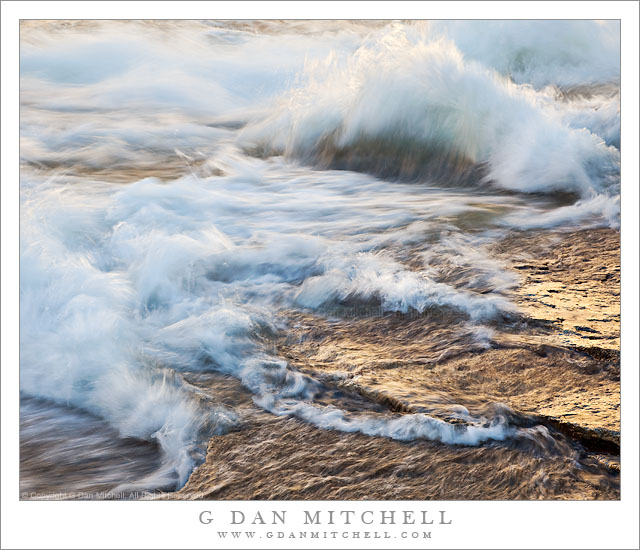
Cascade, Reflected Sunlight

Cascade, Reflected Sunlight. Yosemite National Park, California. June 28, 2010. © Copyright G Dan Mitchell – all rights reserved.

Sunlight reflects on granite ledges next to cascades on Tenaya Creek.

In this iteration of the “blurry-fast-moving-water-in-Sierra-creek” photograph, I was looking to cram a variety of elements into the frame – as you can see, the entire photograph is not filled with water. There is a transition from white water with flashes of sunlit light at the tops of the waves, through the water with smaller areas of foam, to water reflecting the golden late afternoon light from a cliff face on the other side of the creek, to some bits of streamside granite slabs along the lower right edge of the frame. To me, these areas of shallow water and wet rock reflecting more distant light almost have a molten quality.

One of the trickiest things about this photograph for me was dealing with the strong contrast between very blue tones in the shaded parts of the water and the very warm tones of the reflections. As every photographer knows, the light in shade can be very blue, especially when the subject is supposed to be white and is lit almost entirely by the blue sky, as is the case in parts of the turbulent water. Adjustments are necessary in order to make it look realistic and conform with the colors that our eyes tell are are there. (Our vision system is remarkable… but it is not objectively accurate!) But adjustments to the blue water, if applied to the warm tones of the reflecting granite, can end up looking bizarre and overdone in the opposite direction!

G Dan Mitchell Photography | Flickr | Twitter | Facebook | Email
Text, photographs, and other media are © Copyright G Dan Mitchell (or others when indicated) and are not in the public domain and may not be used on websites, blogs, or in other media without advance permission from G Dan Mitchell.

Whitewater, Tenaya Creek

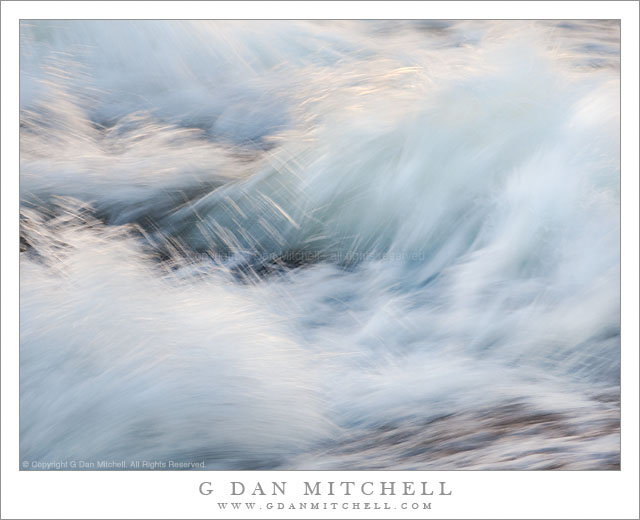
Whitewater, Tenaya Creek

Whitewater, Tenaya Creek. Yosemite National Park, California.June 28, 2010. © Copyright G Dan Mitchell – all rights reserved.

Turbulent whitewater flows through an area of steep granite along Tenaya Creek, Yosemite National Park.

You can, of course, find a place to shoot subjects like this one all over the Sierra and no doubt in many other places as well. This photograph was made during a period of relatively high water early in the season and in a spot where the water flowed over some rocks in shade. Sunlight on the other side of the stream reflected into the water and revealed highlights, especially the flying spray that I allowed to blur with a somewhat slow shutter speed.

The moving water in Sierra streams and rivers seems to be an almost irresistible subject for many photographers, and I confess that I count myself among them. In some ways it is almost too easy to make these photographs, and one basic requirement is a willingness to make quite a few exposures. The instantaneous motion of the water and the reflections of light simply cannot be controlled or predicted, so one almost has to make many, many exposures. Of course, there is a bit more to it than pointing the camera at water and then repeatedly pressing the shutter release. It is important to find some sort of compositional interest first – it could be where water flows around or over a rock, a place where the light catches the water, or possibly just the twisting forms of turbulent water. Light is extra important in these photographs I think – most often the colors come from a combination of the blue-green shades of water full of foam and from reflected light from things that are out of the frame. (In this photograph, the light mostly comes from sunlight reflected off of granite on the far side of the stream.) Shutter speed is an important consideration, as a short exposure will stop or nearly stop the water and freeze the motion, a somewhat longer exposure can hold some detail but still allow blur along the direction of the flow, and very long exposures can create a misty and diffuse effect.

G Dan Mitchell Photography | Flickr | Twitter | Facebook | Email
Text, photographs, and other media are © Copyright G Dan Mitchell (or others when indicated) and are not in the public domain and may not be used on websites, blogs, or in other media without advance permission from G Dan Mitchell.