
Tag Archives: fog

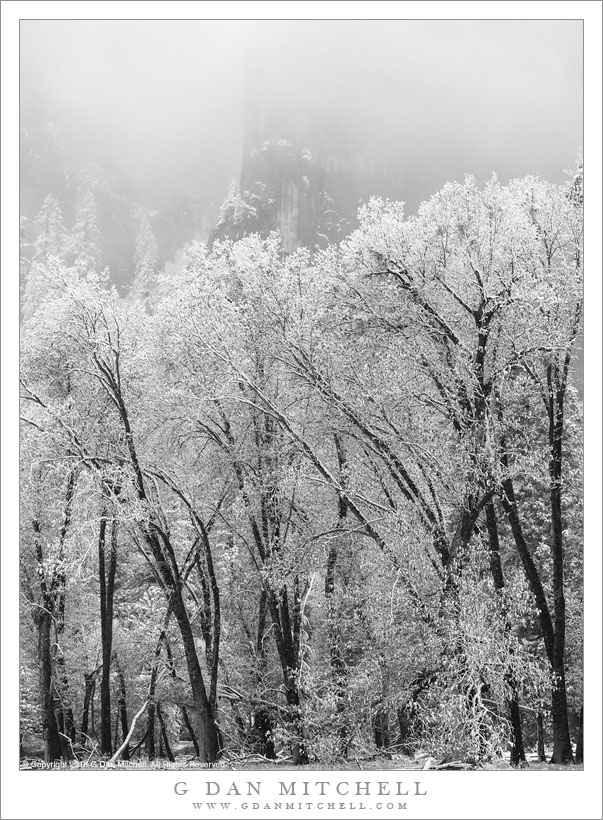
Curving Trees, Falling Snow

Curving Trees, Falling Snow
Snow falls among winter dormant trees in a Yosemite meadow

Curving Trees, Falling Snow. © Copyright 2018 G Dan Mitchell – all rights reserved.

Snow falls among winter dormant trees in a Yosemite meadow

I have known for a month or so that I’d be in Yosemite for the last full week of February. That lead-in month was a very strange one for California weather. We had virtually no precipitation, and warm temperatures often made if feel more like summer than winter. These are not happy conditions for wintertime photography in the park, when a lot of the plant life is dormant and when snow and storm clouds usually provide more interesting conditions.

But immediately upon my arrival — literally the first moments I spent in the Valley — the weather changed. Not only did winter weather return, but it did so with a vengeance, and temperatures dropped much lower than would be typical for the date. On most days of my stay there were at least some clouds and on several days there was snowfall. The day I made this photograph brought the most daytime snow. In the afternoon a weak front worked its way into the Valley, and there were periodic snow showers. I headed to a tree-filled meadow when this shower arrived, and there I photographed juxtapositions of the interestedly shaped trees silhouetted against the falling snow.


G Dan Mitchell is a California photographer and visual opportunist. His book, “California’s Fall Color: A Photographer’s Guide to Autumn in the Sierra” is available from Heyday Books and Amazon.
Blog | About | Flickr | Twitter | FacebookGoogle+ | LinkedIn | Email


All media © Copyright G Dan Mitchell and others as indicated. Any use requires advance permission from G Dan Mitchell.
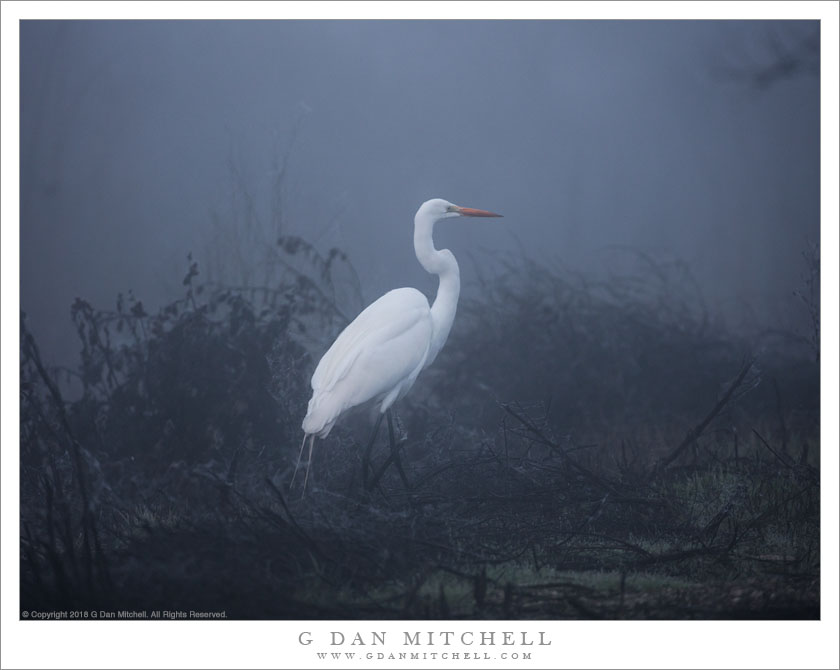
Egret, Blue Hour Fog

Egret, Blue Hour Fog
An egret hunting in blue hour fog

Egret, Blue Hour Fog. © Copyright 2018 G Dan Mitchell – all rights reserved.

An egret hunting in blue hour fog

For those who don’t know the term, “blue hour” is that twilight period when the light tends to become soft and blue, most likely because the primary illumination is from the blue sky itself, with no assistance from direct sunlight. You might not notice the depth of the blue color of the light if you don’t think about it carefully or look at a photograph. Our eyes adjust to the color and see things as being “normal,” but the camera records (more or less) “what is.” Most often when people refer to blue hour they are referencing that period of early twilight — just after the red sunset tones have faded, but before it becomes extremely dark. Of course, there are two “blue hours” every day – one before sunrise and one after sunset.

I usually start my bird photography before it becomes light, and I frequently have to wait a bit before starting to photograph. On this morning it was exceptionally murky — not only was it still dark, but the tule fog was very thick. Eventually I looked for subjects that I could photograph in this challenging light. You are never far away from an egret in places like this, and it wasn’t long before I came upon one that was hunting in the nearby vegetation. In many cases I might try to compensate for the blue tones and the darkness, but here I instead decided to “go with the blue” and produce a photograph that feels more like such mornings actually feel.


G Dan Mitchell is a California photographer and visual opportunist. His book, “California’s Fall Color: A Photographer’s Guide to Autumn in the Sierra” is available from Heyday Books and Amazon.
Blog | About | Flickr | Twitter | FacebookGoogle+ | LinkedIn | Email


All media © Copyright G Dan Mitchell and others as indicated. Any use requires advance permission from G Dan Mitchell.
Winter Fields

Winter Fields
A flock of sandhill cranes flies through an evening winter sky about the San Joaquin River

Winter Fields. © Copyright 2018 G Dan Mitchell – all rights reserved.

A flock of sandhill cranes flies through an evening winter sky about the San Joaquin River

During winter I travel to California’s Central Valley somewhat frequently, ostensibly to photograph birds but, to be honest, also to photograph the landscape — one that often features fog, fields and trees on the trajectory between winter and spring, unusual effects of light, and those birds. In mid-January I was there one afternoon, on my way to an opening reception at the Carnegie Arts Center in Turlock. The drive would usually take me about two hours, but I left early to create some time to explore areas along the San Joaquin River as it approaches the delta and eventually San Francisco Bay.

It was an interesting weather day. It was range when I left the San Francisco Bay Area, but I got ahead of the front as I crossed into the valley, and it was partly sunny as I headed east on country roads towards this destination. Out here by the river it was hazy and foggy, as it so often is this time of year, and before long the clouds of that front caught up with me and produced an interesting and evocative “atmospheric soup” that was occasionally illuminated subtly when the clouds above the fog to the west thinned. The photograph looks across fallow and muddy fields where sandhill cranes were collecting and towards the scattered trees that grow nearer to the river, above which a flock of cranes flies past.


G Dan Mitchell is a California photographer and visual opportunist. His book, “California’s Fall Color: A Photographer’s Guide to Autumn in the Sierra” is available from Heyday Books and Amazon.
Blog | About | Flickr | Twitter | FacebookGoogle+ | LinkedIn | Email


All media © Copyright G Dan Mitchell and others as indicated. Any use requires advance permission from G Dan Mitchell.
Island With Trees, Thinning Fog

Island With Trees, Thinning Fog
Sunlight begins to illuminate a small wetland island as San Joaquin Valley tule fog thins

Island With Trees, Thinning Fog. © Copyright 2018 G Dan Mitchell – all rights reserved.

Sunlight begins to illuminate a small wetland island as San Joaquin Valley tule fog thins

We all know that (apparently false) story about the number of words that Inuit people have for the myriad types of snow. I suspect that it would be possible to have a similarly diverse vocabulary of descriptions for fog, dependent upon its thickness, temperature, quality and color of light, tendency to move, effect on sound, time of day, season, persistence, and much more. Photographing in California is something of a laboratory in the nature of fog, in that we have so many types. Living in the San Francisco Bay Area I am very familiar with the type of fog created by the marine influence — often cold and gray and damp, and frequently a feature of the late-spring and summer months. Photographing Central Valley birds (and driving across the great valley while traveling to and from the Sierra Nevada) has given me ample opportunities to know the tule fog, mostly a winter phenomenon caused by cool and damp conditions over land.

On winter days when I photograph in the valley I experience transitions though many different types of fog and fog-light. I often start before dawn, when the fog and darkness can close the world down to what I can (barely) see in my headlights, or by the glow of commercial signs and streetlights as I pass through towns. Before sunrise the fog can glow in colors ranging from sky blue to the gaudy reds, oranges, yellows, and purples of first light on clouds above the fog. Eventually that color dissipates and the fog can simply become gray. Then, as it things (often from the top down), and light begins to filter down to the ground level, the colors of grasses and trees and water being to appear faintly.


G Dan Mitchell is a California photographer and visual opportunist. His book, “California’s Fall Color: A Photographer’s Guide to Autumn in the Sierra” is available from Heyday Books and Amazon.
Blog | About | Flickr | Twitter | FacebookGoogle+ | LinkedIn | Email


All media © Copyright G Dan Mitchell and others as indicated. Any use requires advance permission from G Dan Mitchell.