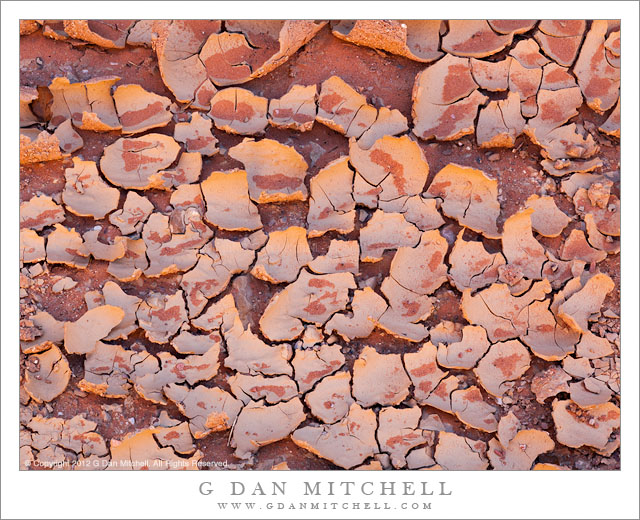
Cracked dry mud curling atop a bed of red sand, illuminated by reflected canyon light, Grand Staircase-Escalante National Monument
Dried and cracked mud is one of those strange subjects that seems to be almost irresistible for landscape photographers. Often the concept seems more interesting that the photograph turns out to be, but that rarely stops me from giving it a try. The specific location is entirely unimportant, but I photographed this somewhere in the Grand Staircase-Escalante National Monument in Utah while exploring a canyon.
Pardon me while I become enthusiastic about… mud. ;-) These patterns are fairly common, forming where silt-laden water flowed during a rainstorm. Because here the sand is from Utah’s common red sandstone, everything in this images has some red quality to it. The silt itself is tinged pink, and the sand below, some of which ended up on top of the dry mud, is very red. In addition, because this specimen was deep down in a canyon, that beautiful southwest light that reflects off the upper canyon walls casts a lot of very warm colored light onto this little intimate landscape. In fact, without that wonderful light this scene would have little too offer and the coloration would probably be too subtle to work well.
G Dan Mitchell is a California photographer and visual opportunist whose subjects include the Pacific coast, redwood forests, central California oak/grasslands, the Sierra Nevada, California deserts, urban landscapes, night photography, and more. Blog | About | Flickr | Twitter | Facebook | Google+ | 500px.com | LinkedIn | Email
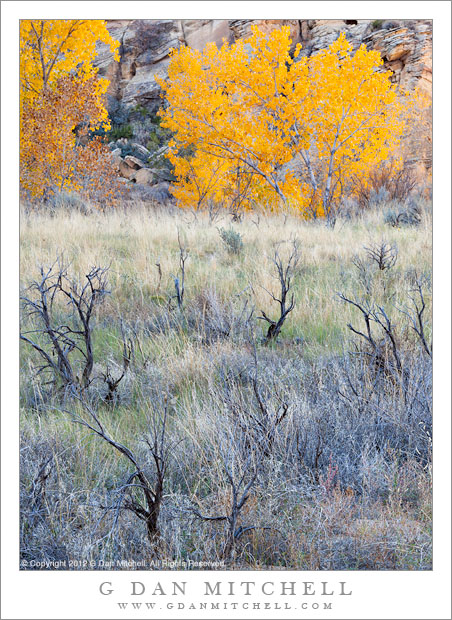
Stumps of dead brush in a meadow with autumn cotton wood trees, Grand Staircase-Escalante National Monument
We encountered these first autumn-foliage cottonwoods shortly after we entered this canyon, and this being our first day shooting in this area, I think we (or at least I) felt obligated to shoot every possible subject, since everything was so new on this day. Later I might have passed up these cottonwoods which, despite their brilliant color, were it a tricky spot to photograph and were just about to end up in the direct morning sunlight.
Trying to find some sort of composition that could include them but not make them the whole story, I first saw the brushy meadow with its light green grasses and older dry grass, but that was too featureless of a foreground for what I had in mind. Then I saw these old dead stumps of perhaps tamarisk or some other desert plant that were still standing in a section of this meadowy area, and I decide to use them to fill the foreground.
G Dan Mitchell is a California photographer and visual opportunist whose subjects include the Pacific coast, redwood forests, central California oak/grasslands, the Sierra Nevada, California deserts, urban landscapes, night photography, and more. Blog | About | Flickr | Twitter | Facebook | Google+ | 500px.com | LinkedIn | Email
The Colorado River winds through rugged country beyond the White Rim, Canyonlands National Park
On our second visit to Canyonlands National Park (the first had been back in April of the same year, when we briefly visited the “Island in the Sky” highlands of the park) we were somewhat stymied by less than astonishing light. Overall the skies were sort of partly cloudy, but that “partly” portion seemed to line up almost perfectly with where we were, and from afternoon on a large mass of clouds sat above us and to the west. For this photograph, that might have actually been a bit of a blessing, in that trying to photograph the tremendously intricate and detailed landscape visible from the “Grand View” overlook in full sun at this time of day would have been challenging, to say the least. This landscape, lit that way, would have contained some extremely bright features along with very deep shadows in the canyons, and the result probably would not have been all that great. The clouds, however, somewhat mute the contrasty light, making the bright areas a bit less bright and allowing diffused light down into areas that would otherwise be dark. At least there was a bit of light on the buttes in the far distance at the upper edge of the frame.
This scene is one of those “iconic” views that, well, everyone photographs. Generally, I’m not that much about photographing icons. In fact, often when I go to places like this I try to not know what the iconic shots are or where to find them, preferring to instead just sort of guess, follow hunches, poke around, and see what I discover. This may not be the most effective way to find the “cool stuff” in a new location, but it does let me start to develop my own relationship with a landscape from the very beginning. So when we went into Canyonlands the first time I basically had almost no idea what I was “supposed” to see and photograph. (For example, I had no idea that iconic “Mesa Arch” is in this park – drove past the road to it and said, “Ah, that’s where Mesa Arch is!” And, no, I did not photograph it.) However, as we wandered about and looked at stuff, we somehow managed to end up at several of “those places” – especially the Green River overlook (which I now recognize as one of the iconic views of this park) and Grand View. In addition, I’ve often advised others to not eschew icons in certain situations. One, of course, is when you find yourself in front of such an icon and have never photographed it before. But another is when one visits a location for the first time and does not yet have a deeper knowledge of the place. For example, I’ll occasionally get asked by first time visitors to Yosemite or Death Valley (places where I shoot a lot) about where the “secret spots” are that not everyone shoots. I tell them that getting to know a place to such an extent that you can find, “see,” understand and photograph the non-iconic subjects is not a reasonable goal for a first visit. Often that takes many visits, perhaps in different seasons, and the time to let the place “get under your skin” to the point that you have a real feel for it.* But everyone has to start somewhere, and photographing icons is a fine place to start when you are new to a place. They are, after all, usually quite spectacular spots – as I say, “They are icons for a reason.”
*For my part, during my first year photographing in Utah I spent over 30 days there during three long visits. It wasn’t until well into the third visit that I really began to feel that I was moving past the “Oh, wow, Utah!” state and starting to really understand the place.
G Dan Mitchell is a California photographer and visual opportunist whose subjects include the Pacific coast, redwood forests, central California oak/grasslands, the Sierra Nevada, California deserts, urban landscapes, night photography, and more. Blog | About | Flickr | Twitter | Facebook | Google+ | 500px.com | LinkedIn | Email
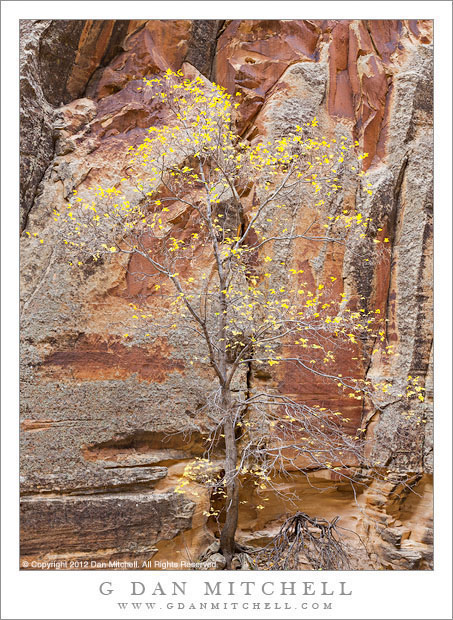
The last autumn leaves on a box elder tree against a dark wall of Escalante Canyon, Utah
On a very cold and somewhat cloudy day in late October we explored portions of the Escalante River in Utah. This was a tough day for shooting! Not only was it cold – it was trying to snow by the end of the day – but it was also very windy, making photography of cottonwood and box elder trees and other vegetation a real challenge.
In places the river twists and turns, first going one way and permitting sun down to the river, then abruptly turning in a share s-curve and heading back the other direction. Then, as they say, “lather, rinse, repeat.” The back and forth winding course of the river continues. As we passed through one of the sharp bends, beneath very tall cliffs and in deep shade, we had to wade across the river as it flowed next to this sandstone wall. Tucked up against the wall and growing from rocky ledges were several trees, including this one that still retained just a few autumn leaves.
G Dan Mitchell is a California photographer and visual opportunist whose subjects include the Pacific coast, redwood forests, central California oak/grasslands, the Sierra Nevada, California deserts, urban landscapes, night photography, and more. Blog | About | Flickr | Twitter | Facebook | Google+ | 500px.com | LinkedIn | Email
Photographer and visual opportunist. Daily photos since 2005, plus articles, reviews, news, and ideas.
Manage Consent
To provide the best experiences, we use technologies like cookies to store and/or access device information. Consenting to these technologies will allow us to process data such as browsing behavior or unique IDs on this site. Not consenting or withdrawing consent, may adversely affect certain features and functions.
Functional
Always active
The technical storage or access is strictly necessary for the legitimate purpose of enabling the use of a specific service explicitly requested by the subscriber or user, or for the sole purpose of carrying out the transmission of a communication over an electronic communications network.
Preferences
The technical storage or access is necessary for the legitimate purpose of storing preferences that are not requested by the subscriber or user.
Statistics
The technical storage or access that is used exclusively for statistical purposes.The technical storage or access that is used exclusively for anonymous statistical purposes. Without a subpoena, voluntary compliance on the part of your Internet Service Provider, or additional records from a third party, information stored or retrieved for this purpose alone cannot usually be used to identify you.
Marketing
The technical storage or access is required to create user profiles to send advertising, or to track the user on a website or across several websites for similar marketing purposes.

 G Dan Mitchell is a California photographer and visual opportunist whose subjects include the Pacific coast, redwood forests, central California oak/grasslands, the Sierra Nevada, California deserts, urban landscapes, night photography, and more.