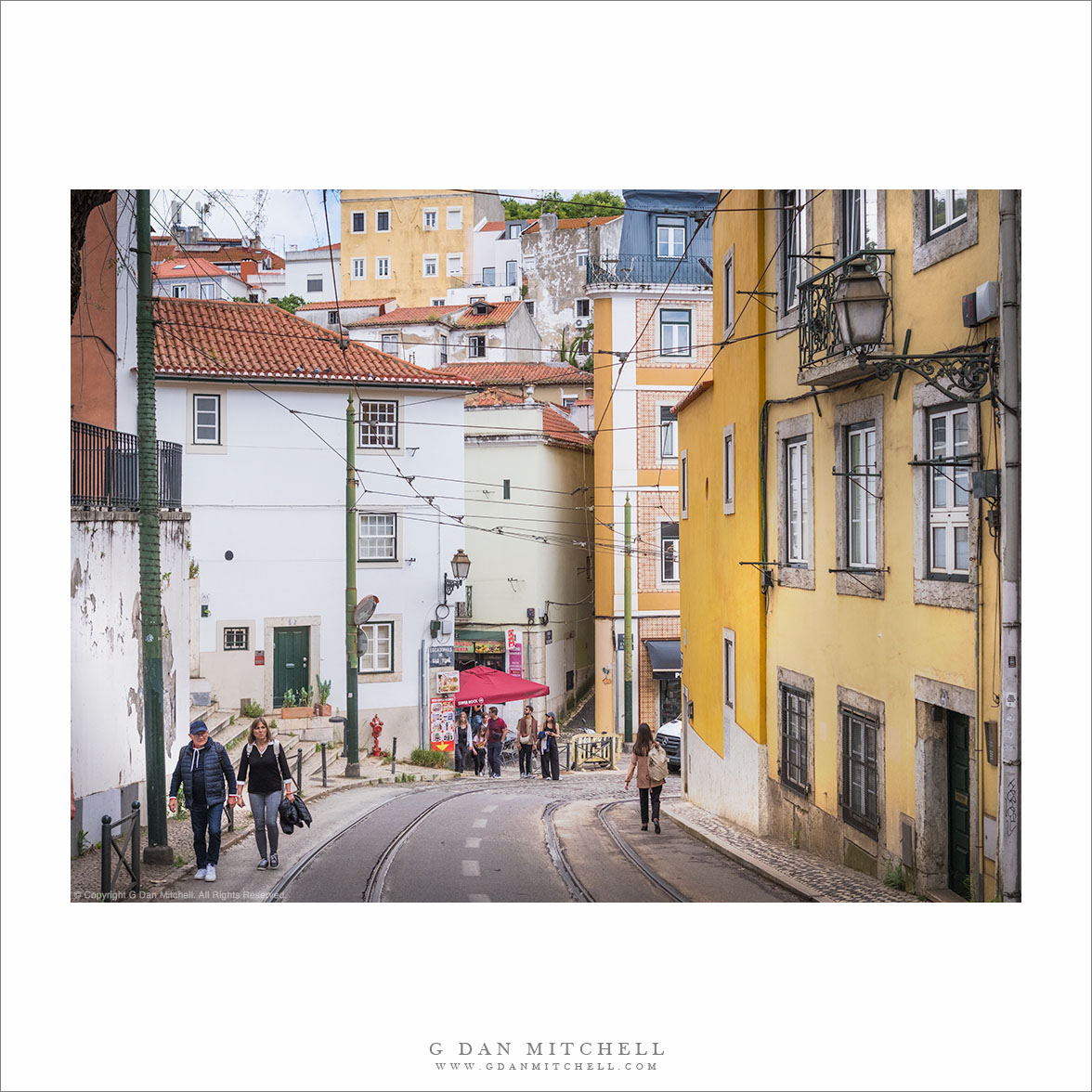
“A Lisbon Street” — A narrow, curving street in Alfama, lined with colorful buildings.
From my limited experience, this feels like a “typical” street of Lisbon’s Alfama district… except that the street is wider than many of the passageways. The lines suggest that it is two lanes wide — though I imagine that when a trolley goes up and down those tracks there isn’t a lot of room for anyone else!
There is a lot in this scene that attracted my attention. The street itself with its pairs of tracks and optimistic center dividing line is one. The stacked and tightly spaced buildings are another. And I love the saturated colors, from the nearly pure white to the many yellow buildings, and the bits of blue here and there.
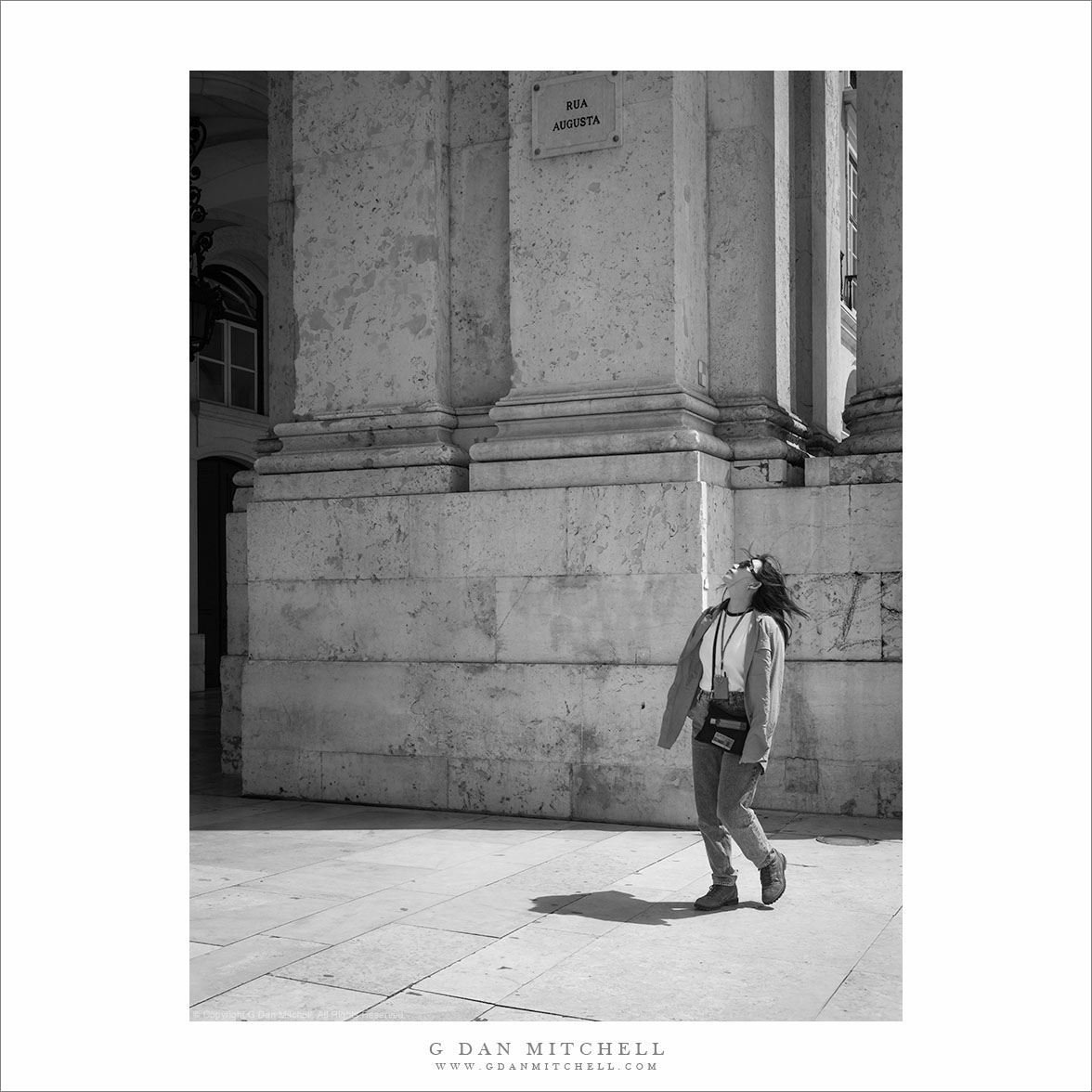
“Woman in Sunshine” — A woman looks upwards in the sunshine, Lisbon.
I made this photograph on our first foray in Lisbon during our visit this past May. If I recall correctly, after arriving late the previous night, we were up (and quite jet-lagged) and out the door to walk some of the surrounding streets. We joined the crowd and made our way down to the popular Praça do Comércio square.
I made this photograph quickly, since photographing such subjects happens in real time — there’s little opportunity to stop and carefully consider. There’s an element of serendipity in such photographs. The right person has to be in the right place and light at the right time, I have to be there, I have to look the right direction, and I have to react quickly.
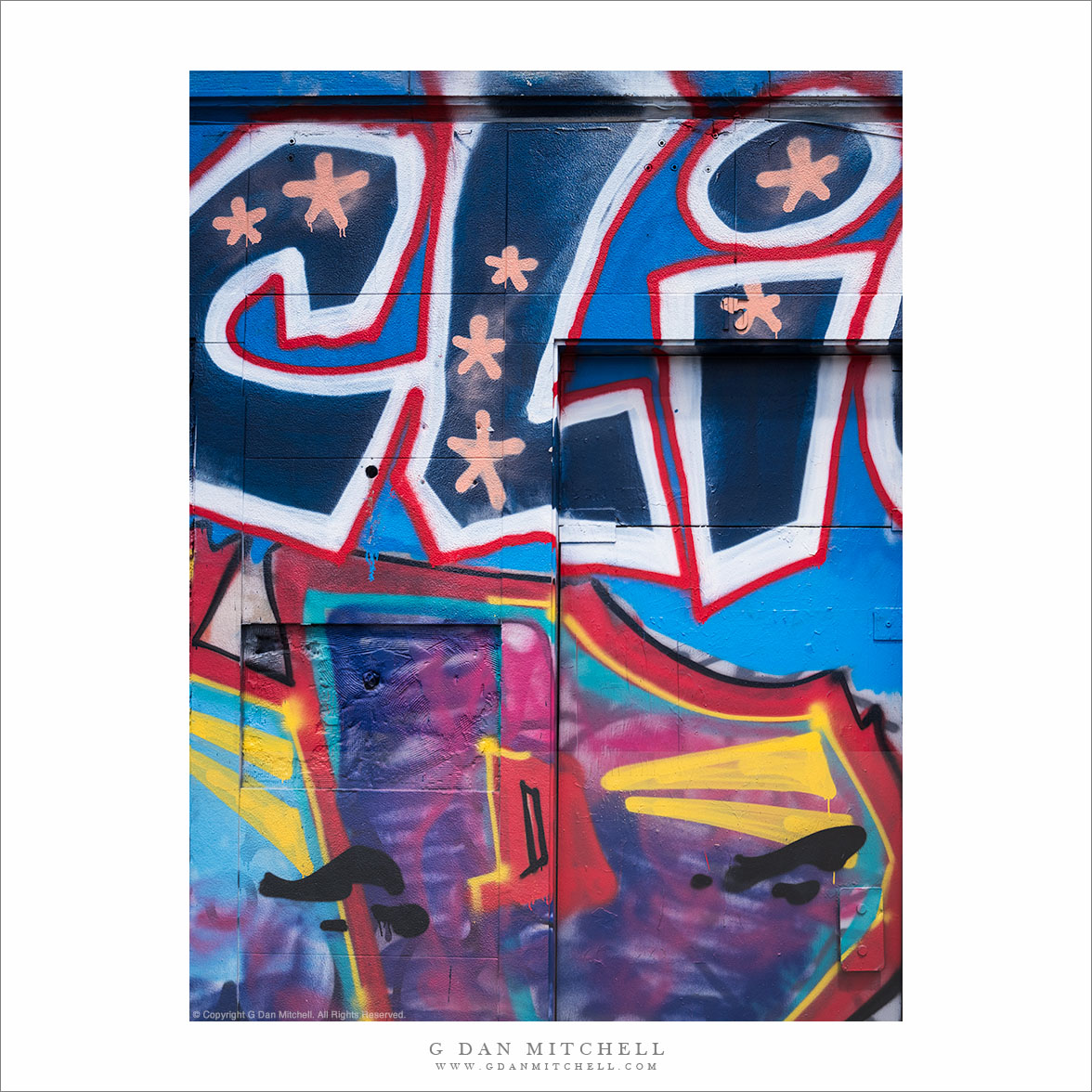
“Alfama Street Art” — Detail of street art on a wall in the Alfama district of Lisbon.
This detail of a bit of Portuguese street art comes from the Alfama district of Lisbon. This is the oldest neighborhood of the city, with tightly spaced buildings and streets so narrow and twisting that vehicles cannot pass. It was (and reputedly still is) a neighborhood where the poor are more likely to live — though one can see a creeping urbanization occurring around the edges.
I don’t generally photograph graffiti — the “I am here” initials and other personal marks made in public spaces. But there’s a fine line between that and what I think of as street art. I will photograph the latter. Here the imagery covers of a mundane wall — look closely and you can make it out beneath the paint — and uses wildly exuberant patterns and colors.
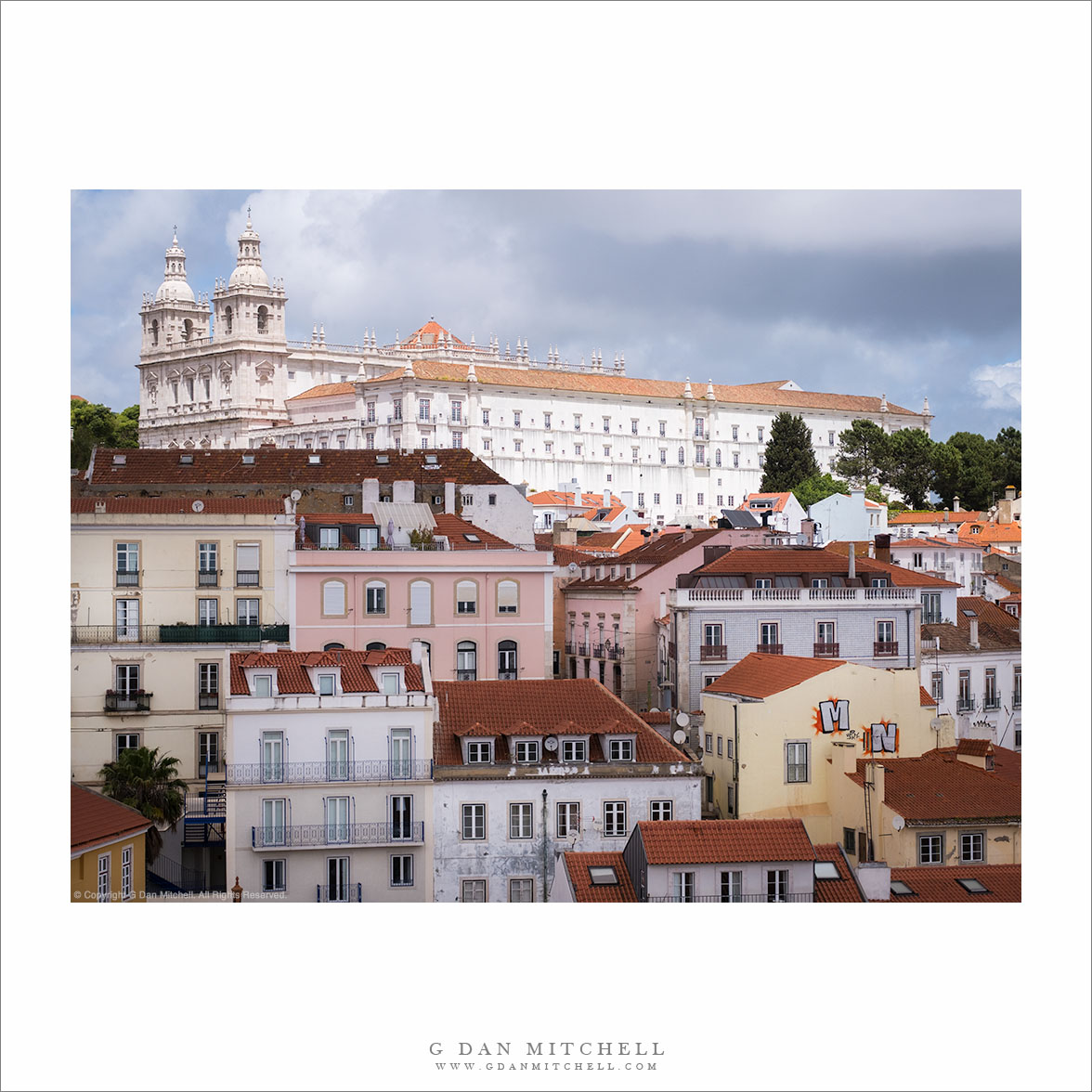
“Monastery of São Vicente de Fora” — The Monastery of São Vicente de Fora rises above Alfama, Lisbon.
Unfortunately we did not actually get to the Monastery of São Vicente de Fora during our Lisbon visit — we were merely tempted by the sight of the impressive architecture on this ridge above Alfama in Lisbon. As is our practice, we headed out for a walk on this day, a walk that followed only the most general plan. We knew we wanted to get to visit Alfama, but beyond that we would just wander. Eventually — and, I suppose, inevitably — we arrived at Portas do Solwhich presented this view.
The buildings of Alfama are tightly packed and separated by very narrow streets, many of which would not accommodate vehicle traffic. A small section of such buildings is in the foreground in this photograph, temporarily shaded by the passing clouds. The Monastery dominates the view, as it sits on the hilltop above the district — and at this moment it was in the sunshine.
Photographer and visual opportunist. Daily photos since 2005, plus articles, reviews, news, and ideas.
Manage Consent
To provide the best experiences, we use technologies like cookies to store and/or access device information. Consenting to these technologies will allow us to process data such as browsing behavior or unique IDs on this site. Not consenting or withdrawing consent, may adversely affect certain features and functions.
Functional
Always active
The technical storage or access is strictly necessary for the legitimate purpose of enabling the use of a specific service explicitly requested by the subscriber or user, or for the sole purpose of carrying out the transmission of a communication over an electronic communications network.
Preferences
The technical storage or access is necessary for the legitimate purpose of storing preferences that are not requested by the subscriber or user.
Statistics
The technical storage or access that is used exclusively for statistical purposes.The technical storage or access that is used exclusively for anonymous statistical purposes. Without a subpoena, voluntary compliance on the part of your Internet Service Provider, or additional records from a third party, information stored or retrieved for this purpose alone cannot usually be used to identify you.
Marketing
The technical storage or access is required to create user profiles to send advertising, or to track the user on a website or across several websites for similar marketing purposes.

Join the discussion — you are welcome to leave a comment or question. (Comments are moderated and may not appear immediately.)