Tag Archives: monochrome

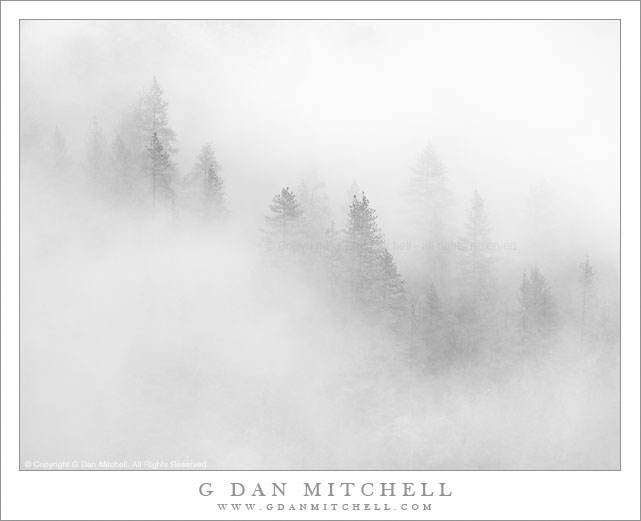
Fog and Trees, Yosemite Valley

Fog and Trees, Yosemite Valley

Fog and Trees, Yosemite Valley. Yosemite National Park, California. October 30, 2010. © Copyright G Dan Mitchell – all rights reserved.

Forest trees are almost completely obscured by evening fog in Yosemite Valley.

If you have been watching some of my recently posted photographs, you have perhaps figured out that I’m working on a series of photographs in which mist and fog and clouds obscure to a greater or lesser extent some underlying elements of the landscape. (If you haven’t been watching my recent posts… you can still be my friend! ;-) In a few of them I am seeing how far I can take this and still have an interesting photograph. This one marks a further step along that path in that at least half of the scene has little or no detail, being almost completely obscured by drifting fog, and even in the areas where trees are still visible the details are very muted.

I’m thinking about just how little detail I can retain in the scene and still retain a sense of form. And this isn’t the most extreme in the series at all. I’m working on another one which retains less “solid” detail than this one. (It may be that it works as a print but perhaps not as a web jpg, in which case I may not post it here – we’ll see.)

The photograph was made at – icon alert! – Wawona Tunnel View above Yosemite Valley on an evening when I had little interest in shooting the classic view of the Valley itself, but had instead gone there because I was almost certain that fog would form among the trees on the Valley floor as the temperature dropped following a rainy day. If anyone had noticed me shooting on that evening among the line-up of dozens of photographers, they might have been perplexed as to why I was aiming a very large lens down when the famous view was obviously straight ahead! ;-)

This photograph is not in the public domain and may not be used on websites, blogs, or in other media without advance permission from G Dan Mitchell.

G Dan Mitchell Photography
Flickr | Twitter | Facebook Fan Page | Facebook | Friendfeed | Email

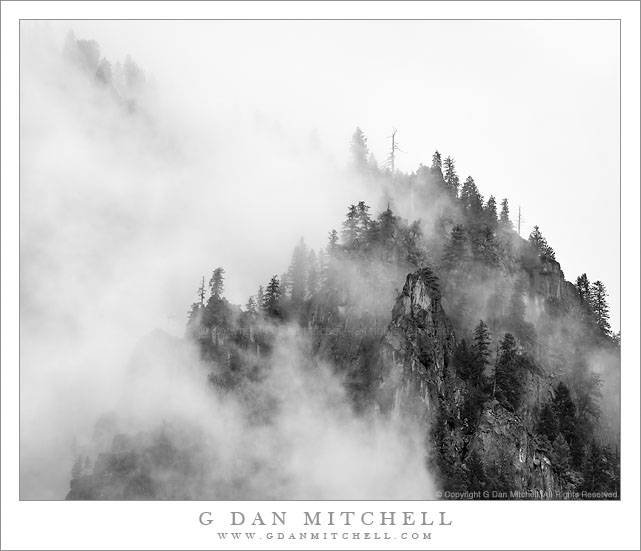
Mist and Curving Ridge, Yosemite Valley

Mist and Curving Ridge, Yosemite Valley

Mist and Curving Ridge, Yosemite Valley. Yosemite National Park, California. October 30, 2010. © Copyright G Dan Mitchell – all rights reserved.

Mist from an autumn storm flows across the crest of a curving ridge high on the walls of Yosemite Valley.

The mist from this late-October storm is flowing over the edge of a curving ridge high above the floor of Yosemite Valley, leaving just a hint of the higher, curving ridge above this pinnacle through the clouds at upper left. This photograph, like one I posted very recently, was made as I alternated my attention between the image of Upper Yosemite Fall alternately transitioning between filtered sun and obscuring clouds and small details of the closer Valley walls as seen in this image. From moment to moment there were many interesting combinations of light, cloud, trees, and rock… but they came and went quickly and almost without warning.

I usually post photographs here before printing them, and not all of the posted photographs necessarily get printed. This one is an exception in that I made the first print of it yesterday. I’m also happy to say that some very subtle details that are barely or not visible in this web jpg reproduction are there in the print, including some faint outlines of trees in the upper left portion of the frame and some details of the rocky face at lower right.

This photograph is not in the public domain and may not be used on websites, blogs, or in other media without advance permission from G Dan Mitchell.

G Dan Mitchell Photography
Flickr | Twitter | Facebook Fan Page | Facebook | Friendfeed | Email

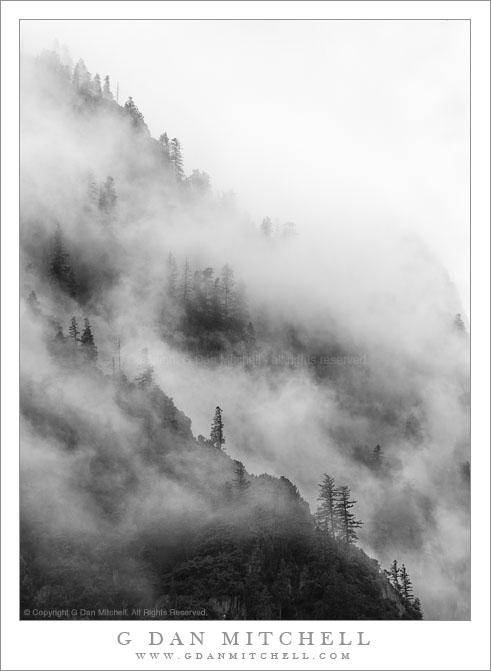
Fog-Shrouded Trees and Ridges, Yosemite Valley

Fog-Shrouded Trees and Ridges, Yosemite Valley

Fog-Shrouded Trees and Ridges, Yosemite Valley. Yosemite National Park, California. October 30, 2010. © Copyright G Dan Mitchell – all rights reserved.

As an autumn storm begins to clear, fog and mist swirls among trees and ridges along the rim of Yosemite Valley.

After a few days of gaudy fall color, I am returning briefly to non-gaudy fall black and white! This is another – and perhaps the last for a while – in the series of misty and cloudy photographs from my visit to Yosemite in late October as a fall storm was passing over the Valley. I was happy when I saw that my planned visit would coincide with a storm, since I love shooting the Valley in the fall in cloudy and wet conditions. As much as I enjoy the beautiful and wam late-summer days, I find the “bad” weather a lot more interesting photographically. The Valley did not disappoint during this visit – I had light rain, clouds ringing the valley, fog both on the Valley floor and among the ridges and trees along the rim, and even some cloud-filtered sunlight.

The subject of this photograph could be any of what seems like an infinite number of scenes of cliffs and ridges and trees along the upper walls of the Valley. The specific spot isn’t important, though it was just to the west of Glacier Point. At times the clouds almost completely obscured the cliff and trees, but as they moved across the face they would periodically clear enough to make bits of the scene momentarily visible. This was another of those situations in which the landscape was emphatically not static – instead it was in a constant state of flux, and it required close and constant attention to catch the photographable moments.

This photograph is not in the public domain and may not be used on websites, blogs, or in other media without advance permission from G Dan Mitchell.

G Dan Mitchell Photography | Twitter | Friendfeed | Facebook | Facebook Fan Page | Email

10 Critical Tips for Landscape Photographers

1. Use a camera. The most important and basic tool of the landscape photographer is the camera. Using a camera greatly simplifies the process of capturing photographic images, and without one you’ll likely feel a bit lost. You may have noticed that pretty much all great landscape photographers use a camera – some use more than one! – so take a cue from the pros and make sure you have a camera, too!

2. Get a lens. Having a lens makes your camera much more useful. While a camera is critical to your work as a landscape photographer, without a lens the usefulness of the camera is greatly diminished. For this reason, virtually all successful landscape photographers end up, sooner or later, getting a lens to use with their camera. You’ll definitely want one, too – just like the pros! (Some cameras come with a lens built in – what a useful idea!)

3. Remove your lens cap. How many photographers can tell stories of forgetting to remove the lens cap before making a photograph, only to discover that the results were not what they had hoped for? But you don’t have to learn the hard way! Practice removing your lens cap at home – that way, when you are in the field you will have developed “photographer’s instincts” that will ensure that you remove the lens cap. (The good news is that with digital cameras you don’t have to worry about whether you loaded the film – but don’t forget your memory card!)

4. Photograph interesting things. Although it isn’t universally true, you will probably get more interesting photographs if you photograph interesting things. There are many things in the world, and not all of them are interesting. Look for the interesting things and photograph them. Look around – it is an interesting thing to do! Interesting, yes?

5. Pick the right brand. There are many brands of photographic equipment out there – cameras, lenses, filters, bags, you name it. Picking the wrong brand may hamper your photography; pick the right brand and you may not hamper your photography so much. So be sure to pick the right brand. If you aren’t sure which brand is best, talk to photographers – any one of them can tell you which is best… and why!

6. Light is important. Without light it would be pretty much impossible to make photographs, at least the typical landscape photographs. So if you plan to make typical photographs, look for scenes that are illuminated by… light! Light is your friend. Seek out light and when you see it make photographs. Think about it… how many of the photographers you admire work without light? So, do what the pros do – use light!

7. Pick the right subject. Pick the wrong subject and your photograph won’t be what you wanted it to be, so be sure to photograph the right subject. Seek it out and when you see the right subject make a photograph. Perhaps make several. There are so many subjects in the world that finding the right one can be a challenge, so be sure to apply yourself carefully to this task.

8. Colors are important. Unless you are making black and white photographs – in which case the only important colors are black and white. You’ll want to pay careful attention to color. The most important advice is to focus on color in your color photographs – just like the pros!

9. Focus on what is most important. Some people think that mastering technical issues is the most important thing. Others think that having the right equipment is critical. Some claim that the artistic quality of the photograph is important. (Don’t forget – color is important, too!) Before you make great photographs you’ll have to decide which is the most important in your work. Don’t waste your time being a generalist and trying to do everything – pick one and focus on it!  Successful photographers develop a speciality and stick to it.  And don’t forget the rule of thirds!

10. Find good locations. There are many popular spots to make photographs, and you can make photographs just like the pros if you seek out these locations and shoot there, too. You’ll have to be attentive, since these spots are easy to miss if you are talking on your cell phone as you drive past them. Some telltale hints include parking lots full of cars and lines of people with tripods. Stop and make a photograph – there is always room for one more tripod! You can probably make one that looks just like those that the other photographers are making! (Hint: You can also visit online photography sites ahead of time – both to find the locations and to save yourself from spending too much time searching for compositions when you actually get there. Your time is precious!)

Good luck!

(I probably should have saved this for April 1, but I couldn’t wait… :-)

For those whose first experience with my blog is this tongue-in-cheek post, I write serious stuff, too, and a related recent post might interest you: Photographic Myths and Platitudes – ‘Landscape Photography Lenses’ (Part I)