
Tag Archives: national park

Detail, Zabriskie Point Formations

Detail, Zabriskie Point Formations

Detail, Zabriskie Point Formations. Death Valley National Park, California. March 29, 2010. © Copyright G Dan Mitchell – all rights reserved.

Detail photograph of patterns of barren hills and gullies at Zabriskie Point, Death Valley National Park, California.

From my series of detail photographs of smaller elements of the landscape at Zabriskie, and another one shot during atypical times of day – in this case in very bright afternoon sunshine. Because of these lighting conditions – color, intensity, and angle, the quality of the image is less “dreamy” than the typical early morning soft-light photographs of this area. Here you see more clearly the rough texture of the material making up the folds and gullies of these interesting hills that drop into Gower Gulch.

This photograph is not in the public domain and may not be used on websites, blogs, or in other media without advance permission from G Dan Mitchell.

G Dan Mitchell Photography | Twitter | Friendfeed | Facebook | Facebook Fan Page | Email

Technical Data:
Canon EOS 5D Mark II
Canon EF 100-400mm f/4.5-5.6 L IS USM at 330mm
ISO 100, f/16, 1/50 second

keywords: zabriskie, point, detail, hills, gullies, barren, dry, earth, dirt, afternoon, light, diagonal, forms, abstract, geology, nature, landscape, patterns, death valley, national park, scenic, travel, california, usa, north america, stock, eroded
Titus Canyon

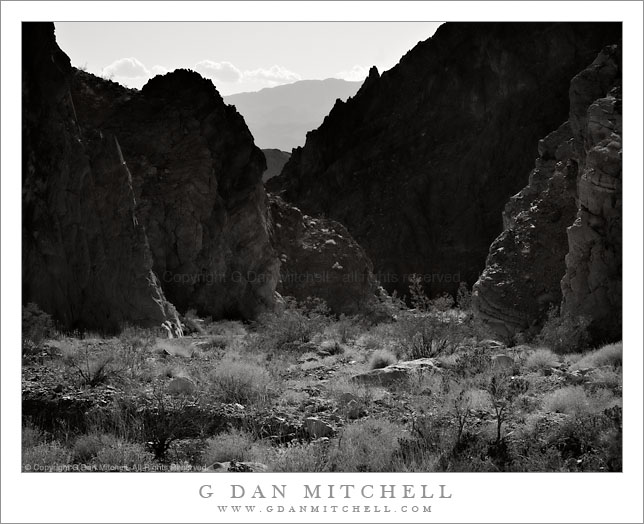
Titus Canyon
Titus Canyon

Titus Canyon. Death Valley National Park, California. April 3, 2008. © Copyright G Dan Mitchell – all rights reserved.

Black and white photograph of Titus Canyon, Death Valley National Park, California.

This photograph was made on a trip to Death Valley a couple of years ago – I pulled it up recently while working on a post about photographing Death Valley at my web site. Titus Canyon is known for the lower section which is a very narrow and deep slot canyon with a road through it. The road is a spectacular drive, starting east of Death Valley near Rhyolite and Beatty, crossing the mountain range along the east side of Death Valley, descending steep canyons on the west side, passing though the very deep and narrow lower section, and finally emerging into Death Valley. I regard the route as one of the most spectacular drives that I’ve seen – though it isn’t an easy drive. You’ll want a vehicle with good ground clearance, 4WD is advised, and those unnerved by steep and winding gravel roads that sometimes pass across very exposed areas might think twice about driving it. (As of this writing, Titus Canyon has been closed by flooding during the recent southern California storms.)

This photograph was made in the lower portion of the canyon, but above the slot canyon section near where the canyon emerges into Death Valley. The mountains seen in the distance are on the other side of Death Valley and far to the west.

This photograph is not in the public domain and may not be used on websites, blogs, or in other media without advance permission from G Dan Mitchell.

G Dan Mitchell Photography | Twitter | Friendfeed | Facebook | Facebook Fan Page | Email

keywords: titus, canyon, road, cliff, rocks, sky, clouds, trees, bushes, plants, desert, grapevine, mountains, landscape, scenic, travel, drive, california, usa, death valley, national park, stock, curve, rugged, desert, road

Thoughts About Photographing Icons

Earlier today I posted a photograph of an icon, Yosemite’s Half Dome. The idea of photographing such a thing evokes a variety of thoughts and concerns that I suspect many photographers understand: Is it too easy? Has it already been done? How will the shot stand in comparison to those that have already been done by greater and more famous photographers? Why bother?

It is interesting to see the variety of ways in which photographers respond to this issue. At one extreme are those who perhaps chase the icons, realizing that they are beautiful and compelling and that there sure as heck is a market for them. (Experiment: Take two of your best photographs from a famous location, one showing an icon and one showing something less familiar, and post them at Flickr… and see what happens. :-) At the other extreme are those who fall into the camp represented by a photographer who, when asked how to photograph icons more or less replied, “Don’t.”

I suppose I’m somewhere in the middle. Let’s use Yosemite Valley as an example since it is so familiar and since I frequently have the opportunity to travel there to do photography. I most certainly do not head straight for icons when I shoot there. In fact, when I photograph in the neighborhood of most of the icons you will frequently find my camera pointing the other direction. After visiting the Valley for decades, I think I’ve come to understand there is much more to this place than the post card shots.

However, icons are icons for a reason. Every so often I’m in the company of someone who is seeing the Valley for the first time, and through their reaction I am again reminded of the visual power of some of the icon scenes. (I wish I could experience what it must be like to emerge from Wawona Tunnel for the first time having never seen that stupendous view of the Valley before!) So I will shoot icons, but I suppose I at least think I’m more selective about how and when I’ll shoot them. I look for a different angle, a way to position the icon as a background element in a photograph of something less iconic, or perhaps unusual conditions.

It isn’t for me to say how successful I might be at this, but it seems that it is perhaps more of a challenge to find a way to shoot an icon in an interesting way than it is to shoot something that is less familiar.

So the photograph I posted earlier today fits into this category – you can’t get much more iconic than Half Dome! I’ve been trying to learn to understand this particular location – the variables of season and time of day and weather and technical issues about capturing the scene – and I now have a couple images in mind that I’d like to shoot here eventually when the time is right. This one gets close to one such shot I have in mind… but I’ll be back at this overlook many more times.

Pine Trees, Edge of the Forest

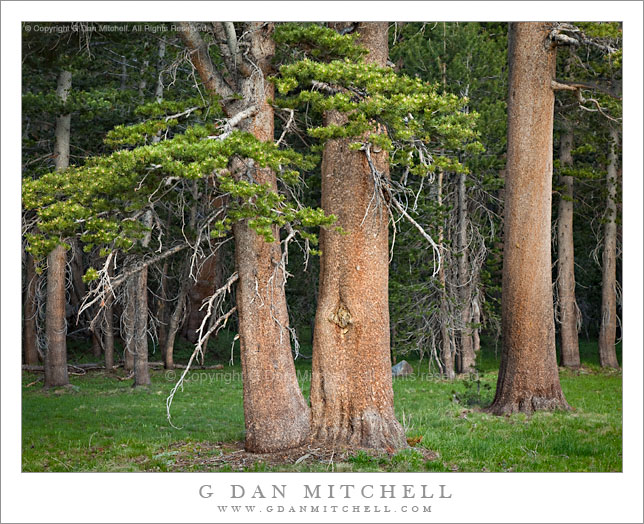
Pine Trees, Edge of the Forest

Pine Trees, Edge of the Forest. Tioga Pass, Yosemite National Park, California. July 11, 2009. © Copyright G Dan Mitchell – all rights reserved.

Lodgepole pines stand at the edge of the forest next to Tioga Meadows, Yosemite National Park, California.

I have photographed these trees before. They are found at the edge of the meadow along the left side of the road after you leave the forest near the Mono Trail parking lot and enter the meadow at Tioga Pass and approach the entrance station. Several things intrigue me about the trees in this area: they mark the edge of dense forest into which it is difficult to see, few people stop to look at them, they border the meadows, and they sometimes are illuminated late in the day by light reflecting from Mount Dana’s lower slopes to the east.

This photograph is not in the public domain. It may not be used on websites, blogs, or in any other media without explicit advance permission from G Dan Mitchell.

Web: G Dan Mitchell Photography
Twitter: http://twitter.com/gdanmitchell
Friendfeed: http://friendfeed.com/gdanmitchell
Facebook: http://www.facebook.com/gdanmitchell

keywords: pine, lodgepole, tamarack, tree, forest, grove, trunk, branch, needle, meadow, tioga, alpine, thick, dense, grass, flora, pass, road, yosemite, national park, california, usa, sierra, nevada, range, mountains, summit, crest, landscape, nature, travel, scenic, stock, green, edge, dark