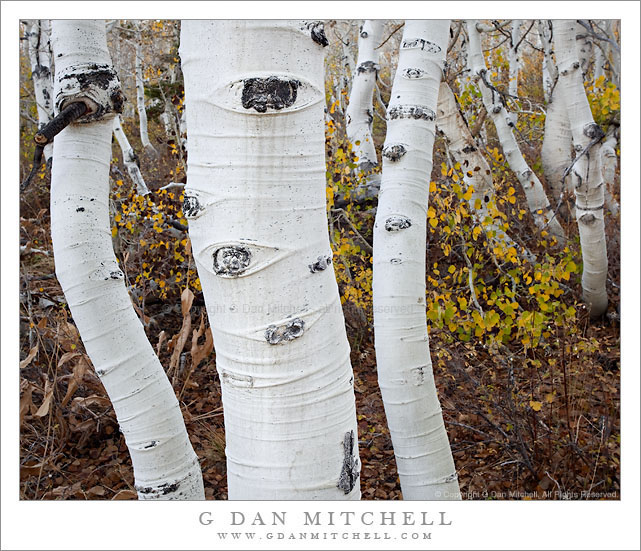
A dense grove of thick and twisy aspens growing along Dunderberg Road in the eastern Sierra Nevada.
This just may be my final new aspen photograph from the 2010 season in the eastern Sierra. (Then again, I do go through all of my raw files during the final couple of weeks of the year, and who knows what might turn up!)
The photograph was made late in the day along the dirt track of Dunderberg Road in a grove of trees that I have visited in the past. Aspen trees can assume a seemingly infinite variety of forms, ranging from the groves of tall and slender trees growing in near perfect symmetry to stunted and twisted specimens that seem more like shrubs than trees. In this grove the trees seem to have endured some real stress – they have thick and strong trunks, but the trees are not tall and the trunks are gnarled and twisted in all sorts of crazy directions. Often when you see a trunk as thick as this one you would expect the tree to be quite tall… but not here.
This photograph is not in the public domain and may not be used on websites, blogs, or in other media without advance permission from G Dan Mitchell.
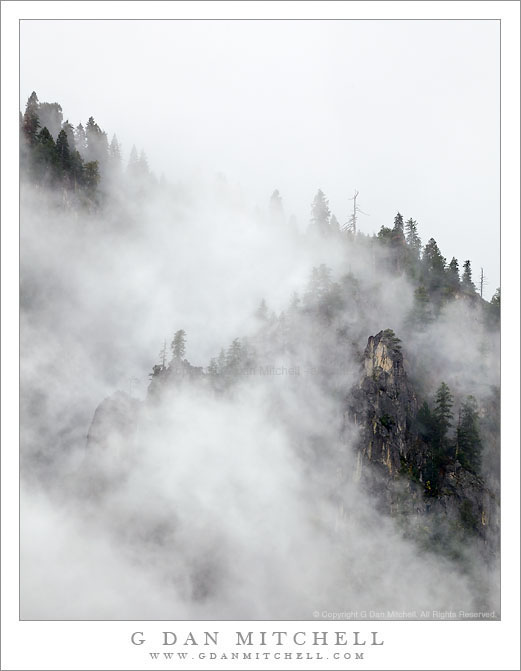
Trees and rocks emerge from fog flowing over curving ridges on the rim of Yosemite Valley during an autumn storm.
This may be the final photograph from the “fog shrouded cliffs” series that came from my late October visit to Yosemite Valley during a fall storm. Since I’ve described this series in some detail previously, I’ll try to keep this comment short. I initially had my eye on the pinnacle at the lower left, and it became a more prominent subject in other photographs in this series. But as I photographed it I was attracted to the angles formed by the foreground ridge rising from left to right and the upper ridge beyond rising the opposite direction. (I think it is the same ridge, with the two sections joined directly above the pinnacle.) The fog/clouds were in constant motion, at one moment almost completely obscuring the scene and a moment later revealing portions of the landscape. For a brief instant the pinnacle stood clear of the clouds and bot sections of the upper ridge were visible.
This photograph is not in the public domain and may not be used on websites, blogs, or in other media without advance permission from G Dan Mitchell.
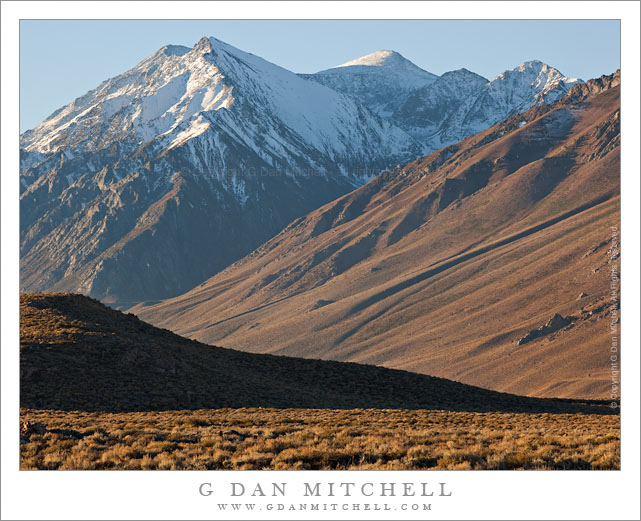
Snow crested Mount Morgan rises above McGee Canyon and the sagebrush-covered hills of Owens Valley in the eastern Sierra Nevada.
I’ve been traveling to the Sierra for many years. My first recollection of the range is a faint mental image of a shoreline park at Lake Tahoe when my family moved to California – I was four years old. My next memory is of staying at a small motel in El Portal next to the high water of the Merced River back in the days before the current mega-hotels were erected. One thing that all of my early Sierra experiences had in common is that I always approached the range from the west since I lived (and still live) in the San Francisco Bay Area. For the person whose orientation to the range is from the west, the Sierras are a range that begins almost imperceptibly in the Central Valley. Although you can see distant peaks from the Valley on clear days, it is hard to say where the range begins. As you head east you encounter some very small and rounded hills which gradually get larger. Eventually you are going up more than up and down as you travel through oak and grass lands. At some point the road rises into forest, but the mountain tops are mostly rounded and forest covered. Keep going and a few rocky prominences begin to appear along the ridges and some distant granite peaks become visible. Only after a lot of driving do you find yourself in the higher reaches of the range, and this only in the few areas where roads cross from west to east. In most places you cannot even see the summit of the range close up from the west without walking a long ways.
It was only many years later that I first went over the summit of the range and saw it from the east side. The Sierra is (are?) completely different when approached this way. Instead of a long, gradual, and relatively gentle rise to high valleys and forests and meadows, the eastern escarpment of the Sierra rises abruptly – one might say violently – and directly, in most places, from the high desert sagebrush country of Owens Valley and similar places. This wall of peaks seems almost inaccessible, and I imagine that many people who only drive past on highway 395 must regard it that way.
This photograph was made from a spot just a mile or two east of highway 395, out an a gravel road that I know. I have photographed this shadowed foreground ridge and the peaks beyond in the past, so I had a fairly good idea of what I would find at this location before I made the photograph on an early October morning when fall storms had dusted the highest peaks with snow. I used a somewhat long lens and tight framing to emphasize the rise from the foreground desert to the very high peaks beyond.
This photograph is not in the public domain and may not be used on websites, blogs, or in other media without advance permission from G Dan Mitchell.
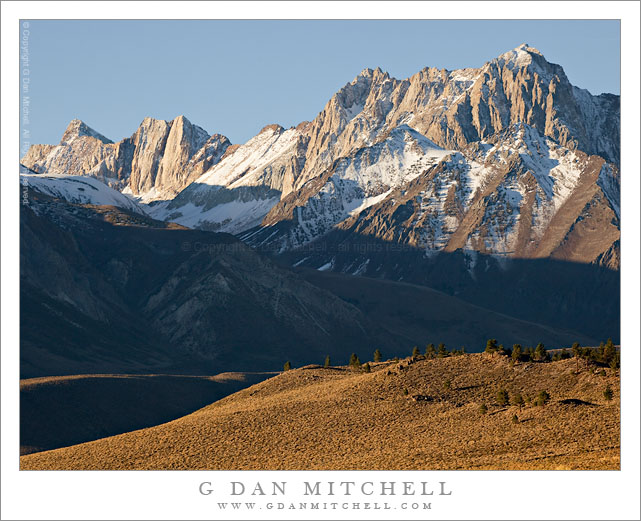
Early morning light on sagebrush covered Owens Valley hills and the Sierra crest near Mount Morrison.
I was out in this section of Owens Valley early on this October morning, initially to photograph at a small lake further out in the valley. However, knowing parts of this area pretty well from past visits, I wanted to try a photograph that included the foreground tree-covered ridge in morning light with the Sierra peaks in the background – so I headed back on a gravel road that travels a bit north of the paved road I had taken earlier in the morning. I found this scene with the early light illuminating the crest of the Sierra and the sagebrush-covered foreground hills, but with morning shadows still lying across the lower eastern face of the Sierra just south of Convict Lake.
The dusting of early season snow was left over from a week of early autumn storms. Mt. Morrison is the huge and impressive summit at the right end of the ridge. Mt. Baldwin is the small but very high summit near the left end. In between is a vertical rock face that appears to be split by a crack – I think it is called “the Great White Fang.”
This photograph is not in the public domain and may not be used on websites, blogs, or in other media without advance permission from G Dan Mitchell.