
Tag Archives: patterns

Displacement

Displacement
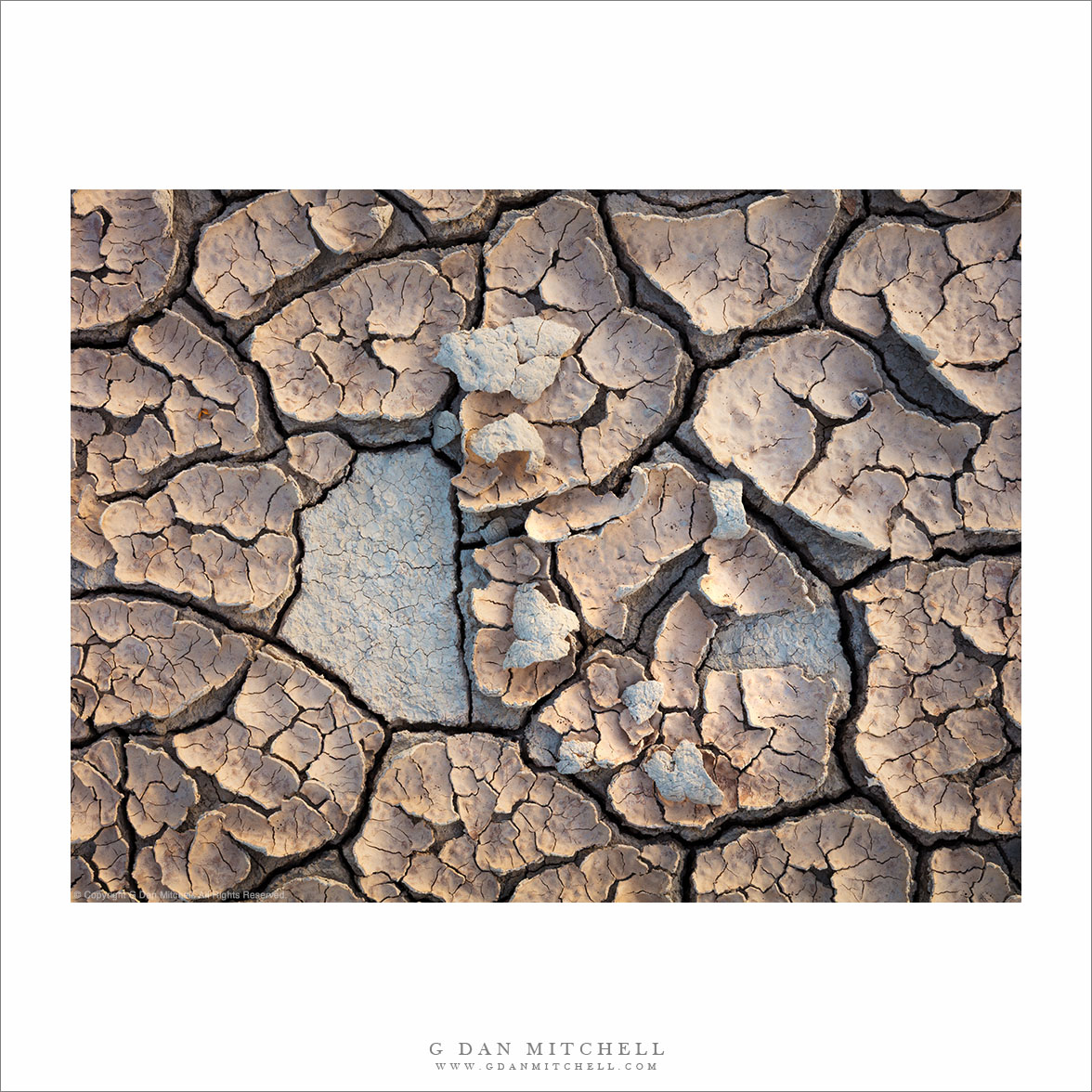
“Displacement” — Cracked and broken dry desert mud, Death Valley.

Those who photograph in the desert inevitably end up photographing… mud. I was attracted to many things in this little scene. The fractal patterns themselves, are always fascinating. (Finding just the right patterns is more difficult than it should be!) In this case I also liked the disruption of the expected pattern by the displacement of material from one of the dried cakes of mud. It appears that something has broken the top layer, left shards to the right, and interrupted the overall coloration of the little scene.

I cannot quite say why it is that photographers are so interested in desert mud — but we definitely are. There is something about the patterns themselves, but also the way light plays across these textures. I recall one time walking down an Utah canyon with a half dozen photographer friends. We encountered a little patch of nearly dry mud, and our progress immediately halted as all of us unloaded packs, set up tripods, and went to work for the next half hour… photographing mud.


Leave a comment or question using the form. (Click the title to see the full article and to comment if you are viewing it on the home page.)

G Dan Mitchell is a California photographer and visual opportunist. His book, “California’s Fall Color: A Photographer’s Guide to Autumn in the Sierra” (Heyday Books) is available directly from him. Blog | Bluesky | Mastodon | Substack Notes | Flickr | Email

All media © Copyright G Dan Mitchell and others.
Shadows, Ponte Dei Carmini

Shadows, Ponte Dei Carmini
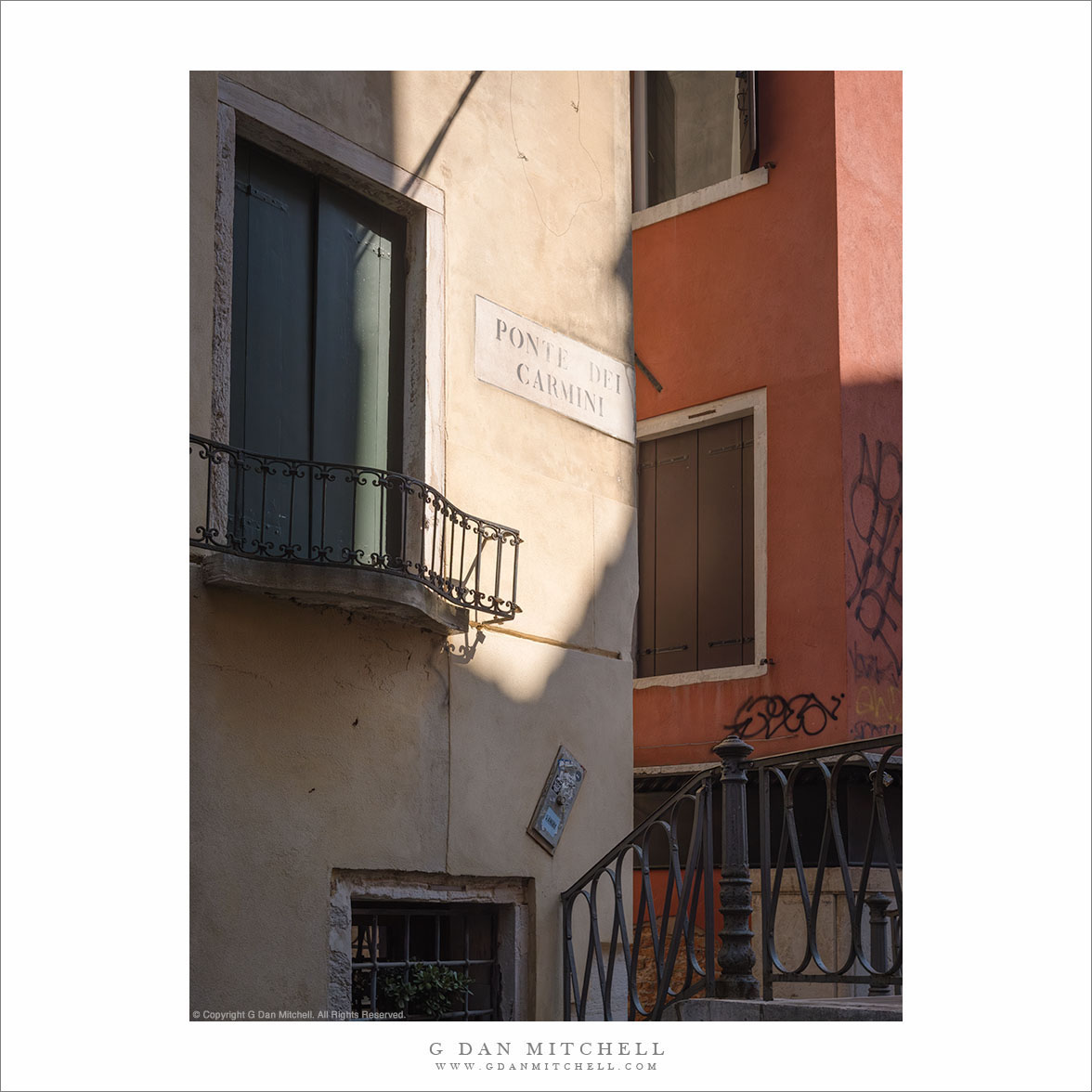
“Shadows, Ponte Dei Carmini” — Light and shadows on buildings at the Ponte Dei Carmini, Venice.

This photograph from Venice embodies many of the features that I expect to see in that part of the world. The Southern European light? Yes. Wrought iron work? Check. Earth tone colors on the buildings? Indeed. Narrow walkways? For sure. Of course, the venetian-style canals — not visible in this photo — are not quite so ubiquitous.

I’ll share a little technical note about this photograph. Cameras cannot really produce a native image that shows us details in both the very bright highlights (direct sunlight) and deep shadows. (Our eyes deal with this by quickly adapting to the brightness at the center of our attention.) So with digital photography our first priority is to protect those bright highlights — let them get out of control and you’ll lose highlight details completely. The subsequent post-processing task is then to brighten details in the shadows to restore what we think we saw when we looked at the scene. The trick is to do that in a manner that doesn’t give it away, one that doesn’t make the technique too obvious


Leave a comment or question using the form. (If you are reading this on the home page, click the article title to see the full article and the comment form.

G Dan Mitchell is a California photographer and visual opportunist. His book, “California’s Fall Color: A Photographer’s Guide to Autumn in the Sierra” (Heyday Books) is available directly from him. Blog | Bluesky | Mastodon | Substack Notes | Flickr | Email

All media © Copyright G Dan Mitchell and others.
Sand Dune Abstract

Sand Dune Abstract
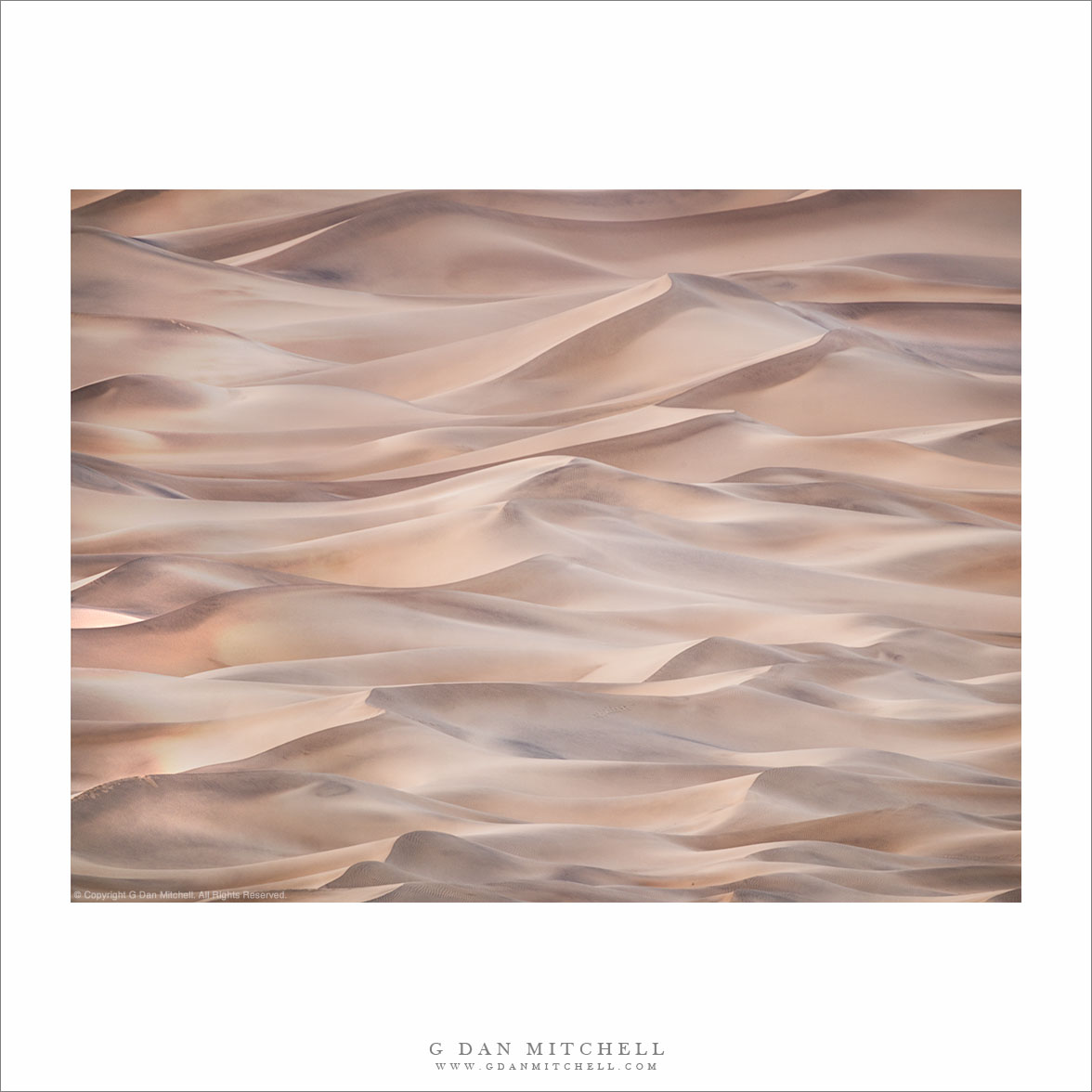
“Sand Dune Abstract” — Sand dune patterns in evening light, Death Valley.

I first photographed this specific subject in Death Valley well over a decade ago, and perhaps closer to two decades. I “discovered” it by accident while driving back from visiting an entirely different feature. I had stopped in this location to photograph other things, and as I scanned the landscape I noticed this section of almost pure sand dunes. I went here again this year at the end of February when the light on my intended subject died early, and I thought I might be able to work with the soft light in this spot.

Because I have photographed here for some time, I have watched — at times with some concern — as this location started to become another “icon” of Death Valley photography. One positive development of this, perhaps, is that the many photographs can look quite different, revealing how ambient light “paints” the landscape of the desert. (Well, OK, also revealing the role that post-production interpretation plays in such photographs.)


Leave a comment or question using the form. (If you are reading this on the home page, click the article title to see the full article and the comment form.

G Dan Mitchell is a California photographer and visual opportunist. His book, “California’s Fall Color: A Photographer’s Guide to Autumn in the Sierra” (Heyday Books) is available directly from him. Blog | Bluesky | Mastodon | Substack Notes | Flickr | Email

All media © Copyright G Dan Mitchell and others.
Eroded Layers

Eroded Layers
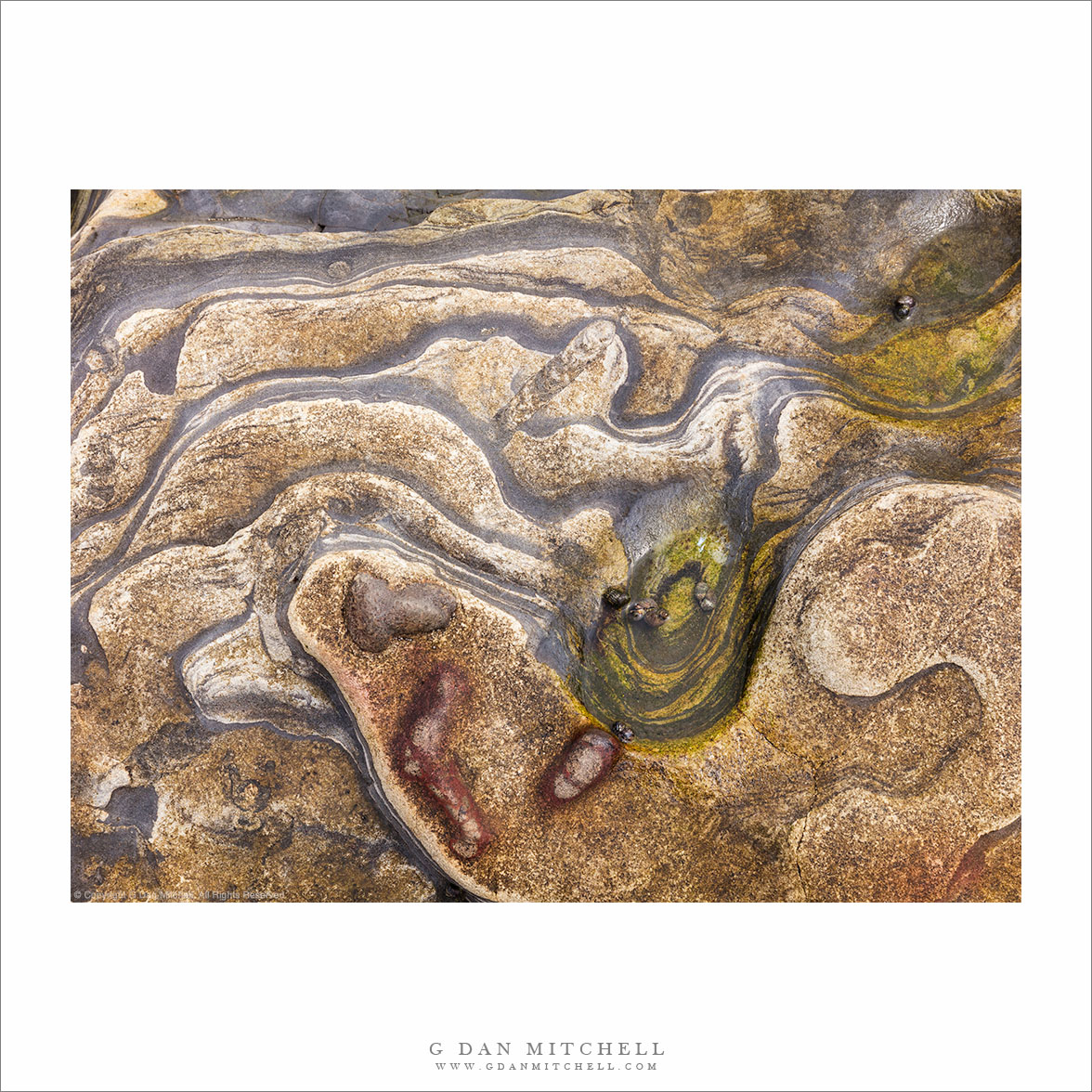
“Eroded Layers” — Erosion exposes layers in rocks, Pacific Coast, Point Lobos.

These rock formations have fascinated me since I first saw them decades ago as a child. My parents used to take us on family outings to Point Lobos, and very early on I began to photograph the place. (I am pretty sure that I went there on an elementary school field trip, a memory brought back to me on this visit when I saw a busload of kids eating lunch at picnic tables.) This little intimate landscape includes forms which seem to suggest the sea itself — I can see waves and inlets and more in it.

This particular spot at the reserve has a variety of interesting features. Stratified rock layers descend to the water of a cove, and they are twisted all sorts of interesting ways as the work of the water exposes them. There are colorful bands and intrusions. Sometimes the layers are turned on their sides. And, as here, the action of waves gradually peels back the layers, leaving abstract forms. (Hint: If you look closely you might spot a tiny tide pool and a few of its small inhabitants.)


G Dan Mitchell is a California photographer and visual opportunist. His book, “California’s Fall Color: A Photographer’s Guide to Autumn in the Sierra” (Heyday Books) is available directly from him.

G Dan Mitchell: Blog | Bluesky | Mastodon | Substack Notes | Flickr | Email


All media © Copyright G Dan Mitchell and others as indicated. Any use requires advance permission from G Dan Mitchell.