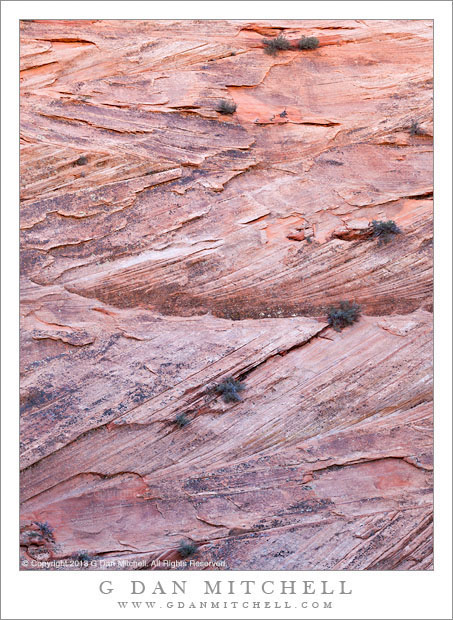
Complex patterns in sandstone formations at Zion National Park
I’m certainly no geologist, but that doesn’t keep me from being somewhat amazed by the fantastical and convoluted shapes and conjunctions in this little detail of cross-bedded sandstone photographed in the Zion National Park high country. As I understand it, these rocks originated in sand that was laid down, perhaps as dunes, in the distant past. For a variety of reasons, layers that originally tilted one direction ended up butted up against or nudging into layers tilting in radically different directions. My untrained eyes count a number of such layers in this small bit of rock. Overlaid on this are eroding flakes, cracks, bits of vegetation, lichen, and more – and all of it on this intensely colorful Southwest rock.
I am not certain precisely where this bit of geology was photographed, beyond recalling that it was along the Mount Carmel Highway through Zion National Park and that the photograph was made in shaded and diffused light. I am not only intrigued by the disjunct lines and angles of the underlying rock here, but also by odd features such as the big curve running across the middle of the frame and the subtle differences in the coloration of the rock – in places it is quite pink, verging on redness, while in others it is almost somewhat purple.
G Dan Mitchell is a California photographer and visual opportunist whose subjects include the Pacific coast, redwood forests, central California oak/grasslands, the Sierra Nevada, California deserts, urban landscapes, night photography, and more. Blog | About | Flickr | Twitter | Facebook | Google+ | 500px.com | LinkedIn | Email
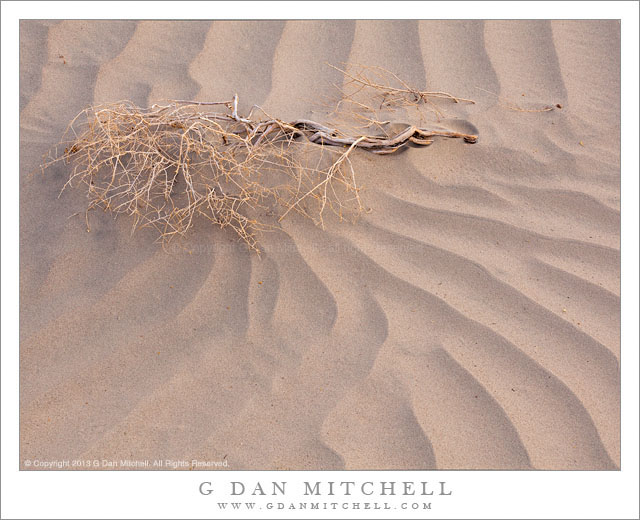
The dry remnants of a dead plant in recently wind-blown sand dune, Death Valley National Park
I have been visiting Death Valley regularly for perhaps fifteen years, typically photographing there for nearly a week every year for the past decade, and occasionally more. On my most recent trip, from which I returned only days ago, I was thinking about a number of thing regarding my experience with the place and how it has changed. On my first visits there was, of course, the excitement and wonder of discovering a place that was essentially completely new to me. I recall that on my first trip there I got close to the Race Track without going all the way to this location. We camped not far from that playa and I imagined this place that I had heard so much about and even envisioned it in a particular location – and when I did visit a year or two later I discovered that it was quite a bit different from what I imagined, though magical in different and perhaps more powerful ways. After a few years of visiting and photographing the best known iconic sites I began to find them less interesting, and though I continued to photograph them when the opportunity arose, I focused more on expanding the areas I knew about and on looking more closely at areas I thought I knew.
As I did this, I have to confess that portions of the Death Valley experience baffled me or even put me off a bit. While I found some of the terrain to be tremendously beautiful, there were other aspects that I just couldn’t quite relate to. As a person who has spent a lot of time in forested places with flowing water – mainly the Sierra Nevada – I found some areas of this desert to be, quite honestly, boring. I drove through or past them on my way to what I thought of as the more interesting places where I could find colors outside of the range from tan to gray and where some special object or formation might create an obvious center of interest. However, from time to time I would be surprised to find in some plain, nondescript, and even boring place an experience of stillness, immense space, and deep silence that I had rarely encountered elsewhere. More and more, I began to see this as a primary attraction of this landscape – more so in many cases that the specific features of this pinnacle or that formation or the other valley.
On this recent trip, conditions conspired to make me look more closely at some of these things that I had originally overlooked. The conditions were such that if I had experienced them a few years ago I might have simply left. (In fact, that thought did cross my mind once or twice on this trip.) The spectacular light really never came, skies were cloudy, the air was hazy, it was very hot, the winds blew strongly, and there was a dust storm. During the first couple of day, with the exception of shooting the dust storm, many of the subjects I had in mind simply didn’t work out the way I planned. A bit surprisingly, without the possibility of shooting yet another beautiful golden hour sunset image of a spectacular bit of geography (though I did do some of that still) I slowed down and looked more closely at some of those “boring” places that I had passed through more quickly in the past.
This photograph was made in one of those locations. It was not far from one of those iconic locations, but it wasn’t the iconic spot at all. An hour or so before sunset I simply wandered away from the road, past vegetation and into the sand, and started looking around. In the low spots between dunes, the world beyond was out of sight and the wind was blocked, and as the light faded I encountered again that deep and powerful and timeless silence that is so hard to find almost anywhere else.
G Dan Mitchell is a California photographer and visual opportunist whose subjects include the Pacific coast, redwood forests, central California oak/grasslands, the Sierra Nevada, California deserts, urban landscapes, night photography, and more. Blog | About | Flickr | Twitter | Facebook | Google+ | 500px.com | LinkedIn | Email
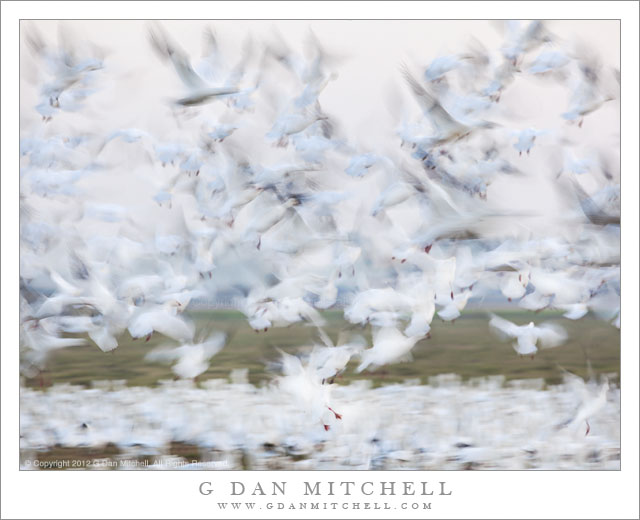
An explosion of sudden motion as a flock of Ross’s geese takes to the evening sky over the Central Valley of California.
Watching the Ross’s geese from close by (in this case, using my car as a “blind”), we watch and wait for the inevitably sudden lift-off. I’ve watched and tried to figure out what advance warning there might be that this will happen, and I think I detect something in the sound of the flock or perhaps the way they behave, but I have yet to put my finger on it precisely. Sometimes there can be an obvious cause – as when a young calf romped straight through the flock during this visit – but more often there doesn’t seem to be any obvious thing that triggers it.
When it does happen, it is often an astonishingly sudden event, with thousands of the birds lifting off virtually simultaneously in a maelstrom of flapping wings and squawking cries and then circling the area a few times before (in most cases) settling back down in the same spot or one not far away. Sometime when shooting in low light, such as during the early morning or late evening or when it is foggy, I like to drop the shutter speed and “go with the blur” as I did in this photograph. A close look reveals distinctly goose-like shapes and parts – feet, beaks, wings, and occasional complete body forms – but the overall effect might evoke the fluttering wildness of their lift-off.
G Dan Mitchell is a California photographer and visual opportunist whose subjects include the Pacific coast, redwood forests, central California oak/grasslands, the Sierra Nevada, California deserts, urban landscapes, night photography, and more. Blog | About | Flickr | Twitter | Facebook | Google+ | 500px.com | LinkedIn | Email
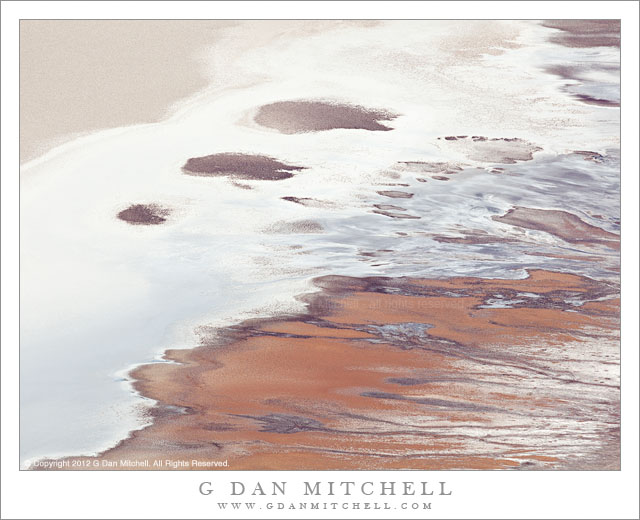
Detail of a section of Death Valley salt flats as seen from Dantes View
Death Valley is often not quite what it seems to be. Repeat visits and views from different perspectives – far away, very close up, from above – begin to reveal things that you might not see at first. From next to and on the salt flats in the lowest section of the Valley, you see a very desolate terrain – one of the most non-human terrains I know. Here, well below sea level, there are places that seem completely inhospitable and alien, landscapes of caked salt, worked and sharp-edged salt and dried mud, seeps of shallow water, occasional odd plants, and landscape that often seems to go on almost endlessly the same way. But just as looking more closely reveals surprises (such as living creatures in those millimeters-deep pools of salty water), the view from overhead shows patterns that cannot be readily seen up close.
This photograph was made from the summit of Dantes View. This high point along the eastern side of the valley is close to a mile above the Valley floor. The view can often be panoramic, stretching for tremendous distances in almost all directions, blocked only by the higher peaks of the Panamint Range to the west and a few other high points nearby. Although Dantes View is one of the best known “iconic” locations in the park, I have a complicated relationship with the place. First of all, I seem to attract awful weather when I go there, perhaps because I tend to do so in the season that is winter elsewhere in the state. Not too long ago I attempted to drive to the summit on a winter day and was turned back by a snow storm perhaps a half mile from the end of the road. In addition, it has been hard for me to warm up to the place as a photographic subject. In some ways, there is almost just too much in the view for me to see how to isolate a photograph out of that detailed immensity. I dealt with that here by using a very long lens and restricting my view to a small section of the valley floor, without much context of surrounding terrain, which I think produces a photograph that allows the features in this frame to be seen as abstractions.
G Dan Mitchell is a California photographer and visual opportunist whose subjects include the Pacific coast, redwood forests, central California oak/grasslands, the Sierra Nevada, California deserts, urban landscapes, night photography, and more. Blog | About | Flickr | Twitter | Facebook | Google+ | 500px.com | LinkedIn | Email
Photographer and visual opportunist. Daily photos since 2005, plus articles, reviews, news, and ideas.
Manage Consent
To provide the best experiences, we use technologies like cookies to store and/or access device information. Consenting to these technologies will allow us to process data such as browsing behavior or unique IDs on this site. Not consenting or withdrawing consent, may adversely affect certain features and functions.
Functional
Always active
The technical storage or access is strictly necessary for the legitimate purpose of enabling the use of a specific service explicitly requested by the subscriber or user, or for the sole purpose of carrying out the transmission of a communication over an electronic communications network.
Preferences
The technical storage or access is necessary for the legitimate purpose of storing preferences that are not requested by the subscriber or user.
Statistics
The technical storage or access that is used exclusively for statistical purposes.The technical storage or access that is used exclusively for anonymous statistical purposes. Without a subpoena, voluntary compliance on the part of your Internet Service Provider, or additional records from a third party, information stored or retrieved for this purpose alone cannot usually be used to identify you.
Marketing
The technical storage or access is required to create user profiles to send advertising, or to track the user on a website or across several websites for similar marketing purposes.

 G Dan Mitchell is a California photographer and visual opportunist whose subjects include the Pacific coast, redwood forests, central California oak/grasslands, the Sierra Nevada, California deserts, urban landscapes, night photography, and more.