Tag Archives: peak

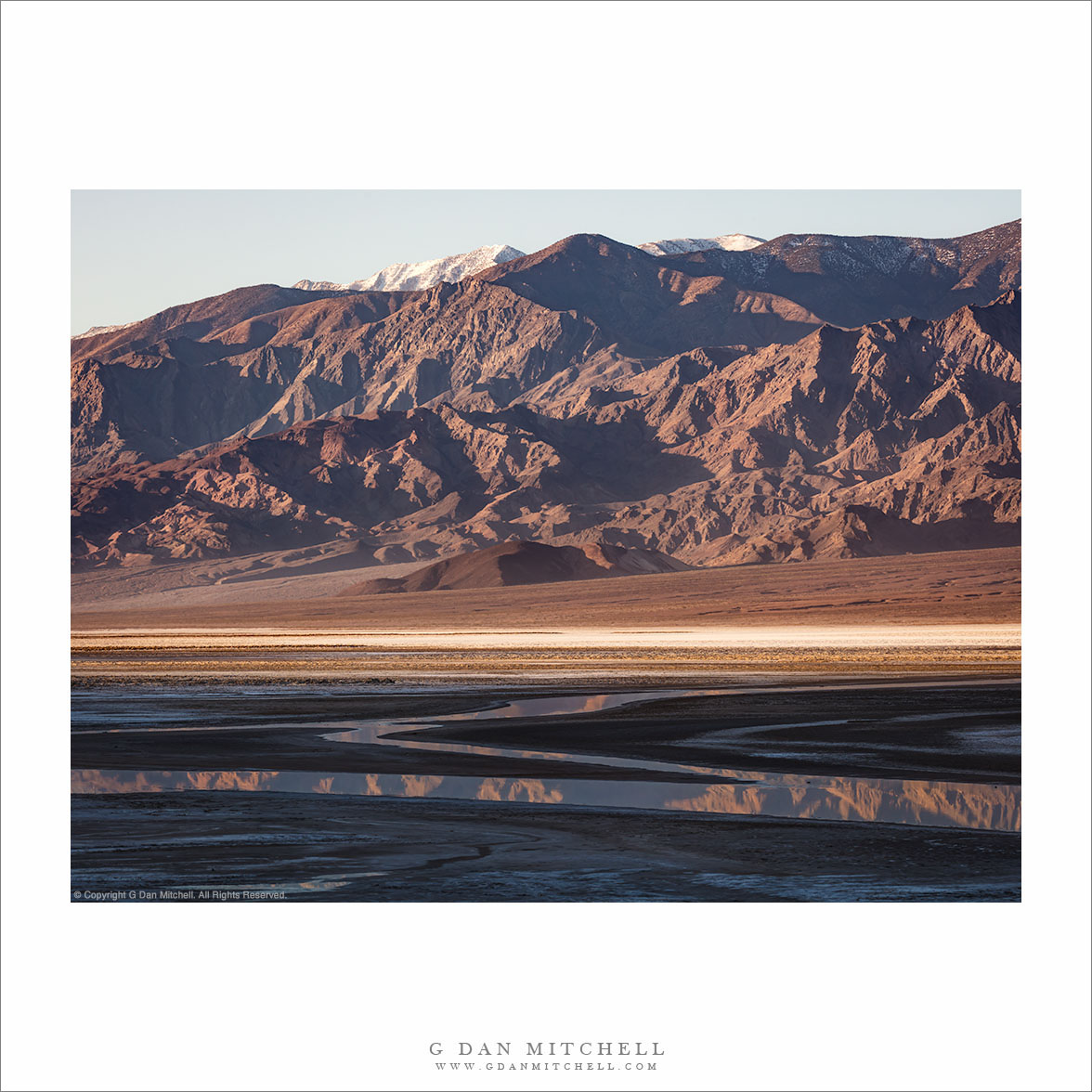
Desert Mountains, Evening

Desert Mountains, Evening, Death Valley
“Desert Mountains, Evening” — Desert mountains tower above a huge fan and hills, Death Valley National Park.

First days in Death Valley are always a bit of a challenge. The day typically starts before dawn with a very long drive from the San Francisco Bay Area. It is at least mid-afternoon by the time I get to the park and find a campsite, and it takes an hour or so to get things set up. By this point evening isn’t that far away, so I usually pick a fairly reliable location for the first evening shoot. (I come back to camp for late dinner after dark.)

This time I headed for an area that I know pretty well, along a route that eventually leads out of the park and into Nevada. There are several locations here that I’ve been “working” for years, photographing them regularly on most visits. So I decided that the goal this evening would be to find different views in that familiar area. At my first stop I hiked to the top of a nearby hill without camera gear, just to get the lay of the land. From that elevated vantage point I could see this scene, so I headed back to my vehicle, got my gear, and set up as evening shadows stretched across the landscape.

G Dan Mitchell is a California photographer and visual opportunist. His book, “California’s Fall Color: A Photographer’s Guide to Autumn in the Sierra” (Heyday Books) is available directly from him. Blog | Bluesky | Mastodon | Substack Notes | Flickr | Email

2 responses to “Desert Mountains, Evening”

  1. G Dan Mitchell Avatar
    G Dan Mitchell

    Hi Greg. Thanks for following my blog and for leaving a comment!

    I probably haven’t reached that 75 visit milestone yet, but I’d guess I’ve been there 35 or 40 times, most often for stays of five days or so. My first visit was in the mid to late 1990s, when I went with one of my kids’ school hiking clubs. In some ways, given the near disasters on that trip (it is a long story… ;-) it may be surprising that I ever went back. But as a long time High Sierra backpacker and cross-country skier, there was something magically different about this landscape. I still vividly recall my very first view of Death Valley itself. On the first morning I opened my tent door and looked down into the valley in the early morning light — I had never seen anything quite like it before, and I was hooked.

    As to what inspires me to go back, that’s perhaps a complex thing. I love the immense space of the place and the profound silence and stillness once you get away from the more popular locations. I’m attracted to the way that this desert landscape is laid bare, not covered by trees and brush, letting us see the geology directly. It also appeal to me that we can go almost anywhere our feet will take us in this wide open landscape.

    But this landscape is also incredibly diverse. People tend to associate Death Valley with sand dunes and barren places, and those certainly are found there. But there are also beautiful canyons, and high mountains. And there are fascinating examples of earlier human presence, ranging from the precious and fragile marks left by the first people who were already there when Europeans first arrived, up through the miners and prospectors, evidence of whose time there is all over the park.

    Photographically, this is an outstanding place to work with light. It changes all day and between seasons, and because much of the terrain is not intensely colorful the light takes over and often becomes the main show.

    I could go on, but I’ll stop there for now… :-)

    Dan

  2. Greg Avatar
    Greg

    Dan, I have been following your blog for a few years. Amazing photography. Thanks for sharing your experiences. It looks like you have been to Death Valley
    75 times or so over the past couple of decades. I have only been 5 times in my lifetime. What inspires you to go back year after year. It is a very visual
    landscape. I find it to be very peaceful. Have a great day. Greg

Join the discussion — you are welcome to leave a comment or question. (Comments are moderated and may not appear immediately.)

This site uses Akismet to reduce spam. Learn how your comment data is processed.

(All media © Copyright G Dan Mitchell and others.)

First Light, Panamint Mountains

First Light, Panamint Mountains, Death Valley
“First Light, Panamint Mountains” — The first sunrise light on Rogers Peak and the Panamint Mountains, Death Valley National Park.

How many times have I watched for this first light as it touches the peaks and ridges of the Panamint Mountains before working its way down to the floor of Death Valley? I have no idea, but I’ve been going there for something like 25 years now, so it must be quite a few times! It never gets old.

The highest point in this photograph is snow-capped Rogers Peak. The highest summit in the park, Telescope Peak, is just out of sight to the left. Surprisingly, there are communications facilities on top of Rogers Peak, and in a higher resolution version of this photograph you can see the towers on the very summit.


G Dan Mitchell is a California photographer and visual opportunist. His book, “California’s Fall Color: A Photographer’s Guide to Autumn in the Sierra” (Heyday Books) is available directly from him.

G Dan Mitchell: Blog | Bluesky | Mastodon | Substack Notes | Flickr | Email


All media © Copyright G Dan Mitchell and others as indicated. Any use requires advance permission from G Dan Mitchell.

At the Edge of the Salt Flats

At the Edge of the Salt Flats, Death Valley National Park.
“At the Edge of the Salt Flats” — Panamint mountains tower above as a small wash runs to the edge of the salt flats, Death Valley.

During my late-February visit to Death Valley National Park I spent two early mornings photographing this location. It is generally most interesting at dawn, when the morning light shines on the distant Panamint Mountains, so I was there well before sunrise. In order to find ideal locations here you really have to scout ahead of time. On the first of the two visits I slightly missed my target location in the darkness. I still got photographs, but before my return on the last morning of my trip, I checked it one more time and determined that following this runoff gully would get me where I needed to be.

There was another benefit from following the little gully. The soil on the higher ground to either side is quite soft and walking on it leaves obvious footprints. In many places the bottom of the gully is covered with small rocks, and it is easier (on me and the landscape1) to walk on this harder surface. Distances here are deceiving. If you started at sunrise (and could find a route) it would take you an entire, long day just to get the base of those mountains.


G Dan Mitchell is a California photographer and visual opportunist. His book, “California’s Fall Color: A Photographer’s Guide to Autumn in the Sierra” (Heyday Books) is available directly from him.

G Dan Mitchell: Blog | Bluesky | Mastodon | Substack Notes | Flickr | Email


All media © Copyright G Dan Mitchell and others as indicated. Any use requires advance permission from G Dan Mitchell.

Salt Flats to Mountain Peaks

Salt Flats to Mountain Peaks, Death Valley
“Salt Flats to Mountain Peaks” — Snow-covered Telescope and Rogers Peaks and the Panamint Mountains tower above Death Valley salt flats in morning shadows

It still seems odd to find water flowing here, but out on the salt flats of Death Valley it does flow at all times of the year. It is extremely shallow and it moves very slowly — but the amount of moisture out there is still impressive. Hint: don’t walk on these flats — you aren’t going to enjoy the thick mud on your shoes, the sensation of sinking into it, or the tracks you leave behind.

These mountains face the rising sun, so I was out there before sunrise, getting set up and framing some compositions so that I could work rapidly as the sun arrived. It comes quickly, and it is only minutes from the first light on the high, snow-covered peaks until the line of light starts to creep across the flats. This isn’t the lowest spot in the valley, though it is below sea level. The highest of those distant peaks is over 11,000 feet tall.


G Dan Mitchell is a California photographer and visual opportunist. His book, “California’s Fall Color: A Photographer’s Guide to Autumn in the Sierra” (Heyday Books) is available directly from him.

G Dan Mitchell: Blog | Bluesky | Mastodon | Substack Notes | Flickr | Email


All media © Copyright G Dan Mitchell and others as indicated. Any use requires advance permission from G Dan Mitchell.