
Tag Archives: scenic

Rising Desert Hills

Rising Desert Hills
Rising Desert Hills

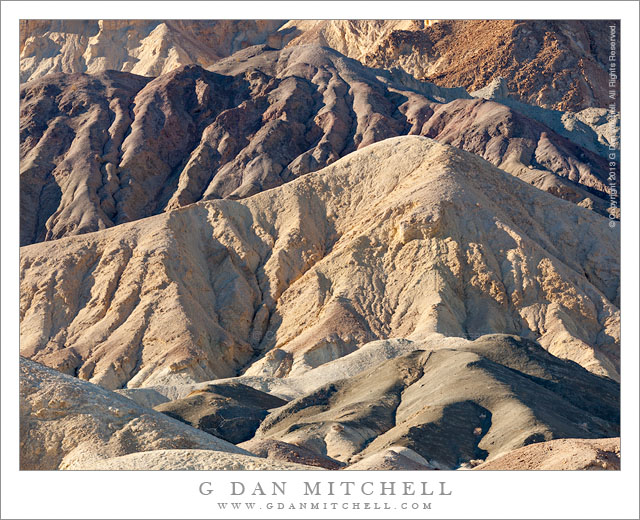
Rising Desert Hills. Death Valley National Park, California. December 10, 2013. © Copyright 2013 G Dan Mitchell – all rights reserved.

A rising series of colorful eroded hills, Death Valley National Park

I get to use this photograph to tell a story at my own expense. Before arriving in Death Valley I had previous shot a very different subject. I don’t recall if it was birds in fading dusk light or perhaps classical musicians in stage lighting and backstage work lights. (Some of you can already guess where this is headed…) On the first morning in Death Valley I headed to a place that I like to photograph in early light – a place where there usually aren’t too many people, despite the easily accessible location, and where the eroded and colorful geology is almost completely devoid of plants. I arrived before sunrise and soon found a nice composition that I had not photographed before. I spent some time working that scene before moving on and photographing another a little ways away. Partway through that second set of shots I realized that my camera was still on the settings for the prior low-light subject – namely ISO 3200. That is not exactly a typical landscape sort of setting, and while good results are possible when shooting low light subjects that way, the noise levels are far from ideal for landscape. I reset and continued shooting. (I did return to the location on the final morning of the trip to reshoot that first subject.)

This scene was one of the first that I shot after realizing my error. These very eroded hills place different color material in a series of rising hills – tan, reddish, purple-black, brown, and more. The smooth features along the tops of some of the small ridges contrast with the very sharp and angular lines of the eroded channels that lead down to the wash. Later in the day the light here is almost impossibly harsh and the colors fade, but for a few minutes at the start (especially) and end of the day the colors briefly intensify.

G Dan Mitchell is a California photographer and visual opportunist whose subjects include the Pacific coast, redwood forests, central California oak/grasslands, the Sierra Nevada, California deserts, urban landscapes, night photography, and more.
Blog | About | Flickr | Twitter | FacebookGoogle+ | 500px.com | LinkedIn | Email

Text, photographs, and other media are © Copyright G Dan Mitchell (or others when indicated) and are not in the public domain and may not be used on websites, blogs, or in other media without advance permission from G Dan Mitchell.
Titus Canyon Narrows

Titus Canyon Narrows

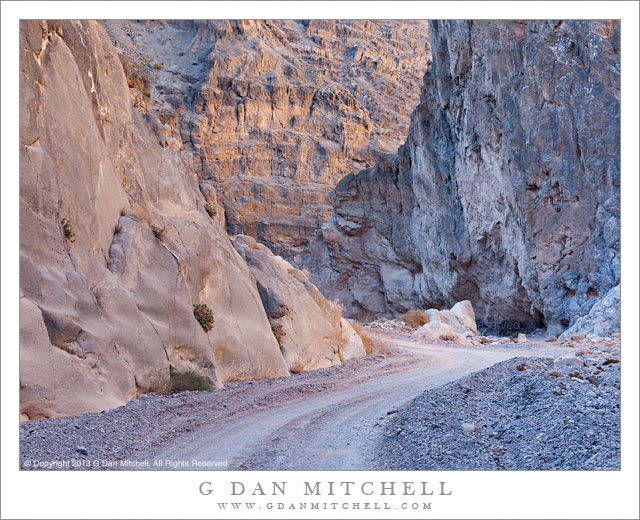
Titus Canyon Narrows. Death Valley National Park, California. December 11, 2013. © Copyright 2013 G Dan Mitchell – all rights reserved.

Titus Canyon road passes through the Narrows as light reflects down from canyon walls high above

Titus Canyon road is a well-known “attraction” in Death Valley National Park, traveling from the eastern park boundary in the Amargosa Valley near the town of Beatty, Nevada over the Grapevine Mountains and then down to Death Valley itself. It is also known as a fairly rough road, subject to washouts and closures after storms – not a true four-wheel-drive road, but certainly not for the faint of heart of those who are not accustomed to rough desert and mountain driving. (Many chose to forgo the long drive and instead hike into the canyon from its mouth, from which the spectacular “narrows” section is easily accessible.)

I have been getting to better know the country through which this road passes as I’ve driven it many times during the past decade or so. More recently I have been slowing down and taking nearly the full day to drive its length – and in doing so I am able to see and photograph things that I used to miss. Oddly, since it is often regarded as the main attraction of the route, I’ve often found it very difficult to photograph the narrows section near the end of the road just before it spills out at the top of a giant alluvial fan along the edge of Death Valley. Perhaps it is the predominantly gray color of the rocks – once you’ve photographed the canyons of the Southwest, California rock just looks so drab! This time I think I passed through the narrows section at what must have been just about the ideal time of day and season, and light hitting upper canyon walls was reflecting down into the bottom of the canyon and creating some interesting, albeit subtle, colors and soft reflections on the rocks.

G Dan Mitchell is a California photographer and visual opportunist whose subjects include the Pacific coast, redwood forests, central California oak/grasslands, the Sierra Nevada, California deserts, urban landscapes, night photography, and more.
Blog | About | Flickr | Twitter | FacebookGoogle+ | 500px.com | LinkedIn | Email

Text, photographs, and other media are © Copyright G Dan Mitchell (or others when indicated) and are not in the public domain and may not be used on websites, blogs, or in other media without advance permission from G Dan Mitchell.
Fractured Rock, Reflected Light

Fractured Rock, Reflected Light

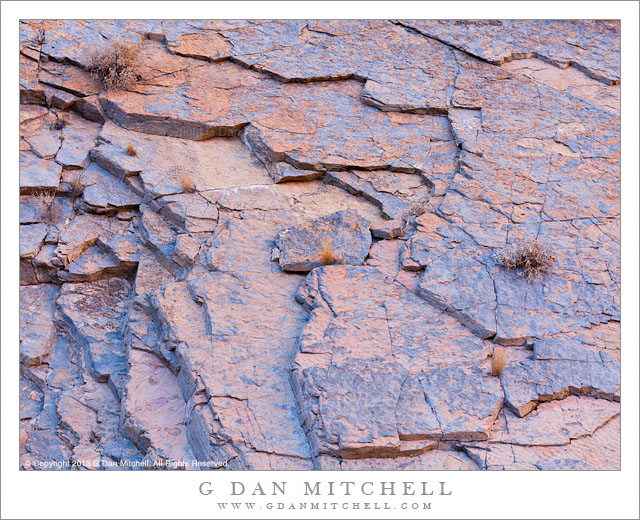
Fractured Rock, Reflected Light. Death Valley National Park, California. December 11, 2013. © Copyright 2013 G Dan Mitchell – all rights reserved.

A few plants grow on fractured pink and blue canyon rock illuminated by light reflected from nearby cliffs

In my experience, the geology of Death Valley mostly features relatively subdued coloration. While this geology is laid bare by the lack of thick vegetation, the colors are mostly shades of gray, white, tan, with occasional blues and greens from mineral deposits. But you rarely will see here the intense colors of, say, the sandstone formations of the Southwest. (Sorry to disappoint anyone, but if you have seen some photographs featuring intensely colorful deposits in places like “Artist Palette,” you may be a bit disappointed to see the real thing!) This is not entirely bad news, as subtle colors can also be very beautiful, and even these colors can become intensified in the right light… and that does occur in Death Valley.

This photograph perhaps tells a story that is partially about the color of rock and a bit about the light, and is also about keeping my eyes open for the fleeting and sometimes surprising examples of color. I was in a place that is not known for brilliant colors, at least not in the walls of this narrow canyon. As I passed through a narrow and twisting section, two things happened, and even though I’ve been there before this was the first time that I noticed them at this point. First, the steep, almost seems cliff-like wall has fractured layers and slabs that remind me a bit of exfoliating granite that I know so well from the Sierra. These layers alternate pinkish rock (that this non-geologist thinks look like some sort of sandstone) with inner layers that have a blue cast. Second, at the right time of day when the light strikes the upper walls of the narrow canyon, the light reflects down into its depths and warms the color of the light, emphasizing these subtle colors to produce what is, at least for Death Valley, some rather striking coloration.

G Dan Mitchell is a California photographer and visual opportunist whose subjects include the Pacific coast, redwood forests, central California oak/grasslands, the Sierra Nevada, California deserts, urban landscapes, night photography, and more.
Blog | About | Flickr | Twitter | FacebookGoogle+ | 500px.com | LinkedIn | Email

Text, photographs, and other media are © Copyright G Dan Mitchell (or others when indicated) and are not in the public domain and may not be used on websites, blogs, or in other media without advance permission from G Dan Mitchell.

Shoreline Sea Stacks

Shoreline Sea Stacks
Shoreline Seastacks

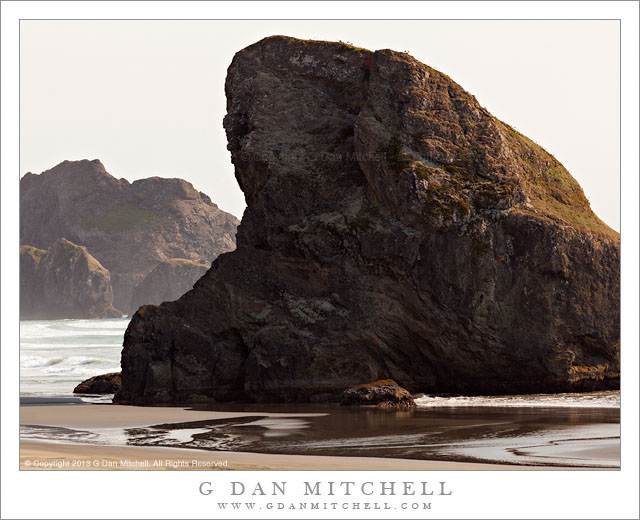
Shoreline Sea Stacks. Port Orford, Oregon. August 20, 2013. © Copyright 2013 G Dan Mitchell – all rights reserved.

Giant shoreline sea stacks along the Oregon Pacific Ocean coastline.

As we traveled south along the Oregon coastline on the Oregon Coast Highway (US 101) we passed through various towns ranging from quite small to middle-sized. Eventually we came to Port Orford, which did not seem to us to be all the exceptional of a place – though apologies to Port Orfordians, who probably know the beauties of the place far better than some Californians quickly passing through! However, there was one interesting feature that immediately caught our attention. As the highway pass through the town it curves to the left to follow the coast. But at the point where the curve went left, a short section of road continued straight ahead to the top of a hill that appeared to overlook the coast, and a giant sign hand-painted on the roadway almost demanded that we leave 101 and see what was there.

Just over the top of this short side road was an open view of the coast to the south, curving inland right below the town to form a shallow bay. Slightly beyond this we could see a set of large sea stacks along the beach… but no picture in this particular light from our position. We continued on along the highway, curving through town and then back towards the south, and soon came to the spot where the sea stacks stood. Despite some tricky light, including wildfire haze and afternoon intense light, we paused to make a few photographs. First, a large group of pelicans surprised us by slowly flying by into the strong headwind and then landing almost directly in front of us at the waterline. Then I put a longer lens on the camera and went looking for an angle that would let me combine near and far towers with a bit of surf along the wild beach.

G Dan Mitchell is a California photographer and visual opportunist whose subjects include the Pacific coast, redwood forests, central California oak/grasslands, the Sierra Nevada, California deserts, urban landscapes, night photography, and more.
Blog | About | Flickr | Twitter | FacebookGoogle+ | 500px.com | LinkedIn | Email

Text, photographs, and other media are © Copyright G Dan Mitchell (or others when indicated) and are not in the public domain and may not be used on websites, blogs, or in other media without advance permission from G Dan Mitchell.