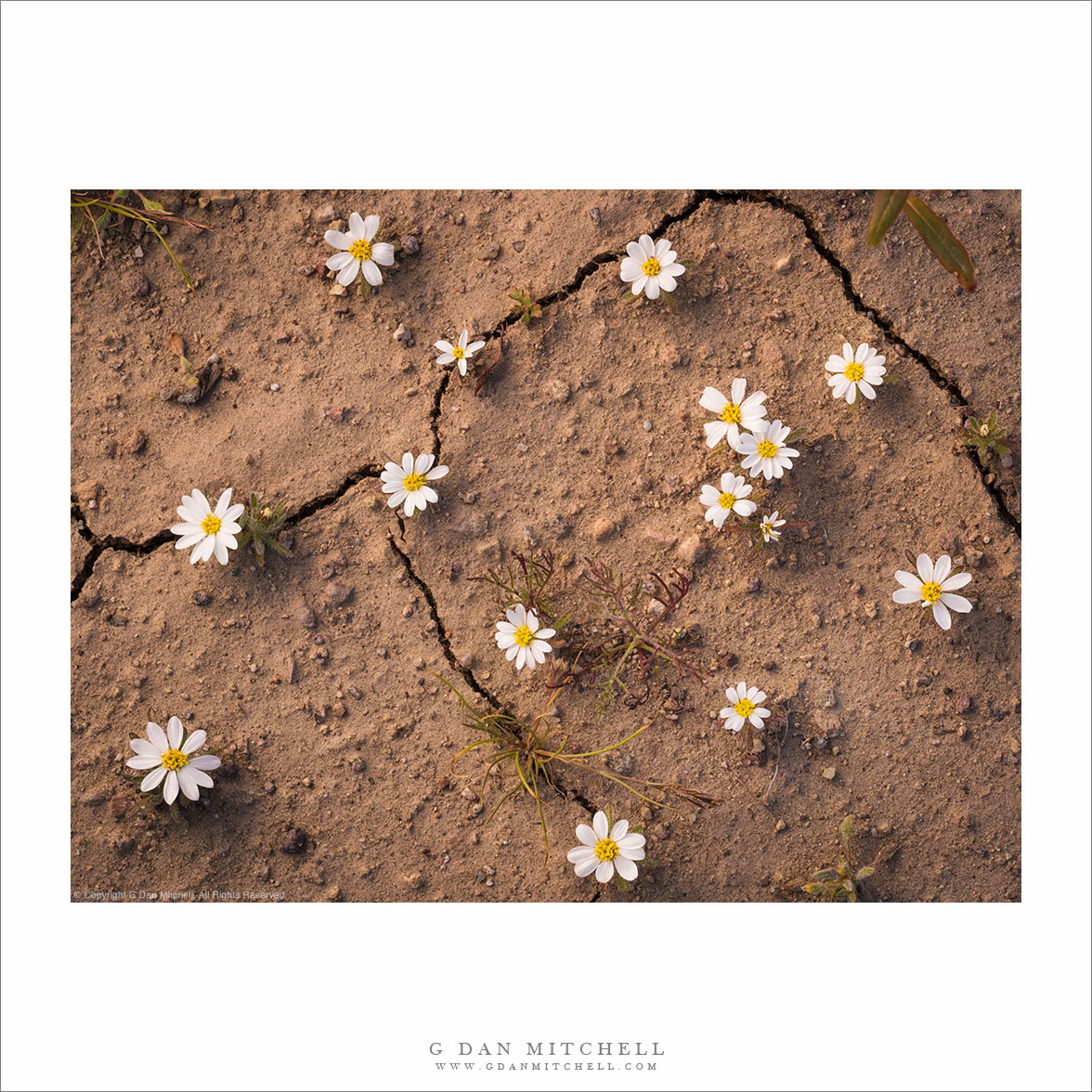
“Desert Star Flowers” — Tiny desert star (monoptilon bellioides) flowers, Death Valley.
As I mentioned yesterday in the first post following our late-February visit to Death Valley, the main stories this time were wildflowers and Lake Manly. This post is about the former. We went to the place where I photographed these desert star (or Mojave star) flowers looking for sand verbena and desert gold, and we definitely found them. But there were lots of other flowers, too, including these tiny specimens.
I’ve always been aware of wildflowers — kind of hard to ignore them when they appear in large numbers and brilliant colors! But I’ve missed a lot about them, too, as I focused on other elements of the landscape. But my wife, Patricia Emerson Mitchell, wildflowers are her thing. And photographing with her taught me to look down and see things that I had missed before. This is especially true in the desert, where there are myriad tiny wildflowers underfoot in the most surprising places.
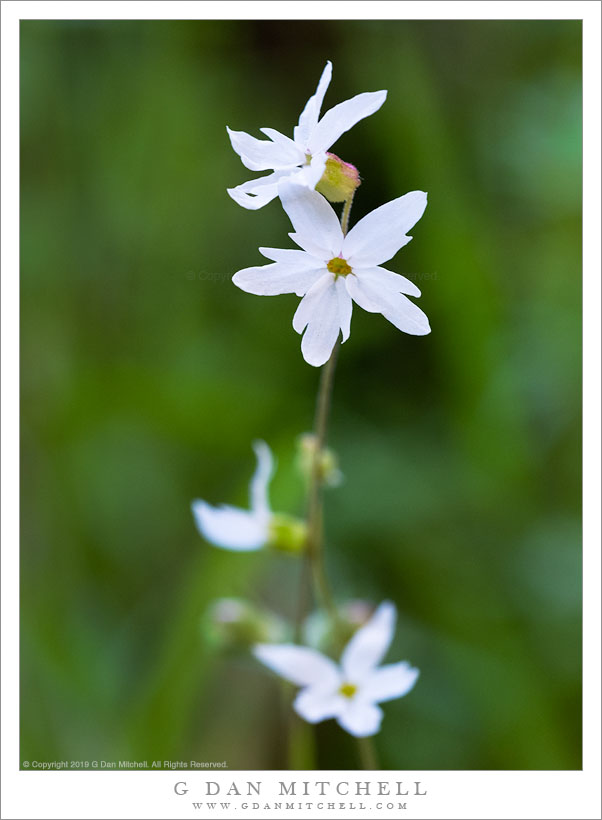
Woodland Star flowers, Spring, Pinnacles National Park.
Pinnacles National Park is almost and “old friend” of a park for me. My family first visited when I was quite young, and I recall exploring the High Peaks Trail and the caves. Although I knew that there could be excellent wildflower displays here I had never gotten myself organized to photograph there. So this was my first time to try to accomplish that task.
I arrived early in the morning, and it was easy to see lots of wildflowers immediately. I decided to hike up the shore of a small reservoir, from which I would continue on to the High Peaks Trail. Along the first section of trail the route passed through a small, intimate valley, and it was in this area that I spotted and photographed these flowers.
G Dan Mitchell is a California photographer and visual opportunist. His book, “California’s Fall Color: A Photographer’s Guide to Autumn in the Sierra” is available from Heyday Books and Amazon.
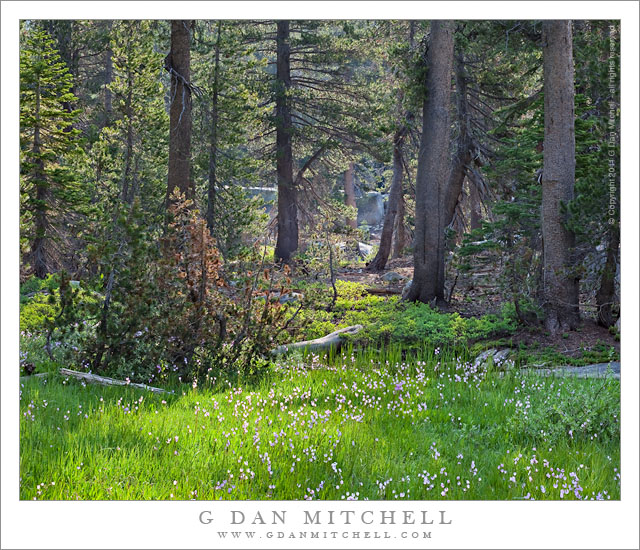
A small sunlit meadow filled with shooting star flowers meets the edge of a dense lodgepole pine forest, Yosemite National Park.
For some reason many of the photographs I made on my recent trip to the Yosemite high country seemed to focus on the trees and the forests, and perhaps a bit less on the rocky peaks and prominences of the park. This photograph was made in a place that is not “special” in the ways that specialness is often measured in this park. As far as I know, it has no name, though it is not too far from Olmsted Point. It is simply a little area like so many others in this part of the Sierra, but one that I feel a connection to now that I have revisited it on several occasions and gradually pushed out the boundaries of my familiarity with it.
I first stopped near this spot along Tioga Pass Road several autumns ago on an evening when fog blanketed the nearby ridges. Very close to this spot there was a break in the fog, and I could see the sunset light and its effect on the fog clouds, so I pulled over and made some photographs. A year or so later, now having an actual awareness that there was a pull-out at this spot in the road, I stopped again on a summer morning for no particular reason and saw that a faint trail headed off into the lodgepole forest that was mixed with glacial boulders. I walked a short distance out on this path and found a small pond that I photographed, and I filed the location away as one to investigate again later.
On this July’s visit, I put this spot on my agenda and made a plan to visit it early on morning after photographing first light on a nearby ridge. Because there is no single attention-grabbing icon at this spot, rather than leaving my car with a target in mind I wandered slowly into this forest and simply kept my eyes open. (And I tried not to think about the mosquitos that are always thick in the lodgepole forest at this time of year!) First I stopped at the pond that I had previously photographed; then I picked up that trail and followed it through the forest, past other ponds, and across some glaciated granite near the edge of this small meadow filled with shooting star flowers, with the light coming through the forest beyond.
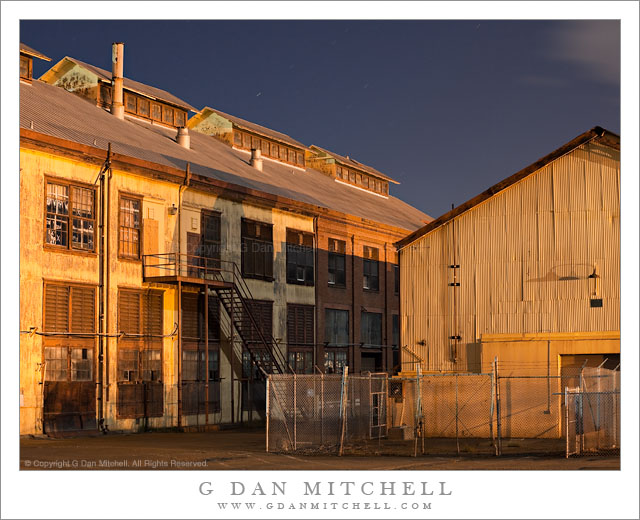
Night photograph of abandoned industrial buildings from the historic Mare Island Naval Ship Yard.
The building on the left is sometimes known as the “UFO Building” – not because of anything that might be stored inside, but because of a shadow in the shape of a “flying saucer” that forms on one of its walls. I thought it was the only one until I took this photo in which you might spot another saucer-shaped shadow on the wall of the building at the right.
This scene is not a particularly unusual one at the historic Mare Island Naval Ship Yard, a place that is full of old industrial buildings left over from the long ship-building history on this island. Many of the old buildings are now in a state of somewhat arrested development, but they certainly show the signs of age and lack of care – lots of boarded up buildings, peeling paint, warnings about hazards of various kinds, and so forth.
Most of the light in this photograph comes from a bank of strong security lights on the exterior of a more modern nearby building, and the yellow color is a result of the type of lighting that is used. There is also a bit of full moon light in the shadows and on the bit of cloud at the upper right, and this also explains the lighter coloration of the sky. When making night photographs in a place like this, I feel comfortable about not really trying to “capture” an objective reality of the place. To be blunt, that is pretty much impossible. First of all, it is actually so dark in many of these places that it takes a while for your eyes to get used to it. Secondly, there are so many varied light sources with so many different colorations that it is essentially impossible to “color correct” the scene – though I’m not even quite certain what it would mean to do that in a scene that we really can’t “see” with our own eyes.
The idea in my night photography is not often to capture the scene as it “is,” but instead to reflect the way “the camera sees,” a way of seeing that is quite different from our native modes of seeing. Things that occur over long periods of time (exposures measured in minutes) appear in a single frame, sometimes objects lose their definition as shadows move and wind blows, stars create streaks in the sky and passing clouds blur, and the colors are far from “natural.”
Photographer and visual opportunist. Daily photos since 2005, plus articles, reviews, news, and ideas.
Manage Consent
To provide the best experiences, we use technologies like cookies to store and/or access device information. Consenting to these technologies will allow us to process data such as browsing behavior or unique IDs on this site. Not consenting or withdrawing consent, may adversely affect certain features and functions.
Functional
Always active
The technical storage or access is strictly necessary for the legitimate purpose of enabling the use of a specific service explicitly requested by the subscriber or user, or for the sole purpose of carrying out the transmission of a communication over an electronic communications network.
Preferences
The technical storage or access is necessary for the legitimate purpose of storing preferences that are not requested by the subscriber or user.
Statistics
The technical storage or access that is used exclusively for statistical purposes.The technical storage or access that is used exclusively for anonymous statistical purposes. Without a subpoena, voluntary compliance on the part of your Internet Service Provider, or additional records from a third party, information stored or retrieved for this purpose alone cannot usually be used to identify you.
Marketing
The technical storage or access is required to create user profiles to send advertising, or to track the user on a website or across several websites for similar marketing purposes.