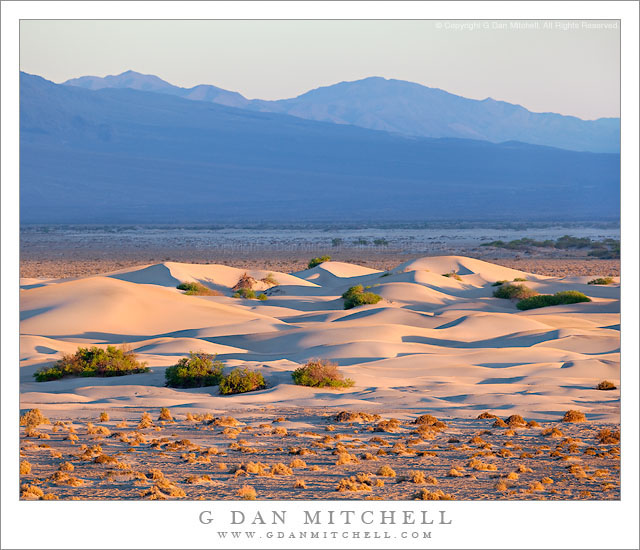
Early morning light striking minor dunes on Mesquite Flat with Cottonwood Mountains wash and the Last Chance Range in the distance, Death Valley National Park.
These dunes are not too far from the main Mesquite Dunes near Stovepipe Wells – they are a bit further east from the better known tallest section of the dunes. The areas of lower dunes provide some very interesting shapes and textures on a smaller scale in some ways that those of the larger dunes. I photographed these with a long lens, shooting from a rise, at a point in time very shortly after the first morning light had struck the sand. The background hills, part of a very large alluvial fan at the base of the Cottonwood Mountains, were in the shadow of a cloud.
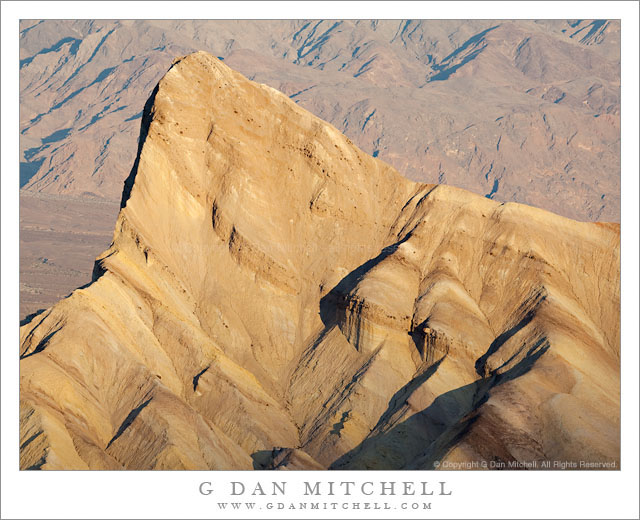
The first morning light strikes Manly Beacon at Zabriskie Point, Death Valley National Park.
Icon alert!
I had more or less promised myself that I would not photograph at Zabriskie Point on this trip – been there, done that – unless the conditions were really special. But I miscalculated my morning start on this day and discovered that I wasn’t going to make it to my intended destination in time. As I passed Zabriskie on my way to the “other place,” telling myself that I still had a half hour before I needed to be in place for the early light… I noticed that clouds above this area were already starting to pick up the pink color of dawn light. I hesitated for a moment – I really wanted to photograph that other subject – but quickly realized that it would make a lot more sense to the shoot the subject that was here in the light that was developing than to drive further and miss out entirely on the first light.
So I turned into that familiar parking lot with its familiar fleet of photographers’ cars and quickly loaded up my gear. I was a bit surprised that I saw so few people up above at the official overlook, but it was quite windy and I figured that perhaps they had just dropped down on the other side of the wall below this spot. In any case, I had a different spot in mind, one further to the right, so I headed over that way and quickly discovered that the wind was blowing almost too strongly to make photographs. I made a couple of shots from a small gap there and then headed up toward the overlook. At the top of the little trail from the parking lot I dropped onto the small use trail to the side of the wall and was again surprised to see almost no other photographers. I walked a few feet farther and discovered that the “usual crowd” was huddled in a small area in the lee of the wall, trying desperately to find protection from the wind.
These days, my main project when I stop at Zabriskie is to find and photograph small, isolated elements of the landscape with a long lens. For the most part – unless truly magical conditions are present, and they weren’t on this morning – I don’t really spend much time on the classic views of Gower Gulch, the Valley, and the Panamint Range. However, since I’m there and know the progression of the light fairly well at this point, I’m not about to pass up the opportunity to get a better image of one of these iconic subjects. So as the first light was about to hit the summit of Manly Beacon I turned my rig that direction and spent a couple of minutes photographing it as the line between shadow and morning light traveled down its face.
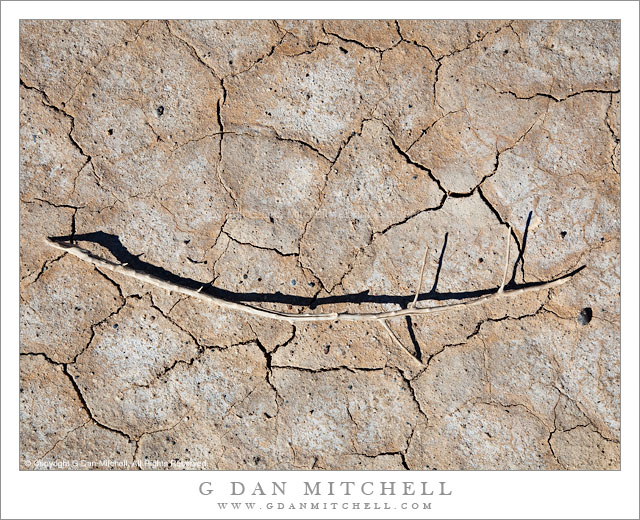
A lone branch lies across dried mud on the playa of Panamint Valley, Death Valley National Park.
First, a story about the location. My first visit to Death Valley was sometime in the late 1990s, when the “hiking and biking” club at my kids’ middle and high school did a trip there. The club is a long and interesting story that I don’t have time or space to describe here fully. Suffice it to say that the teacher, “Mr. Hodges,” had for decades taken kids on amazing outdoor adventures throughout the western United States every year, and that the trip that year was to involve visits to several places in the park and then a backpacking trip down to the Valley from up in the Teakettle Junction vicinity. This may sound like a crazy thing to do with a bunch of school kids, but the group had a record of success. I was along as a parent chaperone since my oldest son was a participant in the trip.
The “readers digest” version of the story of the trip is that, as is often the case near the beginning of April, we encountered an astonishing range of weather conditions. Early on it snowed and the wind blew at gale force levels. This forced us to abandon our initial backpacking plans after we had already camped overnight near Teakettle Junction, and to head back down to the Valley. We readjusted our plans and decided that we might still be able to do an overnight hike down the length of the upper Valley and (leaving out a bunch of intervening adventures in this narrative) we arrived at Stovepipe Wells and set up camp… just in time for a tremendous dust storm to blow in. The next morning the “bus” arrived that was to take the kids and a few of the chaperones home (the rest of us were in a truck carrying tons – literally – of gear on the roof rack and in a trailer) and we headed up to cross Towne Pass. It turned out that the “bus” (which was more or less a large airport shuttle-type van) was ill-equipped for these conditions and after struggling up the pass and then racing down the other side, the transmission blew out at the bottom of the descent into Panamint Valley. Those of us in the truck pulling the trailer arrived a few minutes later to find a group of scared kids and parents who had just experienced more excitement than they wanted.
I have a strong visual memory of “Mary,” one of the parents, who had just had a bit too much excitement walking quietly north away from the road and across this playa. Ever since that time, this place that most people would probably blow right past, has almost always warranted a stop as I passed by on my way out of the Valley. This trip was no exception. I left my camera gear in the car and just walked a ways out onto the playa. As I walked, even though I had been certain that my photography for this trip was finished, I started noticing some of the small details on the playa… and I went back to my car to get my camera, then returned and made a few hand-held exposures of some of these small subjects.
Morning sun back-lights the dense pattern of folds in a small gully at Zabriskie Point, Death Valley National Park, California.
In some ways I think this is one of the more subtle and complex of the various photographs I have made that isolate small sections of the Zabriskie Point landscape, especially the eroded patterns of the small gullies below the main viewing area. This photograph, like many in this series, was made after the normal “dawn light” time period, and at this time the sun is higher in the sky. It begins to back-light the tops of the furrows and gullies and the brighter light reflects down into the lower portions of the gully. There are a tremendous number of overlapping ridges and the color variations are quite large, though subtle at the same time. Some areas have a very blue cast, being in shadow and lit almost completely by the open blue sky. Others take on warmer tones, especially if they are illuminated by light reflected from the warm-tones earth. An area of thin clouds was floating above the scene and its shadow slightly softened and muted the light that otherwise might have been quite stark.
Photographer and visual opportunist. Daily photos since 2005, plus articles, reviews, news, and ideas.
Manage Consent
To provide the best experiences, we use technologies like cookies to store and/or access device information. Consenting to these technologies will allow us to process data such as browsing behavior or unique IDs on this site. Not consenting or withdrawing consent, may adversely affect certain features and functions.
Functional
Always active
The technical storage or access is strictly necessary for the legitimate purpose of enabling the use of a specific service explicitly requested by the subscriber or user, or for the sole purpose of carrying out the transmission of a communication over an electronic communications network.
Preferences
The technical storage or access is necessary for the legitimate purpose of storing preferences that are not requested by the subscriber or user.
Statistics
The technical storage or access that is used exclusively for statistical purposes.The technical storage or access that is used exclusively for anonymous statistical purposes. Without a subpoena, voluntary compliance on the part of your Internet Service Provider, or additional records from a third party, information stored or retrieved for this purpose alone cannot usually be used to identify you.
Marketing
The technical storage or access is required to create user profiles to send advertising, or to track the user on a website or across several websites for similar marketing purposes.