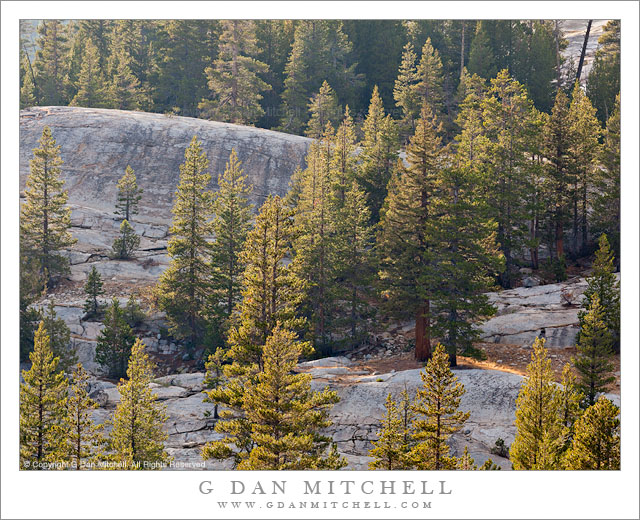
Forest trees ascend a slope filled with small granite domes and ledges, Yosemite National Park.
This little scene could probably be found in a few thousand locations in the Sierra if you were to keep your eyes open while wandering about. The combination of glacially-smoothed, rounded granite formations, a bit of meadowy grass, and groves of pines is a distinctly “Yosemite” sight for me.
I photographed these trees in a location not far from the Tuolumne River where a side canyon comes down from above to join it. From a somewhat open position along one side of this valley I was able to shoot across the valley with a slightly long lens and compress the distance a bit and pick out a series of granite diagonals interrupted and hidden by the back-lit trees.
G Dan Mitchell is a California photographer whose subjects include the Pacific coast, redwood forests, central California oak/grasslands, the Sierra Nevada, California deserts, urban landscapes, night photography, and more. Blog | About | Flickr | Twitter | Facebook | Google+ | 500px.com | LinkedIn | Email
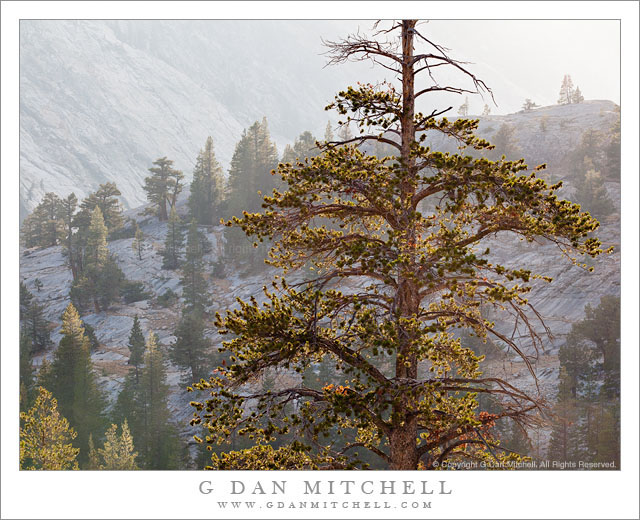
Late afternoon sun back-lights haze around trees growing on granite domes along the Tuolumne River, Yosemite National Park.
I’m a big fan of shooting almost straight into the sun, especially when haze is involved and even more so when backlit trees can be the subject. This photograph was made in essentially these very backlit conditions, with the direct sun just a bit above and to the side of the scene. I liked the way that the near tree’s branches had more presence in front of the haze-faded low contrast background of the nearby ridge with trees and the further ridge fading into the bright haze.
I posted a slightly different version of this scene last week – one in which I had placed the tree almost directly in the center of the frame. Although some will cite some “rule of composition” to disallow that sort of composition, I think that the rules don’t make a lot of sense if your way of applying them is to simply follow them slavishly. I consider them to be more like “observations about composition” than rules of composition. It isn’t that placing a subject in the center of the frame is wrong, it is just that doing so can have a very different effect than putting it along an edge, one-third of the way in from a corner, at the bottom or top of the frame, and so forth. It is more important to get a sense – either intuitive or analytical – of the effects might be of these different placement options. In any case, I liked the centered composition of the other version – centered compositions can have a certain kind of calm strength, and the centering perhaps focused a bit more attention on the tree and a bit less on the background.
At the same time, I like this more “tradition” composition that places the tree a bit off-center to the right side of the frame. In a way, this opens up the frame a bit and I think it gives the middle ridge and its trees a bit more presence. I think it also allows the viewer to see the subtle light on those middle distance trees a bit better. And speaking of that part of the scene… I made a mistake at the time of exposure. With the sun almost in the field of view of the lens, I had to shield the front of the lens from the sun – but in this image I apparently missed a bit since I found a fairly obvious reddish flare in part of the frame. I’m glad to say that by a combination of color balance correction, some control over saturation, and a bit of work with a curve…. I think that I have managed to make the flare go away!
G Dan Mitchell is a California photographer whose subjects include the Pacific coast, redwood forests, central California oak/grasslands, the Sierra Nevada, California deserts, urban landscapes, night photography, and more. Blog | About | Flickr | Twitter | Facebook | Google+ | 500px.com | LinkedIn | Email
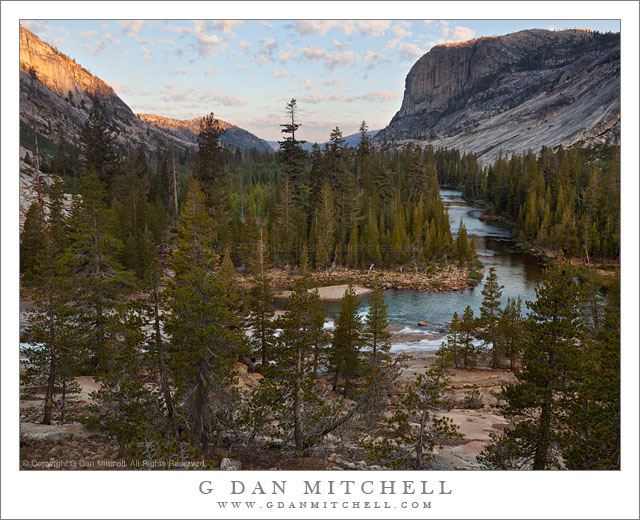
Early light on morning clouds above the Tuolumne River Canyon below Glen Aulin, Yosemite National Park.
This is the same bend in the Tuolumne River, located below Glen Aulin and before the river descends toward Waterwheel Falls and eventually the abomination of Hetch Hetchy Reservoir, that was shown in a photograph of late afternoon light that I posted here a few days ago. This time it was early morning. We had been up well before sunrise and had wandered off in various directions to find early morning photographic subjects. My main goals were the cascading water along the edge of this section of the river (a bit of which is visible in the lower portion of the frame) and a granite bowl to the right of this view. As I came over the rise above this area before descending I saw the beautiful sparse clods to the west, probably extending to the edge of the Sierra and still with pastel colors from dawn light.
A technical observation about this photograph. This scene presented a technical challenge in the form of an extremely wide dynamic range between the bright and red-saturated first direct sunlight on the ridge at upper left and the much darker areas of forest in shade along the river and in the foreground. With a digital exposure, in a scene like this one, the primary rule for me is “don’t blow out the highlights.” If I had overexposed the sky the clouds would have turned into pure white, texture-free blotches and that bit of early sun on the rocks would have lost detail and taken on a very strange coloration. However, an exposure that protects the highlights in a scene like this one can leave the shadows nearly black. While it is possible to “fix” that a bit in post, the result is not necessarily very good when the dynamic range is very large. One “traditional” solution would have been to use a graduated neutral density filter (or “GND”) that blocked some of the brightest areas at the top of the frame while not affecting the lower 2/3 or so. But I don’t use them, and in this case the result would not have been totally wonderful since the same filtering that would reduce sky brightness would also make the large granite dome at the right end up nearly black at the top.
So instead of filtering at the time of exposure, I decided that I would use the roughly comparable, but more flexible, “exposure blending” techniques in post. With that in mind I made several photographs at different exposures – some at shorter shutter speeds to avoid the blown out highlights and others at increasingly slower shutter speeds to reveal the shadow detail that my eyes could see but which the camera otherwise could not. During the post-production phase, I selected two of the exposures, one that was as bright as possible but without blowing out the sky and sunlight, and the other two stops lighter to reveal that shadow detail in a way that seemed consistent with what I recall the scene actually looked like. The two source images were carefully adjusted during raw conversion and their two layers carefully aligned. With the darker image (the one with the “good” sky) on the top, I began to “paint” out the mask to reveal the details of the foreground forest, river, and rocks. (In answer to the expected question, this is not the same as HDR. That is a more or less automated process that works in a different way. Exposure blending is typically a manual process that relies a great deal on the photographers judgment and recall of the actual scene.)
G Dan Mitchell is a California photographer whose subjects include the Pacific coast, redwood forests, central California oak/grasslands, the Sierra Nevada, California deserts, urban landscapes, night photography, and more. Blog | About | Flickr | Twitter | Facebook | Google+ | 500px.com | LinkedIn | Email
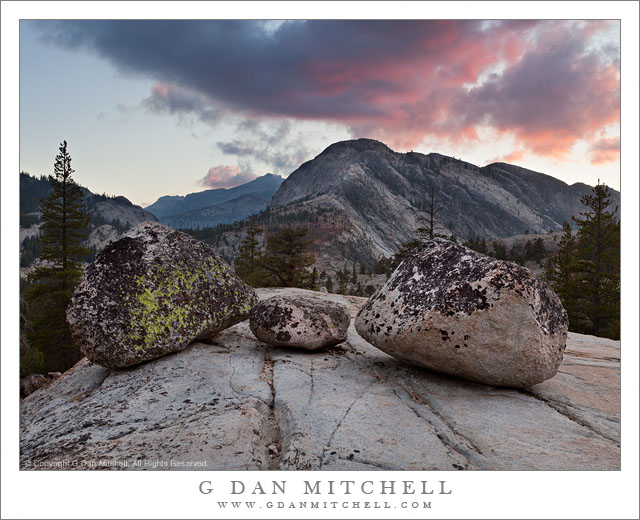
Three glacial erratic boulders atop a granite dome near Glen Aulin, Yosemite National Park.
Looking for something to photograph one evening during my September back-country photography trip into the Glen Aulin and McCabe Lakes area of Yosemite National Park, I climbed up from our camp site to the top of this small granite dome or “whaleback” above the valley of Glen Aulin. The dome is merely the most open and exposed portion of a ridge of more durable rock that rises a ways up the slope from near where we were camped, and from its “summit” I had a 360-degree panorama of the surrounding landscape as the day came to an end.
When I first arrived at this spot more than an hour earlier, the sky was almost completely clouded over. This was one of those situations in which the immediate photographic prospects seemed quite limited, with gray skies and murky atmosphere, but with some potential for interesting things to happen if the clouds thinned as sunset approached. So I decided to stick around in this spot rather than wandering around looking for something else, and in the end the clouds did thin. Before I made this photograph, one of the last of the evening, I had managed to find a range of subjects as the light changed: the light from breaks in the clouds began to move across a forest to my right and light a small prominence nearby; light coming over the ridge at the far right back-lit some haze behind trees on a lower ridge that was closer to me; and finally the remaining clouds took on a bit of color right as the sun dropped below the horizon.
G Dan Mitchell is a California photographer whose subjects include the Pacific coast, redwood forests, central California oak/grasslands, the Sierra Nevada, California deserts, urban landscapes, night photography, and more. Blog | About | Flickr | Twitter | Facebook | Google+ | 500px.com | LinkedIn | Email
Photographer and visual opportunist. Daily photos since 2005, plus articles, reviews, news, and ideas.
Manage Consent
To provide the best experiences, we use technologies like cookies to store and/or access device information. Consenting to these technologies will allow us to process data such as browsing behavior or unique IDs on this site. Not consenting or withdrawing consent, may adversely affect certain features and functions.
Functional
Always active
The technical storage or access is strictly necessary for the legitimate purpose of enabling the use of a specific service explicitly requested by the subscriber or user, or for the sole purpose of carrying out the transmission of a communication over an electronic communications network.
Preferences
The technical storage or access is necessary for the legitimate purpose of storing preferences that are not requested by the subscriber or user.
Statistics
The technical storage or access that is used exclusively for statistical purposes.The technical storage or access that is used exclusively for anonymous statistical purposes. Without a subpoena, voluntary compliance on the part of your Internet Service Provider, or additional records from a third party, information stored or retrieved for this purpose alone cannot usually be used to identify you.
Marketing
The technical storage or access is required to create user profiles to send advertising, or to track the user on a website or across several websites for similar marketing purposes.