
Tag Archives: wetland

Water Plants

Water Plants
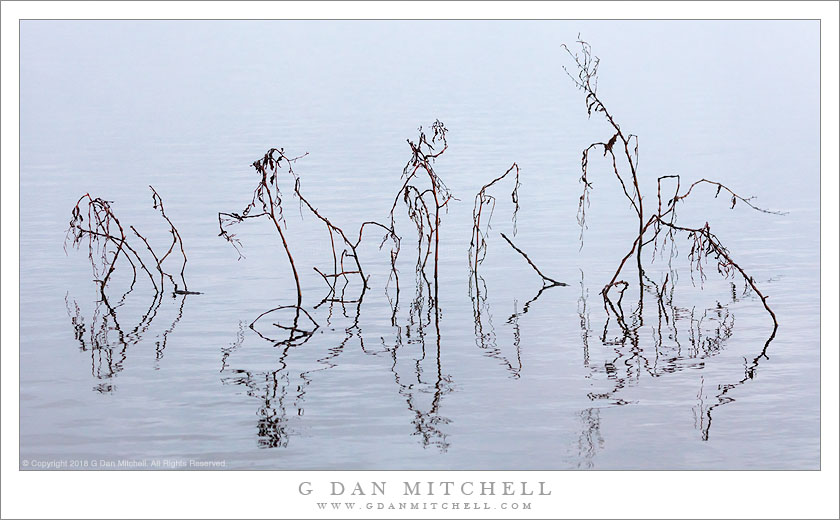
Water plants growing in a wetland pond

Water Plants. © Copyright 2018 G Dan Mitchell – all rights reserved.

Water plants growing in a wetland pond

Reflecting water is endlessly fascinating, and it is hard to resist and opportunity to photograph it, especially when it serves to abstract the forms of other subjects. No two such photographs are ever quite alike, as the water is always in motion and the patterns of reflected light, clouds, and sky are constantly shifting.

These water plants, which you might think of as being almost objectively ugly in some conditions, become transformed by the reflections and by being positioned against the nearly featureless background of the water’s surface. Photographing this subject is, as I’ve observed among my photographer friends, both unavoidable and often a bit more difficult that you think it will be. These nearly random forms are appealing, but when you look at them closely it is easy to find compositional problems — overlaps, awkward shapes, unbalanced arrangements.


See top of this page for Articles, Sales and Licensing, my Sierra Nevada Fall Color book, Contact Information and more.

G Dan Mitchell is a California photographer and visual opportunist. His book, “California’s Fall Color: A Photographer’s Guide to Autumn in the Sierra” is available from Heyday Books and Amazon.
Blog | About | Flickr | Twitter | Facebook | LinkedIn | Email


All media © Copyright G Dan Mitchell and others as indicated. Any use requires advance permission from G Dan Mitchell.
Geese and Pond, Sunset

Geese and Pond, Sunset
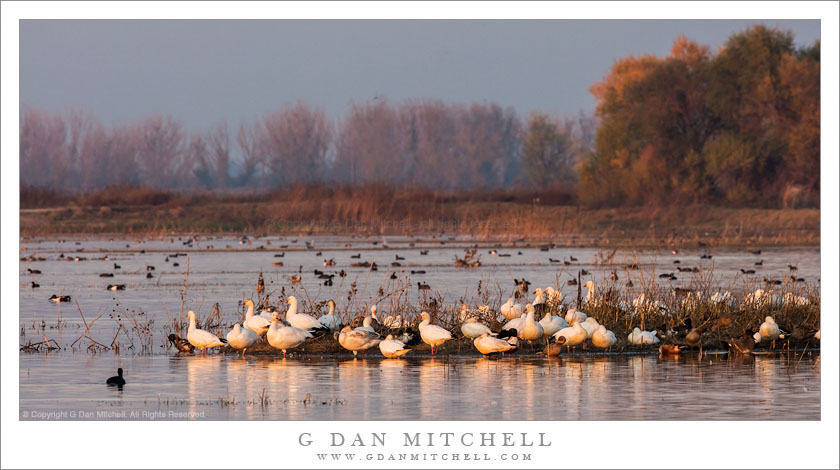
Snow geese and Ross’s geese on a small island in a wetland pond

Geese and Pond, Sunset. © Copyright 2018 G Dan Mitchell – all rights reserved.

Snow geese and Ross’s geese on a small island in a wetland pond

Here in the San Francisco Bay Area we expect temperatures as high as 100 degrees in inland areas. Summer is here, and with a vengeance. I like summer — long daylight hours, little need to worry about that warm jacket, and more — but it is not my favorite season. I prefer the shortening days and golden colors of fall, the interesting weather and light of winter, and the reawakening of spring, to be honest. In other words, with this photograph I am engaging in a bit of nostalgia for the past winter and a bit of expectation of the seasons that follow the one in which we now find ourselves.

While we might think of winter as being a time of less life and growth — which is surely true in most places when it comes to vegetation — the annual migration of birds inclines in the opposite direction. At the time of year when days are short, weather is cold, and growing things are in decline… the birds show up again. I photographed these birds on a late-autumn evening in early December, when trees were still shedding fall leaves and the birds were just beginning to return along the Pacific flyway.


See top of this page for Articles, Sales and Licensing, my Sierra Nevada Fall Color book, Contact Information and more.

G Dan Mitchell is a California photographer and visual opportunist. His book, “California’s Fall Color: A Photographer’s Guide to Autumn in the Sierra” is available from Heyday Books and Amazon.
Blog | About | Flickr | Twitter | Facebook | LinkedIn | Email


All media © Copyright G Dan Mitchell and others as indicated. Any use requires advance permission from G Dan Mitchell.
Great Egret, Reflection

Great Egret, Reflection
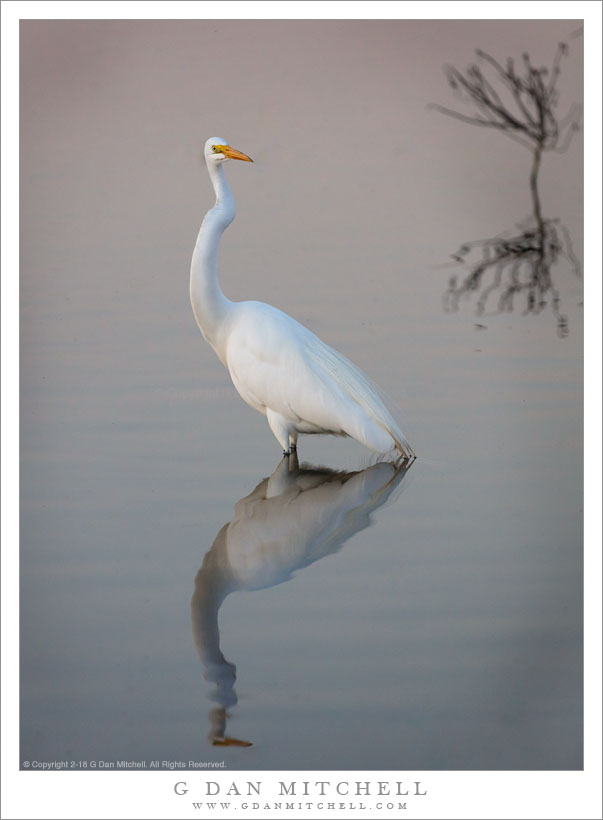
A great egret and its reflection in a wetland pond

Great Egret, Reflection. © Copyright 2018 G Dan Mitchell – all rights reserved.

A great egret and its reflection in a wetland pond

While I don’t know the full extent of their (likely huge) range, these birds are ubiquitous in California. I remember when I first noticed them, many years ago when I was a dedicated cyclist. In those days I commuted to work by bicycle, covering between 30 and 55 miles a day, and portions of my ride always passed creeks and drainage canals. You might miss them speeding past in a car, but on a bicycle I frequently looked into these waterways and spotted these impressively large and nearly pure white birds. As time went on I found them all over the place — they can be found in many agricultural areas, for example, and I have photographed them feeding in kelp beds along the Pacific Ocean shoreline.

In flight they alternate between ungainliness and beauty. They can seem a bit gangly and awkward at times — their take-off can be somewhat awkward, for example. On the other hand they flare their wings beautifully upon landing. I don’t usually go out specifically to photograph the egrets, but sometimes it seems unavoidable since they turn up in so many places. They seem to have somewhat clearly defined boundaries when it comes to human presence. They more or less ignore us until we get too close (though this boundary changes depending upon whether they are feeding or not), but get a bit too close and you can see them “tighten up” and prepare for a sudden take-off, at which point you most often have only the opportunity to photograph them from the back as they depart. This bird had been hunting and seemed a bit more willing than most to let me photograph.


G Dan Mitchell is a California photographer and visual opportunist. His book, “California’s Fall Color: A Photographer’s Guide to Autumn in the Sierra” is available from Heyday Books and Amazon.
Blog | About | Flickr | Twitter | FacebookGoogle+ | LinkedIn | Email


All media © Copyright G Dan Mitchell and others as indicated. Any use requires advance permission from G Dan Mitchell.
Two White-Faced Ibises

Two White-Faced Ibises
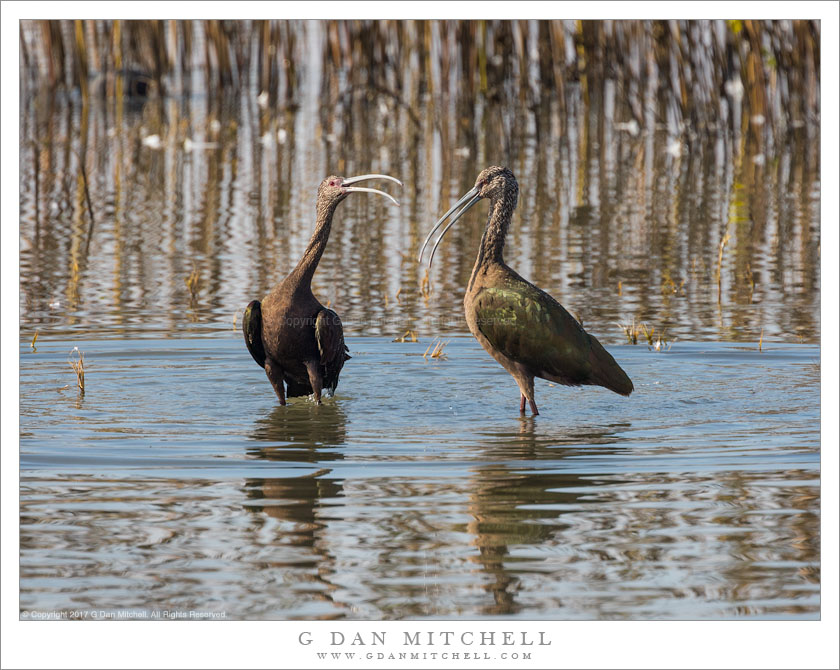
Two white-faced ibises interacting in a San Joaquin Valley wetland pond

Two White-Faced Ibises. © Copyright 2017 G Dan Mitchell – all rights reserved.

Two white-faced ibises interacting in a San Joaquin Valley wetland pond

The white-faced ibises have intrigued me since before I knew what they were — in fact, I suppose I could say that I photographed them before I realized that they existed. Some years back, on my very first more or less accidental exposure to bird photography, I found myself “out there” on an early morning, with no more clue about what was going on than “someone told me I should go here and see the birds.”(That someone was a colleague where I taught.) I barely knew a goose from a swan, at least when they were flying quickly overhead, but I was amazed by the number and variety of birds that morning. I photographed like a madman, not really knowing at all what I was photographing. Later on, back home and looking at files, I recall finding a series of photographs of a line of birds overhead that had oddly long and curving beaks. I wondered what they were. It turns out they were ibises.

Ibises are not always the most common specimens. In addition to their unusual beaks, they have another particular visual characteristic. In many situations you would regard them as dark and fairly drab-looking birds. Photographing them in flight is often difficult, partly because they frequently just end up looking black against any lighter background. But catch them in the right light and the texture, patterns, and colors of their feathers begin to appear. On this morning I happened upon a group of ibises, perhaps a couple dozen, in shallow water. I stopped and watched quietly and was able to photograph a variety of behaviors, including this interaction between two of the birds.


G Dan Mitchell is a California photographer and visual opportunist. His book, “California’s Fall Color: A Photographer’s Guide to Autumn in the Sierra” is available from Heyday Books and Amazon.
Blog | About | Flickr | Twitter | FacebookGoogle+ | LinkedIn | Email


All media © Copyright G Dan Mitchell and others as indicated. Any use requires advance permission from G Dan Mitchell.