G Dan Mitchell, photographer and visual opportunist focusing on the Pacific coast, the Sierra Nevada, redwood forests, California oak/grasslands, California deserts, urban landscapes, night photography and more. Posting daily photographs since 2005, along with articles, reviews, news, and ideas.
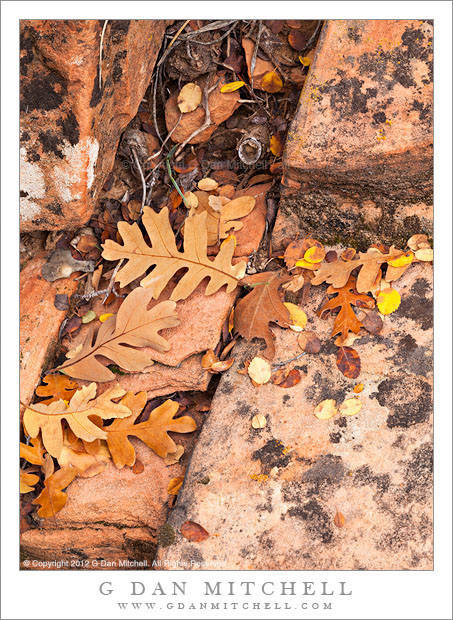
Oak leaves and other autumn material on a rocky streambed in Zion National Park
This mixture of autumn debris was lying on a low shelf near the bottom of a narrow canyon wash in the high country of Zion National Park. We had descended into this wash to look for autumn colors, mostly the red maples and perhaps some cottonwood or box elder trees. It had not been long since the last rain, given the evidence of flow patterns in the sand and occasional wet spots in deeper sections.
The gambel oak trees are quickly becoming a favorite of mine in this area of the Southwest. They are found all over the place and vary from small, bush-like plants to decent sized trees. When fall comes they can put on a quite varied show. Some leaves simply turn the rich brown/tan that you see on some of the leaves in this photograph. Others turn yellow and some take on very bright red colors, especially when the light comes through the leaves from behind. (A photograph from a small canyon in Capitol Reef that I’ll post later shows a more gaudy side of these leaves.) Here the leaves had fallen onto a low sandstone bench just above the stream bed, and the reddish rocks compliment the other autumn colors of this intimate scene.
G Dan Mitchell is a California photographer whose subjects include the Pacific coast, redwood forests, central California oak/grasslands, the Sierra Nevada, California deserts, urban landscapes, night photography, and more. Blog | About | Flickr | Twitter | Facebook | Google+ | 500px.com | LinkedIn | Email
It has been a while since I’ve posted one of these updates, but I’ve just updated the DEALS page on this site to include some holiday offers at site-sponsor B&H, including deep discounts on a large group of Canon lenses and speedlites, Canon DSLR/lens bundles for six of their cameras, a Nikon D600 offer, a deal on the Sony Alpha and lenses, specials from tripod manufacture Manfrotto
G Dan Mitchell is a California photographer whose subjects include the Pacific coast, redwood forests, central California oak/grasslands, the Sierra Nevada, California deserts, urban landscapes, night photography, and more. Blog | About | Flickr | Twitter | Facebook | Google+ | 500px.com | LinkedIn | Email
I just read the stunning and deeply disturbing story of the theft (not “merely” the all-to-common defacing) of a number of petroglyphs from a California location. (See “Petroglyph Thefts Near Bishop Stun Federal Authorities, Paiutes”) Apparently a group of depraved individuals hauled rock-cutting equipment to the site and sawed out the rocks holding several examples of native rock art, defacing and destroying other examples in the process. Anyone who has visited the better known examples of rock art is aware that a certain pathetic sub-group of the human race finds itself unable to resist the temptation to add their own “art” or deface that which is already there, but this incident represents a new low.
Defaced Petroglyph Site
Photographers, those who operate photography workshops, and those of us who write about photography need to take this as an opportunity to think very carefully about how much information we should share about fragile places and things and about where and how we do our sharing. A few years ago I wrote about an occasion on which some friends and fellow photographers called me out on this (“Disclosing Photo Locations: How Much Information is Too Much?”), causing me to re-think how and what I write about my photographs and the places where I make them.
Here is the problem, more or less. “Back in the day,” we might well share what we knew about certain places and subjects without much care at all. While we certainly would not blabber about fragile places in front of people who we thought might disrespect or even damage them, we had no qualms about sharing information with trusted friends. And, in fact, the dangers of that kind of sharing in the pre-web world were not really all that great. The word-of-mouth sharing reached very small number of people, and it was unlikely (though not quite impossible) that the information would eventually get to “the bad guys.” We could even argue that we were serving a greater good by sharing this knowledge with others who should know, and whose voices might contribute to the protection of these places and subjects.
However the web has changed everything. Anything that you or I post today becomes cataloged, is searchable, is readily shared and re-shared, becomes linked to other pieces of information about the same subjects… and can be seen by millions of people you don’t know, among them many whom you would not trust and some that you would never share this stuff with. That’s the new reality. Among the people who may see our work and read our descriptions online are thoughtless barbarians who stand on top of fragile arches, who climb on tufa towers, who inscribe their own “art” into ancient sites, who drive all over the landscape, who remove “sailing rocks” from their playa homes, who leave trash in the landscape, who create trails across wilderness landscapes, who harm wildlife, who party in sacred and quiet places, and more.
As photographers who share our work and write about it and even take other people to these places, we have a responsibility to our subjects to do everything we can to protect them, even if this means restricting what we say, what we share, and where we share it.
Using photographs of rock art as an example, I think that responsible photographers should adopt the following policies:
When posting a photograph, if location information is not important to understanding the photograph, don’t share such information at all.
When some location context is actually important – and sometimes it is – anonymize it as much as possible. Perhaps the name of the 200-mile-square geographical region is sufficient. Perhaps the word “canyon” can be used without naming the canyon.
When making photographs of such things, avoid the inclusion of surrounding or background elements that will help the cretins figure out the location. I know this is hard, given the photographic potential that you’ll need to forego – but a your discretion serves a greater good, and you can figure out an effective alternative way to shoot these subjects. (For my part, I enjoy the challenge of trying to work out an effective composition that doesn’t give things away.)
If you realize that you have been too open about information, edit your text, remove unnecessary or risky references, or withdraw certain photographs. (There used to be an extensive guide to photographing in Death Valley on this web site – it was removed for such reasons.)
When writing about photographs of such subjects, always include some reference to their fragility, their significance, the power of experiencing them, and the responsibility of protecting them.
Recognize that everything you share, no matter the online forum in which you share it, will eventually reach a much wider audience – and think about how much you want the lowest-common-denominator types in that audience to know.
Exercise caution even when you share directly with those you know. Share only with those who you trust to share your love for and concern about these places, and only with those who will refrain from sharing more widely. Perhaps sharing with “online friends” is a bit to liberal – maybe you want to restrict this to people you really know and work with. Even with direct, personal sharing… be conservative.
As tremendously tempting as it is – for financial as well as self-aggrandizement reasons – don’t take your workshops to these places. I’m afraid it isn’t enough to think you have told your students how fragile these places are. Once they leave they will share their photos, they will talk about your workshop, they will give directions, they will brag about the cool thing you showed them… and they’ll do it in that linked, searchable, uncontrollable world of the web.
Speak about these issues more openly – with other photographers, online, in your workshops, and so forth.
Our work to photograph these subjects and the photographs that result from this work should be evidence of our recognition of the importance of these places and of protecting them – and not something that will contribute to endangering them.
Update: A few months later the petroglyphs were recovered. Final outcome in the case is not known as of this writing.
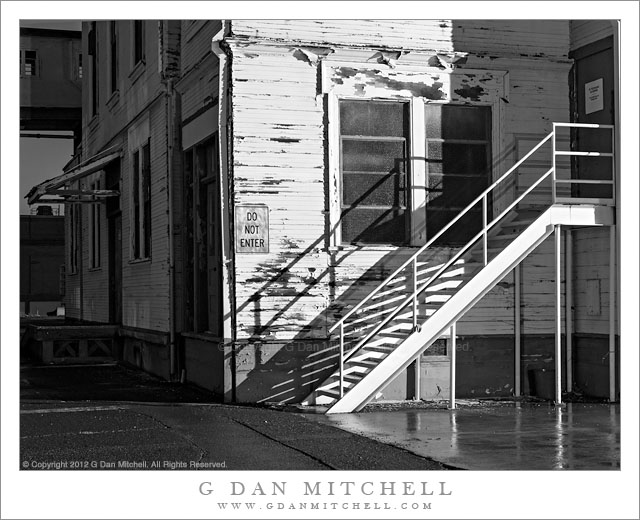
Black and white photograph of a stairway and a portion of a front wall of a building on a rainy evening at the historic Mare Island Naval Ship Yard, Vallejo, California
Black and white photograph of a stairway and a portion of a front wall of Building 45 on a rainy evening at the historic Mare Island Naval Ship Yard, Vallejo, California
I interrupt the almost-steady stream of landscape photographs from the American Southwest (of which there are many more to come) to share a photograph of night photography at the historic Mare Island Naval Ship Yard near Vallejo, California. Depending upon where you see/read this, you may not know that I have been photographing this place at night for a half-dozen years or more, joining a large number of other night photographers who continue to be fascinated by the place. The San Francisco Bay Area group known as The Nocturnes has been instrumental in uncovering the photographic potential of this wonderful location and in ensuring its respectful treatment by photographers, and I was there with them again this week. I’m certain that many people who drive past and see “Mare Island” signs have no idea of how long this place has existed (well back into the 1800s) nor of its historic importance (the first US west coast major ship yard) or some of its “issues,” including the transition from the military to civilian uses and all of the things that this entails.
The whole area, but especially that around the “historic core,” is quite an amazing photographic resource, especially for those who have worked to “see” it at night. There are a number of obvious, impressive, and iconic features – the gantry structures, the power plant, many old buildings, dry docks, and more – yet return visits begin to reveal smaller and subtler features that you could miss on a single visit. There was one wrinkle in this week’s shoot – RAIN! When we assembled there before sunset – for photograph sharing and talk – we knew that a weather front was headed our way, but we hoped that it might hold off long enough to let us complete some shooting first. I wasn’t so sure. (The weather radar app showed a front very close to us!) As soon as it was dark enough, I quickly went to work at this building that I had seen earlier in the day when I arrived. It was already beginning to sprinkle when I got there, and soon the rain increased to the point where I had to work under an umbrella as I completed some relatively long exposures. (For real fun, try juggling camera, lenses, bags, tripod, and an umbrella… in increasing wind… and rain… while trying to attach camera to said tripod and compose and focus!) I had time to make five or six photographs at this location before I had to seek shelter along with my Nocturnes colleagues on the front porch of one of the old officers’ mansions.
G Dan Mitchell is a California photographer whose subjects include the Pacific coast, redwood forests, central California oak/grasslands, the Sierra Nevada, California deserts, urban landscapes, night photography, and more. Blog | About | Flickr | Twitter | Facebook | Google+ | 500px.com | LinkedIn | Email
Photographer and visual opportunist. Daily photos since 2005, plus articles, reviews, news, and ideas.
Manage Consent
To provide the best experiences, we use technologies like cookies to store and/or access device information. Consenting to these technologies will allow us to process data such as browsing behavior or unique IDs on this site. Not consenting or withdrawing consent, may adversely affect certain features and functions.
Functional
Always active
The technical storage or access is strictly necessary for the legitimate purpose of enabling the use of a specific service explicitly requested by the subscriber or user, or for the sole purpose of carrying out the transmission of a communication over an electronic communications network.
Preferences
The technical storage or access is necessary for the legitimate purpose of storing preferences that are not requested by the subscriber or user.
Statistics
The technical storage or access that is used exclusively for statistical purposes.The technical storage or access that is used exclusively for anonymous statistical purposes. Without a subpoena, voluntary compliance on the part of your Internet Service Provider, or additional records from a third party, information stored or retrieved for this purpose alone cannot usually be used to identify you.
Marketing
The technical storage or access is required to create user profiles to send advertising, or to track the user on a website or across several websites for similar marketing purposes.

 G Dan Mitchell is a California photographer whose subjects include the Pacific coast, redwood forests, central California oak/grasslands, the Sierra Nevada, California deserts, urban landscapes, night photography, and more.