
Category Archives: Photographs: Desert

Dried Branch, Sand

Dried Branch, Sand
Dried Branch, Sand

Dried Branch, Sand. Death Valley National Park, California. April 5, 2013. © Copyright 2013 G Dan Mitchell – all rights reserved.

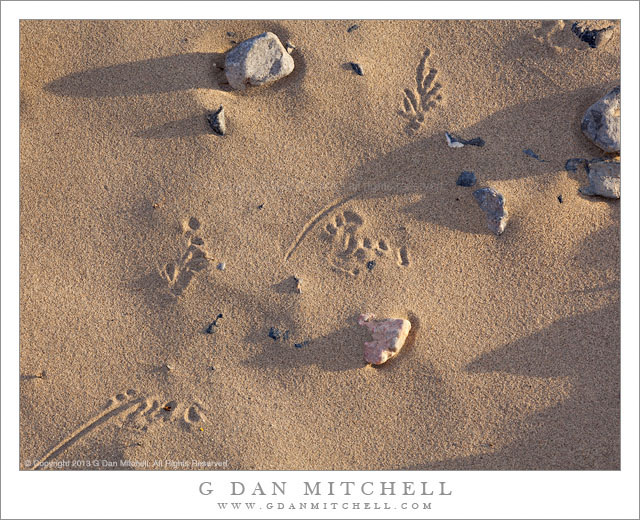
The dry remnants of a dead plant in recently wind-blown sand dune, Death Valley National Park

I have been visiting Death Valley regularly for perhaps fifteen years, typically photographing there for nearly a week every year for the past decade, and occasionally more. On my most recent trip, from which I returned only days ago, I was thinking about a number of thing regarding my experience with the place and how it has changed. On my first visits there was, of course, the excitement and wonder of discovering a place that was essentially completely new to me. I recall that on my first trip there I got close to the Race Track without going all the way to this location. We camped not far from that playa and I imagined this place that I had heard so much about and even envisioned it in a particular location – and when I did visit a year or two later I discovered that it was quite a bit different from what I imagined, though magical in different and perhaps more powerful ways. After a few years of visiting and photographing the best known iconic sites I began to find them less interesting, and though I continued to photograph them when the opportunity arose, I focused more on expanding the areas I knew about and on looking more closely at areas I thought I knew.

As I did this, I have to confess that portions of the Death Valley experience baffled me or even put me off a bit. While I found some of the terrain to be tremendously beautiful, there were other aspects that I just couldn’t quite relate to. As a person who has spent a lot of time in forested places with flowing water – mainly the Sierra Nevada – I found some areas of this desert to be, quite honestly, boring. I drove through or past them on my way to what I thought of as the more interesting places where I could find colors outside of the range from tan to gray and where some special object or formation might create an obvious center of interest. However, from time to time I would be surprised to find in some plain, nondescript, and even boring place an experience of stillness, immense space, and deep silence that I had rarely encountered elsewhere. More and more, I began to see this as a primary attraction of this landscape – more so in many cases that the specific features of this pinnacle or that formation or the other valley.

On this recent trip, conditions conspired to make me look more closely at some of these things that I had originally overlooked. The conditions were such that if I had experienced them a few years ago I might have simply left. (In fact, that thought did cross my mind once or twice on this trip.) The spectacular light really never came, skies were cloudy, the air was hazy, it was very hot, the winds blew strongly, and there was a dust storm. During the first couple of day, with the exception of shooting the dust storm, many of the subjects I had in mind simply didn’t work out the way I planned. A bit surprisingly, without the possibility of shooting yet another beautiful golden hour sunset image of a spectacular bit of geography (though I did do some of that still) I slowed down and looked more closely at some of those “boring” places that I had passed through more quickly in the past.

This photograph was made in one of those locations. It was not far from one of those iconic locations, but it wasn’t the iconic spot at all. An hour or so before sunset I simply wandered away from the road, past vegetation and into the sand, and started looking around. In the low spots between dunes, the world beyond was out of sight and the wind was blocked, and as the light faded I encountered again that deep and powerful and timeless silence that is so hard to find almost anywhere else.

G Dan Mitchell is a California photographer and visual opportunist whose subjects include the Pacific coast, redwood forests, central California oak/grasslands, the Sierra Nevada, California deserts, urban landscapes, night photography, and more.
Blog | About | Flickr | Twitter | FacebookGoogle+ | 500px.com | LinkedIn | Email

Text, photographs, and other media are © Copyright G Dan Mitchell (or others when indicated) and are not in the public domain and may not be used on websites, blogs, or in other media without advance permission from G Dan Mitchell.
Desert Plants, Black Hill

Desert Plants, Black Hill

Desert Plants, Black Hill. Death Valley National Park, California. April 7, 2013. © Copyright 2013 G Dan Mitchell – all rights reserved.

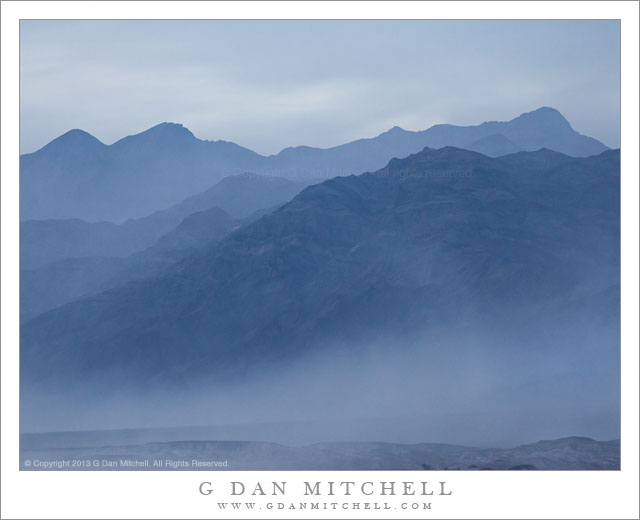
Morning light on desert arrow weed plants at the base of a black hill, with Death Valley Buttes receding into the hazy distance

This was very nearly the last photograph I made on my recent early April visit to Death Valley National Park. I try to go there to photograph at least once each year, and I’ve probably visited during the first week of April more often than at any other time. This tends to be a transitional season in the park, at least in my experience, and the conditions can range from cool to downright hot. On this visit it was, for the season, “downright hot” – temperatures with in at least the mid to high-nineties every day, and rose to just over 100 degrees on one day. This is not unheard of at this time of year, though it is on the high side of normal for the first week in April. This trip was a challenge for other reasons, too. On the second day I encountered a significant sand storm with accompanying winds, and the light was not exactly cooperative. On two mornings and two evenings clouds shut down the golden hour light, and there was quite a bit of general haze.

On this morning I figured I would do an hour or two of shooting before returning to camp to tear everything down and start my drive back home. I started by going up just past the turn off to Wild Rose Canyon, with the plan being to shoot some long distance photographs of sunrise light on some mountains that I have been thinking about shooting. The sunrise itself was more or less a washout – the atmosphere was so murky that I wasn’t even quite sure when the sun cleared the horizon! Eventually I did get some soft directional light from the sun, but I was finished with this subject somewhat quickly. I decided to go with a backup plan to photograph the Mesquite Dunes with a long lens. As I worked this subject I decided to head a bit further east and see if I could get anything from the backlight coming across the low hills above Salt Creek, and as I traveled that direction I passed this small black hill, where I have photographed before, and saw these backlit arrow weed plants and the more distant hills near Death Valley Buttes in the morning haze.

G Dan Mitchell is a California photographer and visual opportunist whose subjects include the Pacific coast, redwood forests, central California oak/grasslands, the Sierra Nevada, California deserts, urban landscapes, night photography, and more.
Blog | About | Flickr | Twitter | FacebookGoogle+ | 500px.com | LinkedIn | Email

Text, photographs, and other media are © Copyright G Dan Mitchell (or others when indicated) and are not in the public domain and may not be used on websites, blogs, or in other media without advance permission from G Dan Mitchell.
Gambel Oak Leaves, Autumn

Gambel Oak Leaves, Autumn - Brilliantly colored autumn colors of Gambel Oak leaves, Capitol Reef National Park
Brilliantly colored autumn colors of Gambel Oak leaves, Capitol Reef National Park

Gambel Oak Leaves, Autumn. Capitol Reef National Park, Utah. October 26, 2012. © Copyright 2012 G Dan Mitchell – all rights reserved.

Brilliantly colored autumn colors of Gambel Oak leaves, Capitol Reef National Park

This is a very different view of the autumn gambel oak leaves than another that I recently posted. That other photograph showed the perhaps more typical brown or tan phase of fall oak leaf color. This one, on the other hand, shows a particularly colorful specimen of these leaves, caught at perhaps just the right moment and in the right light in a canyon of Capitol Reef National Park early one late-October morning.

The angle from which you view these leaves matters a lot, as it often does with autumn leaves in general. The nature of the ambient light also makes a big difference. And did I mention the timing!? If you can get a bit of back-light behind the oak leaves, what might otherwise be a bit dull can begin to glow. And the soft, diffused lighting in this deep canyon setting allowed the light to fill in the shadows. These particular specimens possess very interesting color and shape patterns: there is an interior still-green section on many of the leaves that is just beginning to edge towards yellow-gold, and it is surrounded by brilliantly red and orange leaf edges. When I shoot in deep shade – and these plants were deep in the shade of this small canyon – I often find that the photograph seems unnaturally blue, given that most of the light is either direct or reflected blue sky. In most cases, in order to get a color balance that reflects what the eye saw – and our visual system compensates for the blue saturation – I have to alter the color balance a bit and move it away from this artificial-seeming blueness. However, in this case, if I adjusted far enough to neutralize the blue that you can still see on the more-or-less gray branches and twigs, the color of the leaves would probably defy belief!

G Dan Mitchell is a California photographer whose subjects include the Pacific coast, redwood forests, central California oak/grasslands, the Sierra Nevada, California deserts, urban landscapes, night photography, and more.
Blog | About | Flickr | Twitter | FacebookGoogle+ | 500px.com | LinkedIn | Email

Text, photographs, and other media are © Copyright G Dan Mitchell (or others when indicated) and are not in the public domain and may not be used on websites, blogs, or in other media without advance permission from G Dan Mitchell.

Juniper Tree, Towers at Base of Sandstone Cliff, Evening

Juniper Tree, Towers at Base of Sandstone Cliff, Evening
“Juniper Tree, Towers at Base of Sandstone Cliff, Evening” —A lone juniper tree grows among boulders at below sandstone towers at the base of cliffs, Capitol Reef National Park

I made this photograph midway through a trip of about 11 days that took us to a number of locations in Utah. Every such trip seems to have a sort of arc that includes the initial excitement and expectation of heading out into the world to photograph, a settling in period, perhaps a lull in the middle followed by a reconnection to the work, a sense that the trip is ending and there is too much left to do, and the final trip back to the “real world.” This photograph was made near the end of the “lull,” and might have marked the transition back to rededication to the work. On this mid-trip day, we had found ourselves perhaps a bit without direction and one of the members of the group had not been feeling well. At a low point in our energy but perhaps feeling that we should at least carry on and act like we were working, we went to a nearby area of the park in the evening.

At first we had no clear goal in mind, though we sort of stopped and looked around at a few spots, but without really making any serious photographs. Eventually we headed up into a large canyon, first photographing the walls near the start of the canyon and then photographing the canyon itself a bit as the light began to fade. This work went OK, but it didn’t seem to be quite “clicking.” But eventually, in my experience, you get to the point where you sometimes simply accept this as part of the work, trusting that if you keep looking and keep seeing you will eventually find what you are looking for – and that this is far more productive and useful than packing it up when it isn’t working. (Though, to be fair, there are a few times when packing it up and going and having a nice dinner can be a reasonable option!) In any case, we loaded up the vehicle and began to drive back out of the canyon. Looking up at the surrounding canyon walls, we were surprised to find some very unusual post-sunset light. During normal light these canyon walls look very dark and have the intensely “red” quality of the iconic Utah sandstone. But somehow this light seemed to have drained the color from the rocks, creating a de-saturated and almost slightly metallic effect. We quickly stopped an piled out with cameras and tripods and began shooting, and it seemed to me that the connection had been made once again.


Leave a comment or question using the form. (If you are reading this on the home page, click the article title to see the full article and the comment form.

G Dan Mitchell is a California photographer and visual opportunist. His book, “California’s Fall Color: A Photographer’s Guide to Autumn in the Sierra” (Heyday Books) is available directly from him. Blog | Bluesky | Mastodon | Substack Notes | Flickr | Email

All media © Copyright G Dan Mitchell and others.