
Category Archives: Photographs: Desert

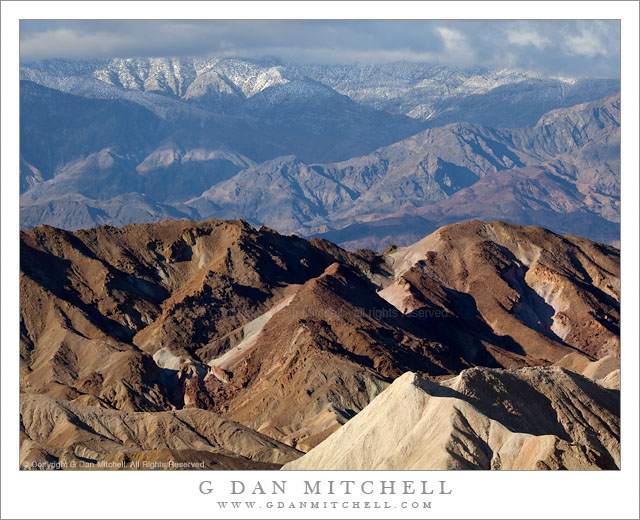
Zabriskie Point Badlands, Morning Snow on the Panamint Range

Zabriskie Point Badlands, Morning Snow on the Panamint Range

Zabriskie Point Badlands, Morning Snow on the Panamint Range. Death Valley National Park, California. February 20, 2010. © Copyright G Dan Mitchell – all rights reserved.

Morning light on fresh snow on the summit of the Panamint Range with Zabriskie Point Badlands in the foreground, Death Valley National Park.

After getting being frustrated by falling snow earlier in the morning when I tried to photograph dawn at Dantes View I headed back down to lower terrain. (Although I was not successful in photographing at Dantes View and, in fact, turned back before the summit in dense clouds and falling snow, it was quite an interesting visit!) I stopped along the way and made some photographs before arriving at Zabriskie Point.

At this point I no longer reflexively photograph at Zabriskie, though I will if something special or unusual is happening with the conditions. Having been frustrated in my original plans, I figured I might as well take a look around since I was there. I left the camera gear in my car and walked up the hill to the famous overlook to see what I could see. The dawn light – if there had even been any on this cloudy morning – was long gone, though a few photographers were still hanging out. As I looked about I noticed two things. First, the clouds were just beginning to thin over the Panamint range. While the summit of Telescope Peak was still socked in – it appeared to be snowing there – light was beginning to break through gaps in the clouds above the east side of the range and interesting shadows were appearing below the snow line. Second, the partially cloudy conditions were softening the light right in the Zabriskie/Gower Gulch area and the light in some of my favorite small gullies to the right of the observation area was looking somewhat interesting. (I have made a project of photographing them with a long lens.)

With no other specific plan, and two potential subjects right here, I followed one of those “laws of photography” that says shoot the thing you see now rather than continuing to wander around hoping that some other miracle crops up. (Sometimes this is great advice. Other times it is dead wrong!) I walked back down the hill to my car, grabbed my gear, and walked back up. I first spent some time photographing the nearby gullies. (I think I have a couple of interesting images of them that will appear here eventually.) But I quickly turned my attention to the interesting weather and light across the Valley, thinking about how I might photograph this wild and rugged scene without making it look like another Zabriskie Point image. I decided to use a relatively long focal length lens – which was already on the camera for shooting the gullies anyway – and try to fill the entire frame with a combination of close and far mountains and snow and clouds in the morning light.

G Dan Mitchell Photography | Flickr | Twitter | Facebook | Email
Text, photographs, and other media are © Copyright G Dan Mitchell (or others when indicated) and are not in the public domain and may not be used on websites, blogs, or in other media without advance permission from G Dan Mitchell.
Remains of a Desert Plant, Pebbles

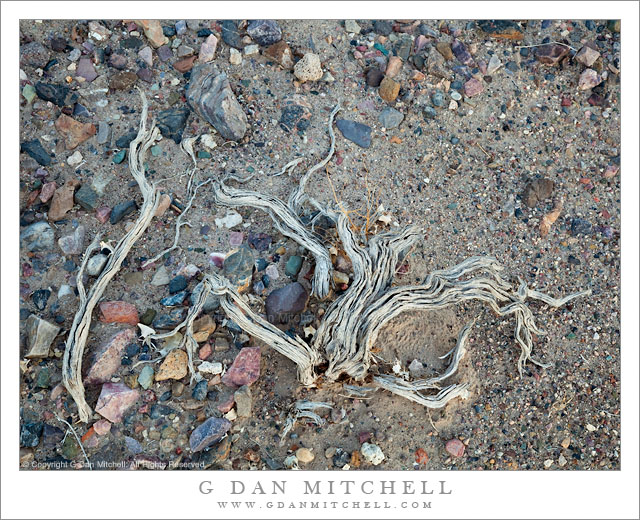
Remains of a Desert Plant, Pebbles

Remains of a Desert Plant, Pebbles. Death Valley National Park, California. February 20, 2011. © Copyright G Dan Mitchell – all rights reserved.

The skeletal branches of a dead plant against the pebbles of a desert wash, Death Valley National Park, California.

I came across the skeletal remains of this desert plant while photographing along the east side of Death Valley near the area identified on some maps as the Kit Fox Hills. I had just finished photographing across the floor of the Valley, capturing an area full of sparse desert plants backlit by the very last rays of sun, and the light had diminished after the sun dropped below the tops of the ridges on the west side of the Valley.

I saw this bit of dead plant near the edge of a wash among the rubble of many-colored rocks and pebbles that had, I presume, been washed down from the canyons in the mountains to the east. For a place that seems so colorless from a distance, there is an astonishing variety of color in these rocks. I can see greens, blues, various shades of pink and purple, and some that almost are orange. The branches are just as I found them, and the soft light with just a bit of directionality from the right fills the shadows that would otherwise be very dark.

G Dan Mitchell Photography | Flickr | Twitter | Facebook | Email
Text, photographs, and other media are © Copyright G Dan Mitchell (or others when indicated) and are not in the public domain and may not be used on websites, blogs, or in other media without advance permission from G Dan Mitchell.
Branch, Water on Salt Flats

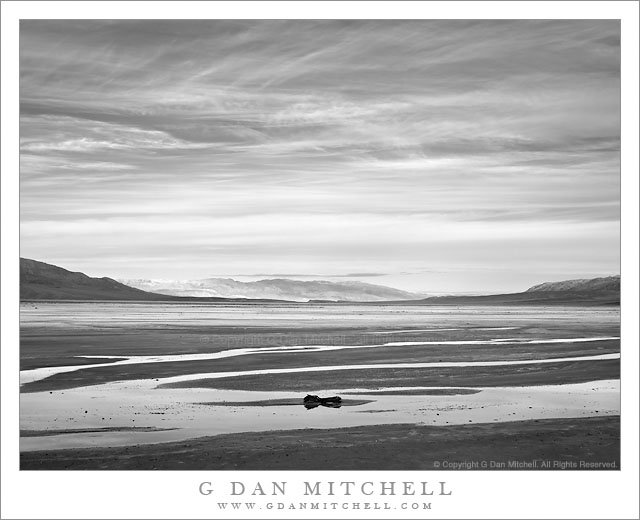
Branch, Water on Salt Flats

Branch, Water on Salt Flats. Death Valley National Park, California. February 21, 2011. © Copyright G Dan Mitchell – all rights reserved.

A forelorn branch sits near pools of reflecting water on salt flats of Death Valley National Park.

After the brief dawn light on the Panamints ended (see the photograph I posted yesterday) and the world went gray over in that direction, I noticed this odd log or branch sitting out on the mud in the salt flats between some of the ponds that streak this section of the flats. While the two minutes of beautiful color on the Panamints had ended, the increasing light was transforming what had been a fairly solid covering of gray into a transparency that revealed interesting layers and patterns of clouds in the morning sky.

I moved a bit closer and made one final sequence of Death Valley photographs before heading back to Stovepipe Wells to take down my camp and start the long drive home. I tried a couple different compositions, including some in which I was closer to the log, but in the end I prefer this one that put some distance between it and me and, I think, suggests the huge spaces that are among of the most compelling characteristics of this landscape.

G Dan Mitchell Photography | Flickr | Twitter | Facebook | Email
Text, photographs, and other media are © Copyright G Dan Mitchell (or others when indicated) and are not in the public domain and may not be used on websites, blogs, or in other media without advance permission from G Dan Mitchell.

Dawn Light, Panamint Range and Salt Flats

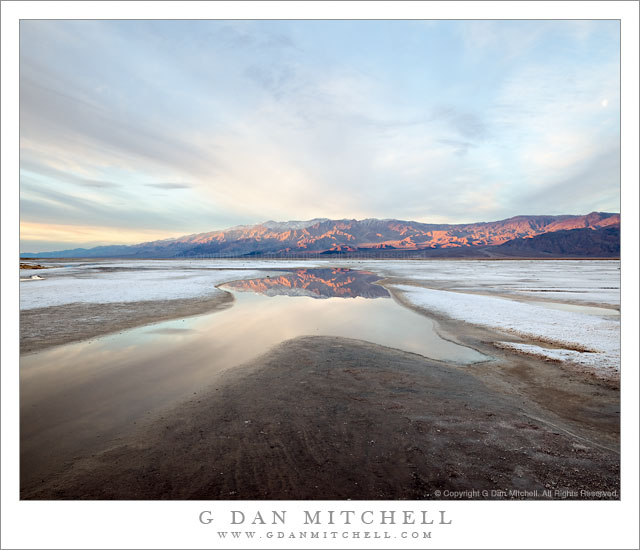
Dawn Light, Panamint Range and Salt Flats

Dawn Light, Panamint Range and Salt Flats. Death Valley National Park, California. February 21, 2011. © Copyright G Dan Mitchell – all rights reserved.

The first dawn light on the snow-dusted Panamint Range is reflected in shallow winter pools on the salt flats of Death Valley National Park.

This is yet another story of serendipity, I think, though it also does involve some advance work – which should please those who become uncomfortable with the idea that not every landscape photograph results from a slow and deliberate and well-planned process! ;-)

The general location of this scene is along a section of salt flat just below the Salt Creek turnoff from the main highway – it is the first area of obvious salt flats that you come to as you head south towards the Furnace Creek area. One one of my first photographic visits to Death Valley I recall stopping near this location along the road and trying to make a photograph pointing down the length of the Valley. It was not successful, but I’ve always been a bit intrigued by this location where the road has to curve around to the east to avoid this salt flat. A day or two earlier on this trip I had stopped along the road at almost this exact location during the “boring light” part of the day after shooting somewhere else. I had wandered – without any camera gear – down across the wash to a patch of brown salt grass and beyond to the edge of the salt flat. I had noticed a lot of things: the very alien nature of this landscape consisting of mud and caked salt and not much else, the surprising presence of some worms and larvae in this tremendously salty water, the fact that the water seemed to seep from beneath the wash, and the interesting shapes that the water created as it slowly spread along the edge of the salt flat.

Move ahead to this morning, the final one of this trip to Death Valley, and I was up well before first light. I had several ideas about what I might photograph, but had not made a firm decision yet since the weather was something of an unknown. I had a vague idea about heading north up the valley and photographing the first light on the hills along its western edge. I was keeping open the possibility that spectacular light might make it worth while to photograph Zabriskie. But I really didn’t know.

I drove to the Furnace Creek/Scotty’s Castle junction and pulled over to watch the light begin to grow. There were lots of clouds! It looked like a lighter area might evolve straight to my east, but I couldn’t quite see photographic potential in it. To the north things looked pretty bleak. There was some possibility that light could happen way to the south, but I wasn’t convinced. I decided to drive a bit south and see what might happen, and very soon I came back to this place where I had stopped earlier. The light wasn’t very promising – clouds to the east seemed likely to block the sunrise light even though there were some interesting cloud patterns overhead that were starting to become more transparent as the sky began to lighten.

Then I caught just a bit of light on some of the higher clouds above the middle level clouds and I started to wonder if the light just might make it through. I went to the back of the car and grabbed my camera with one lens already attached and mounted it on the tripod. I wasn’t sure if I’d want wide or tele for some of the possible subjects, so I grabbed two additional lenses and stuck them in a shoulder bag and headed down the wash, not really looking up too much, just heading straight towards these little areas of water that I remembered from earlier. As I got close to the edge of the flats I saw that, indeed, a band of sunrise light was coming in below the cloud deck to the east (something I have learned to watch for) and starting to light up the highest peaks of the Panamints. I knew that if this light survived long enough to make it down across the range that it was going to happen fast, so I quickly headed out onto the edge of the flats, more or less ignoring the larger scene and simply looking for an interesting reflecting pool. As I set up – working very quickly now – the first sun lit up the face of the panamints and revealed radiating cloud shapes above. I had perhaps two minutes of this light… and then the small gap along the eastern horizon must have closed up as the light disappeared and went back to gray.

G Dan Mitchell Photography | Flickr | Twitter | Facebook | Email
Text, photographs, and other media are © Copyright G Dan Mitchell (or others when indicated) and are not in the public domain and may not be used on websites, blogs, or in other media without advance permission from G Dan Mitchell.