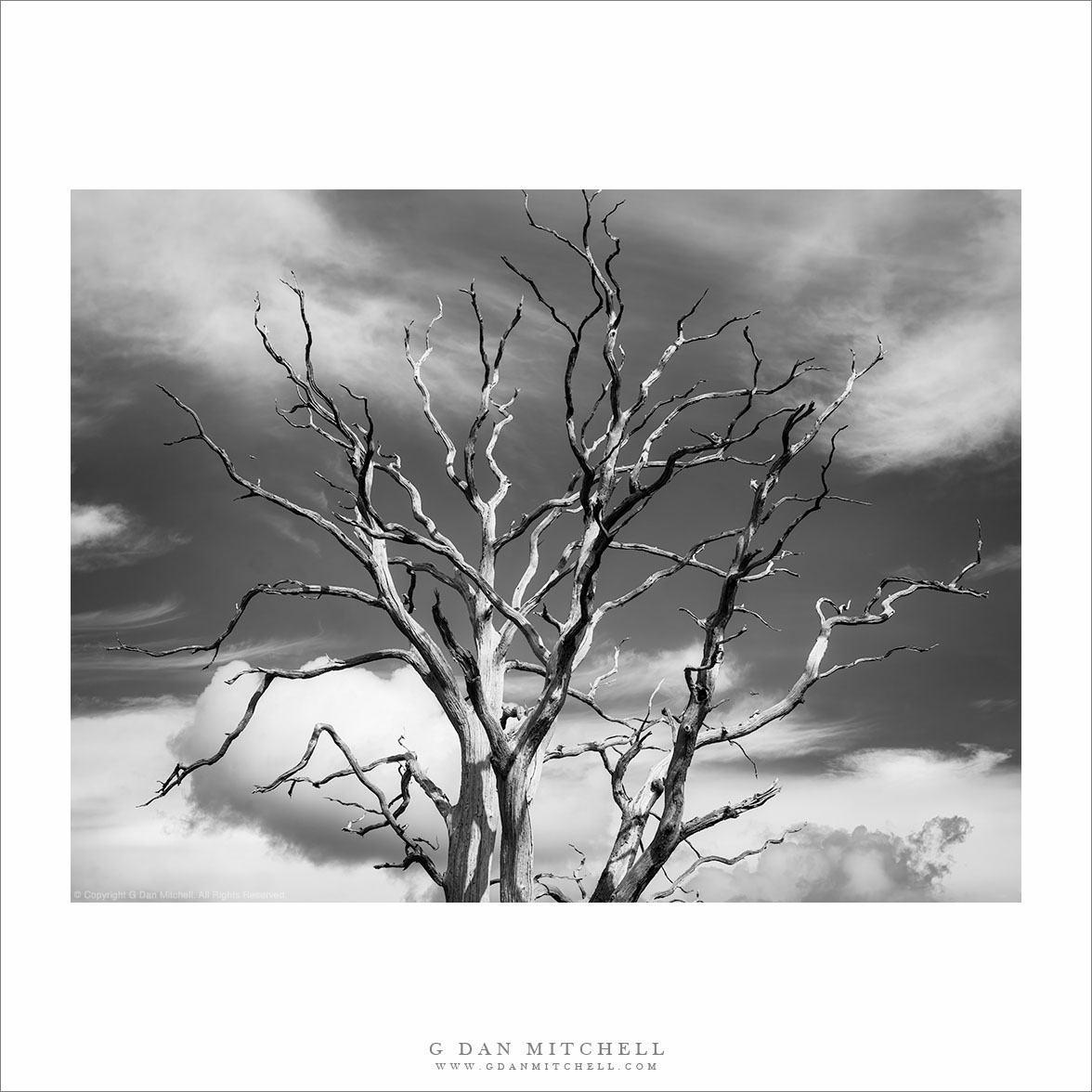
“Snag and Sky” — A skeletal dead tree silhouetted against a cloudy Cotswolds sky, England.
You might never guess by looking at this photograph, but I made this on a beautiful day with blue sky and dramatic clouds, in an area along a trail in the Cotswolds that was very green. I was surrounded by gentle hills, green wheat fields, and many spring-green trees. But there was this one dead snag, devoid of leaves, standing starkly against that sky.
“Stick in the Mud” — Dead branches on a bed of dried and fractured mud, Death Valley.
As always, cracked desert mud turns out to be an irresistible subject. I photographed this little patch in the northern portion of Death Valley. We arrived as broken clouds were developing, and that gave us varied light as shadows moved across the landscape. I made this photograph in the “in between” light — not full sun, but strong enough to be directional. The mud patterns are interrupted by the pieces of old wood, but that’s not all to notice in this little scene. Look closely and you’ll see a variety of spring plants beginning to grow in this seemingly-barren terrain.
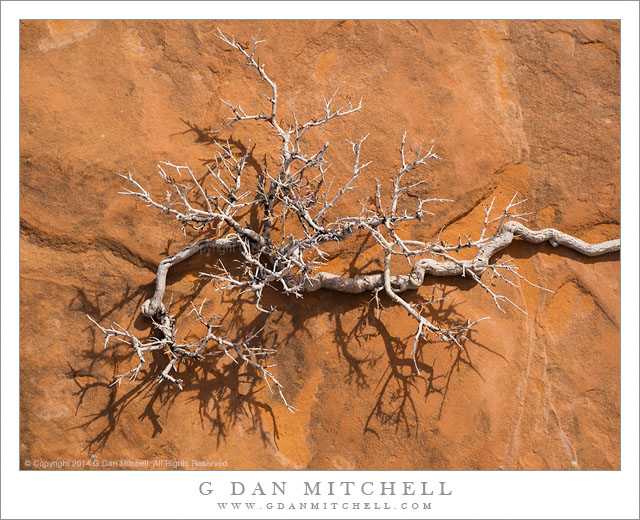
The skeleton of a bleached plant casts shadows across a sandstone slab
In the fall I spent some time making photographs in Utah, getting to a good number of locations, including some I returned to for more photography following previous visits. Partway through this trip I had plans to rendezvous with a group of friends (some new and some old) and photographers in a somewhat remote part of the state. We met, headed out, and spent the next few days camped “out there,” making photographs every day and visiting some very beautiful places.
On the first day of my meeting with this group we found a place to camp and began to settle in. That process took place pretty quickly, as all of us have spent a lot of time camping and we don’t need a lot of luxuries — in addition to friends we need food, a campfire, a place to sleep, and a spot by the fire for our chairs. So I soon found myself with a few hours of late afternoon free time between the camp chores and our evening shoot. I wandered off into nearby hills and eventually ended up on a sandstone bench with a bit of a view of the surrounding terrain. On top of this flat, dry, and nearly lifeless spot there were several plants that had tried to make a living here, setting down roots in tiny pockets of sandy soil and then growing horizontally across the rock. The first thing that attracted me was the stark contrast between the bleached plant and the red rock sandstone, but (as is always the case) the more I looked the more I saw. The curve of the white branch at the right edge of the frame is echoed by the similar upward curve of the eroded bit of darker rock on the left side, and a darker parallel version of the plant falls on the rock in the form of a shadow.
G Dan Mitchell is a California photographer and visual opportunist whose subjects include the Pacific coast, redwood forests, central California oak/grasslands, the Sierra Nevada, California deserts, urban landscapes, night photography, and more. Blog | About | Flickr | Twitter | Facebook | Google+ | 500px.com | LinkedIn | Email
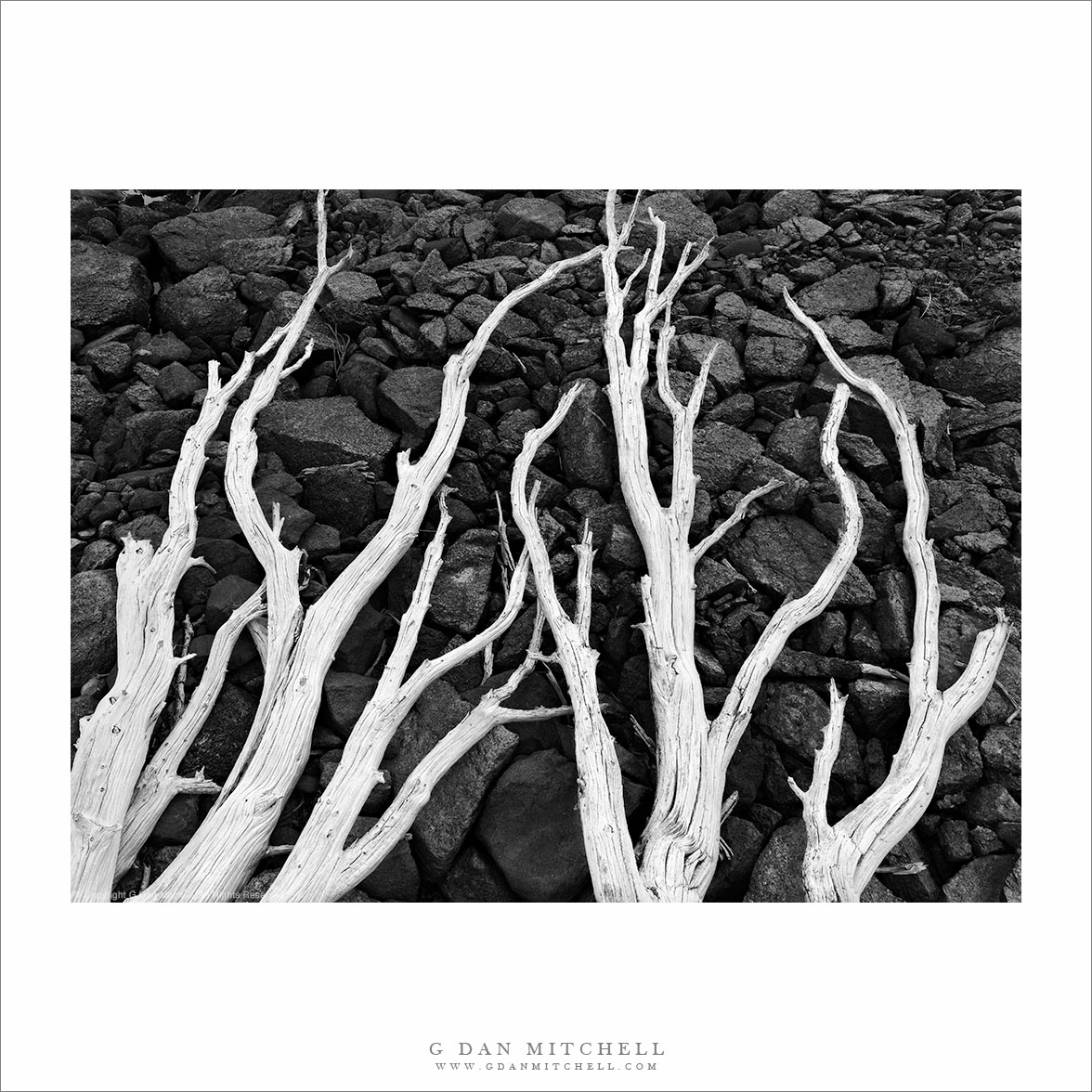
“Fallen Snag, Dry Tarn” — The bleached remains of an old dead tree lie on the rocks of a dry subalpine tarn, Kings Canyon National Park
This year was the second of two very dry years in the Sierra Nevada and much of the west. The snowfall this past winter (2012-13) was far below normal and set records in some places. Last October and November it seemed like we might be starting a very wet season, which would have been welcome after the previous winter’s low levels of precipitation, but then the tap was shut off near the end of the year and there was hardly any more precipitation at all during the rest of the season, the portion when the majority of the Sierra’s precipitation falls. Consequently, this has been a strange summer in the Sierra. Although there may have been more monsoonal rain the usual, the effects of the depleted snow pack are obvious. The spring run-off occurred early and was anemic. By July much of the Sierra looked more like August, and I was already seeing signs of fall by early August.
With all of this in mind, it was no surprise to use to find some unusually dry conditions in the Kings Canyon back-country when we visited for more than a week in mid-September. (Though, in some ways, things were less horrendous than I might have expected. Perhaps this was a combination of going at a time when things tend to be dry anyway and, as a local pointed out to me, some recent summer rains.) On our first day at the location where we stayed to photograph for nearly a week I wandered up some nearby meadows towards a lake that I though I might want to photograph. Very close to my campsite I found several completely dry tarns. (A “tarn” is a seasonal pond fed by snowmelt, and many of them dry up each season.) This very old, sun bleached snag lay across the exposed rocks of this one, creating a stark images.
G Dan Mitchell is a California photographer and visual opportunist. His book, “California’s Fall Color: A Photographer’s Guide to Autumn in the Sierra” from Heyday Books, is available directly from G Dan Mitchell.
Photographer and visual opportunist. Daily photos since 2005, plus articles, reviews, news, and ideas.
Manage Consent
To provide the best experiences, we use technologies like cookies to store and/or access device information. Consenting to these technologies will allow us to process data such as browsing behavior or unique IDs on this site. Not consenting or withdrawing consent, may adversely affect certain features and functions.
Functional
Always active
The technical storage or access is strictly necessary for the legitimate purpose of enabling the use of a specific service explicitly requested by the subscriber or user, or for the sole purpose of carrying out the transmission of a communication over an electronic communications network.
Preferences
The technical storage or access is necessary for the legitimate purpose of storing preferences that are not requested by the subscriber or user.
Statistics
The technical storage or access that is used exclusively for statistical purposes.The technical storage or access that is used exclusively for anonymous statistical purposes. Without a subpoena, voluntary compliance on the part of your Internet Service Provider, or additional records from a third party, information stored or retrieved for this purpose alone cannot usually be used to identify you.
Marketing
The technical storage or access is required to create user profiles to send advertising, or to track the user on a website or across several websites for similar marketing purposes.