“Sierra Setting Moon at Sunrise” — The setting full moon drops behind Sierra Nevada peaks lit my sunrise light.
Last fall I was in a popular Eastern Sierra location to photograph autumn aspen color. I had arrived before sunrise, while it was still pre-dawn twilight. I began photographing before the sun came up, continued through the arrival of first direct light, then moved on to some other nearby subjects. As I continued to work I could not help noticing that the full moon was setting in the western sky.
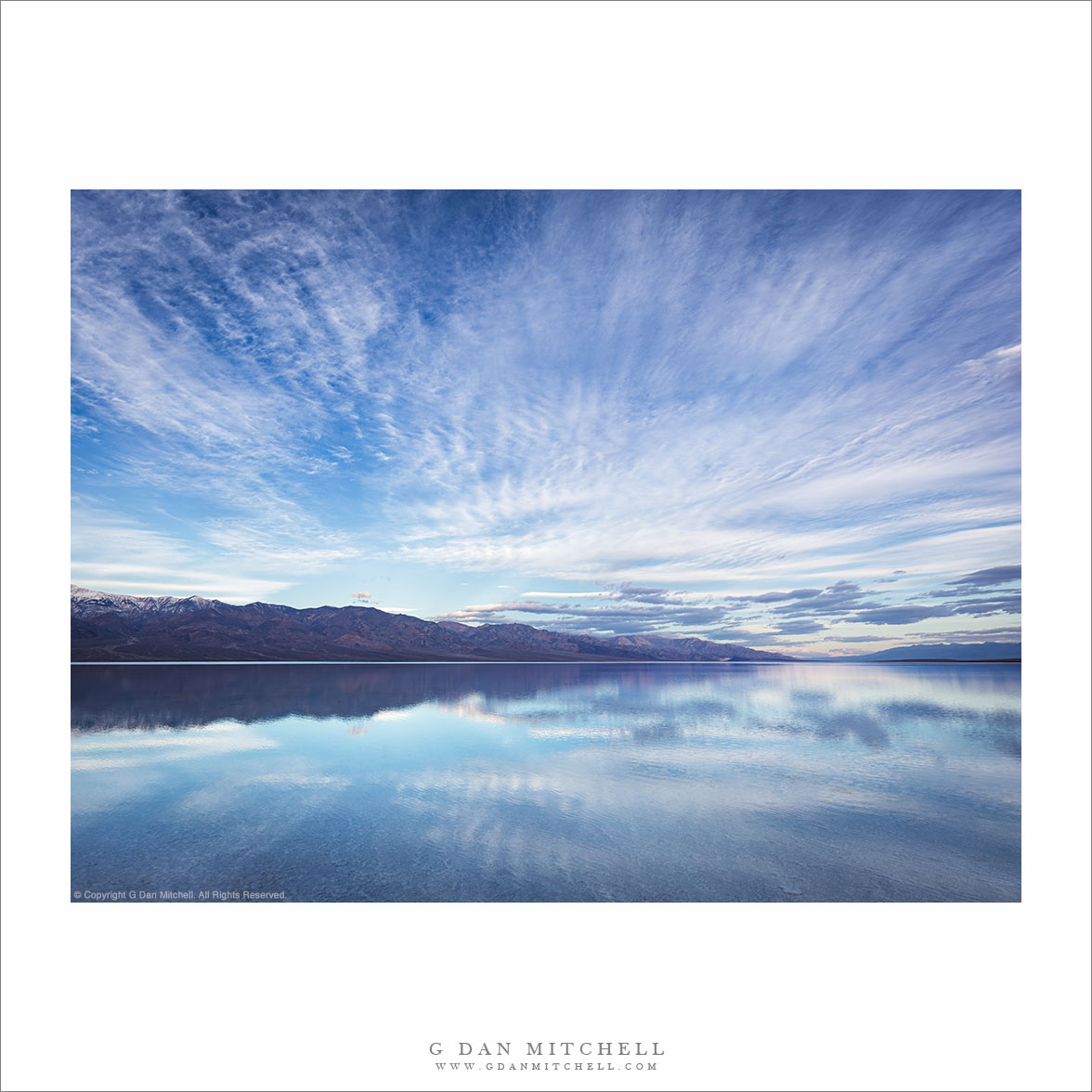
“Morning Clouds, Lake Manly” — Morning clouds and distant mountains reflected in Lake Manly, Death Valley.
Arriving at Lake Manly to photograph on this late-February morning, I would have rated the conditions as “OK but not stupendous.” I was hoping for a colorful desert sunrise over the reflecting waters of the temporary lake, but clouds muted the intensity and color of the light. My practice is to not give up but to instead find other ways of seeing the landscape. I kept photographing, and soon realized that the morning was special in different ways than I had expected.
“Eroded Hills” — Eroded hills of dark material dotted with desert plants.
This is, in several ways, kind of an odd Death Valley photograph. The fine-grained gravel covering the slopes and hills here are not widespread in the park — in most places the ground tends to be lighter in color. On the other hand, the curving shapes and runoff erosion channels are seen elsewhere, as are the plants. (If you look very closely, you will see not only the larger green plants but lots of small wildflower shoots just emerging.)
“Panamint Valley” — View across Rainbow Canyon toward the flats of Panamint Valley.
Death Valley National Park is a huge landscape, in more ways that one. The park is huge. It is the largest park in the contiguous states. (Alaska, where everything is on a larger scale, has four larger parks.) Within the park we often are able to view huge distances — in fact, Death Valley’s visual scale reminds me of places I’ve seen in Alaska. Here we look down Rainbow Canyon and across the entire Panamint Valley (one valley west of Death Valley itself) toward more desert mountains.
Photographer and visual opportunist. Daily photos since 2005, plus articles, reviews, news, and ideas.
Manage Consent
To provide the best experiences, we use technologies like cookies to store and/or access device information. Consenting to these technologies will allow us to process data such as browsing behavior or unique IDs on this site. Not consenting or withdrawing consent, may adversely affect certain features and functions.
Functional
Always active
The technical storage or access is strictly necessary for the legitimate purpose of enabling the use of a specific service explicitly requested by the subscriber or user, or for the sole purpose of carrying out the transmission of a communication over an electronic communications network.
Preferences
The technical storage or access is necessary for the legitimate purpose of storing preferences that are not requested by the subscriber or user.
Statistics
The technical storage or access that is used exclusively for statistical purposes.The technical storage or access that is used exclusively for anonymous statistical purposes. Without a subpoena, voluntary compliance on the part of your Internet Service Provider, or additional records from a third party, information stored or retrieved for this purpose alone cannot usually be used to identify you.
Marketing
The technical storage or access is required to create user profiles to send advertising, or to track the user on a website or across several websites for similar marketing purposes.