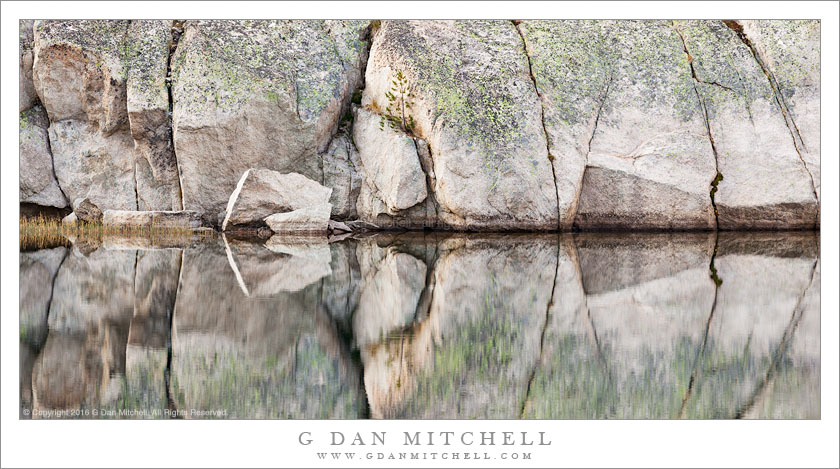
The immense granite face of Cathedral Rocks looms behind trees of El Capitan Meadow in autumn afternoon light
This meadow, located between two of the largest cliffs in Yosemite Valley, is both an obvious place to make photographs – everyone does it – and a place of nearly infinite variations of light, season, and atmosphere. Sometimes when I’m in the Valley I may stop here two or three times during the day. As is the case in other spots in Yosemite Valley, the place changes radically depending upon what the light is doing – soft early morning or evening light, strong light coming down the Valley in the early morning, light blocked by cliffs at midday, strong backlight in the late afternoon. And many of these changes happen very rapidly. As I made this photograph I could virtually watch the shadow move over the trees from the right.
The granite face rising beyond this meadow – one of the two I mentioned above – has always attracted me for some reason. Although not as high as the much more famous El Capitan, in some ways it seems to me to look more forbidding. It seems to lack the obvious crack systems seen on El Capitan, and unlike the larger wall, which is often bathed in sun, this one is often in shadow. In winter it casts a shadow across this portion of the Valley in the middle of the day, though a low spot may allow a beam of light to sweep across this area in the late afternoon.
G Dan Mitchell is a California photographer and visual opportunist whose subjects include the Pacific coast, redwood forests, central California oak/grasslands, the Sierra Nevada, California deserts, urban landscapes, night photography, and more. Blog | About | Flickr | Twitter | Facebook | Google+ | 500px.com | LinkedIn | Email
On this early October drive across the Sierra, eventually heading for the town of Bishop, we crossed Carson Pass from west to east. The object of the drive was to photograph fall subjects on the east side of the range, but there was nothing to keep us from starting early – and we began searching out colorful autumn aspens and other subjects even before reaching the pass. Light snow started west of the pass, and when we stopped at the turn-out at the pass a decent amount of snow was falling, the wind was blowing, and it definitely felt like winter. Back in the car we started down the east side of the pass.
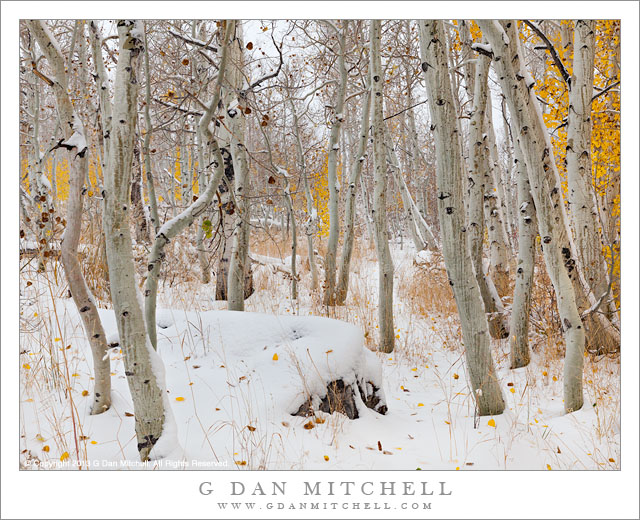
The snow continued as we took a short detour on a gravel side-road, then returned to the main highway to head east on highway 88 through Hope Valley. I first visited Hope Valley many years ago when I had just begun cross-country skiing, and today I often pass through on my aspen-hunting trips. The aspens were turning colors on this day, and if you look very closely you can see a very large grove of them in the distance through the snow. We briefly stopped at the turn-off to Luther Pass, where I made this photograph looking back up the creek that flows through the valley. Snow was falling and there was a thin layer of snow sticking to everything. As if to prove that photographers aren’t the only people nuts enough to stand around in the cold wind and snow, there was actually a fisherman along the creek just out of the frame to the right!
G Dan Mitchell is a California photographer and visual opportunist whose subjects include the Pacific coast, redwood forests, central California oak/grasslands, the Sierra Nevada, California deserts, urban landscapes, night photography, and more. Blog | About | Flickr | Twitter | Facebook | Google+ | 500px.com | LinkedIn | Email
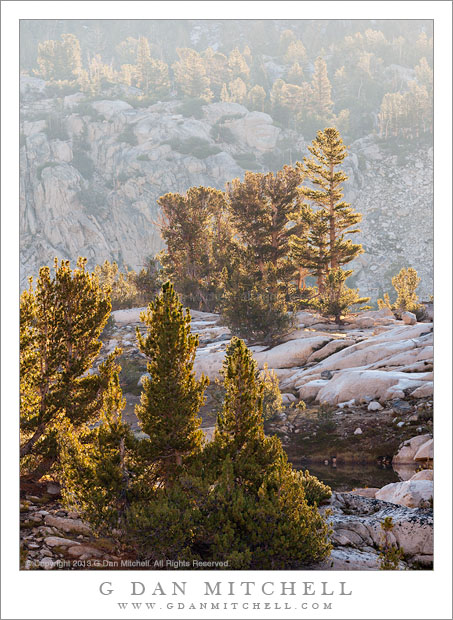
An early autumn snow storm obscures the view of pines, aspens and other fall foliage in the eastern Sierra Nevada
This photograph, like a few others I have posted this fall, was made on an early October day when we drove across the Sierra from west to east during the first “real” snow of the season. Our goal was Bishop, California, since we planned to photograph autumn aspen color on the “east side” for a few days. Since the usual more direct route over Tioga Pass was closed due to snow, we ended up crossing all the way up close to Tahoe over Carson and then Monitor Passes to get to highway 395, which we then followed southwards along the east side of the Sierra.
The snow began before we reached Carson pass, and though it never fell very heavily, it more or less continued for the rest of the drive, only stopping shortly before we got to Bishop. This was quite a contrast to the weather we had been having, which had been up into the low 90s in our part of California only a few days earlier! Since we had the whole day to get to Bishop we made frequent stops and detours along the way, giving us lots of opportunities to photograph scenes that had a distinctly winter-like appearance. One place we paused was along a high point on highway 395 just north of Lee Vining, where huge groves of colorful aspen trees were just visible through the blowing snow. Turning slightly away from the aspen color, I chose to make a few isolated evergreen trees the focus of this photograph.
G Dan Mitchell is a California photographer and visual opportunist whose subjects include the Pacific coast, redwood forests, central California oak/grasslands, the Sierra Nevada, California deserts, urban landscapes, night photography, and more. Blog | About | Flickr | Twitter | Facebook | Google+ | 500px.com | LinkedIn | Email
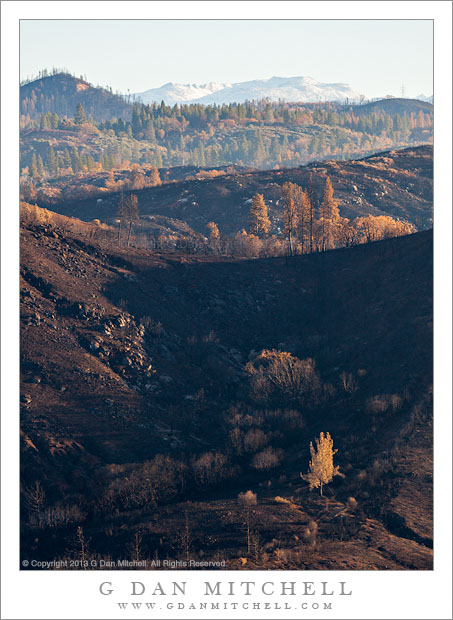
Hazy morning light filters across the burned hillsides in the area of the Rim Fire, California
In photographic terms this is perhaps not the most spectacular photograph, and the location is not quite a scenic icon – though it is a place that many stop and take a look on their way to Yosemite, the “Rim of the World” overlook along highway 120 between Groveland and the northern park entrance. However, this view is loaded with implications and connected to many stories.
Late this past summer, the state of California was tremendously dry after a second drought season. It wasn’t a question of whether there would be big wildfires, but more of where, when, and how many. Perhaps the biggest one of all started very near the Rim of the World overlook, and in the hot and dry conditions it quickly – some might say explosively – spread to the north, east, and south. While many think of it as “the Yosemite fire” – and it did burn a lot of terrain inside the park – it really was more of a “Yosemite area” fire. Because of the conditions – the long-term conditions of drought and the immediate conditions of heat and wind – the fire apparently did very serious damage to the forests in the are.
Shortly after the fire was contained, I thought that I might drive through the park on Tioga Pass Road to get to and from the eastern Sierra in early October. In fact, the roads had opened up again by that time, but snow closed Tioga Pass on my trip to the west and we ended up coming back over Sonora Pass. So the post-fire conditions of this area, which is very familiar to me after years of visits, were still an unknown when I drove to The Valley on October 30 for a few days of autumn photography. Passing into the first fringes of the burned areas along highway 120 things didn’t look all that different than they do after any wildfire – some areas badly burned, some singed, and others that mostly escaped the fire. I decided to stop at the Rim of the World overlook, which was pretty much the only place where stopping was allowed, and get out and take a look. I was floored by the scale of the fire. It had come from behind my position, burned down and across the deep canyon of the Tuolumne River, up the canyon walls on the far side, and then across a vast series of receding ridges. Some smoke and haze still seemed to be coming from the area, and early morning light glanced across the ridges, with their dead trees. In the far distance there is a low peak with a bit of early season snow.
I have seen quite a few fires in the park over the past few decades. One not far from here destroyed a large area of forest a few decades ago – and on this trip, ironically, I was noting that new evergreen trees are finally taking hold there. Later several very bad fires blew up from near Foresta, doing terrible damage to the section of Crane Flat Road descending towards The Valley. There have been others. In most of these cases – though I wondered in the case of the most recent Foresta fire, too – it seemed that I could watch the forest recover and return to something resembling what I remember. However, given the intensity and scale of this fire, I wonder if I’ll have that opportunity where the Rim Fire burned?
To end on a cheerier note, a couple of other observations. Even near badly burned areas, I did see sections where this fire only burned some of the vegetation and a few that seemed to have been completely spared. And when I got to a spot inside the park along highway 120 where I often stop to photography dogwood trees in the spring and fall, a spot that seemed like it might have been within the burn zone on the maps, I found my little spot completely intact, with the dogwoods turning to fall colors.
G Dan Mitchell is a California photographer and visual opportunist whose subjects include the Pacific coast, redwood forests, central California oak/grasslands, the Sierra Nevada, California deserts, urban landscapes, night photography, and more. Blog | About | Flickr | Twitter | Facebook | Google+ | 500px.com | LinkedIn | Email
Photographer and visual opportunist. Daily photos since 2005, plus articles, reviews, news, and ideas.
Manage Consent
To provide the best experiences, we use technologies like cookies to store and/or access device information. Consenting to these technologies will allow us to process data such as browsing behavior or unique IDs on this site. Not consenting or withdrawing consent, may adversely affect certain features and functions.
Functional
Always active
The technical storage or access is strictly necessary for the legitimate purpose of enabling the use of a specific service explicitly requested by the subscriber or user, or for the sole purpose of carrying out the transmission of a communication over an electronic communications network.
Preferences
The technical storage or access is necessary for the legitimate purpose of storing preferences that are not requested by the subscriber or user.
Statistics
The technical storage or access that is used exclusively for statistical purposes.The technical storage or access that is used exclusively for anonymous statistical purposes. Without a subpoena, voluntary compliance on the part of your Internet Service Provider, or additional records from a third party, information stored or retrieved for this purpose alone cannot usually be used to identify you.
Marketing
The technical storage or access is required to create user profiles to send advertising, or to track the user on a website or across several websites for similar marketing purposes.