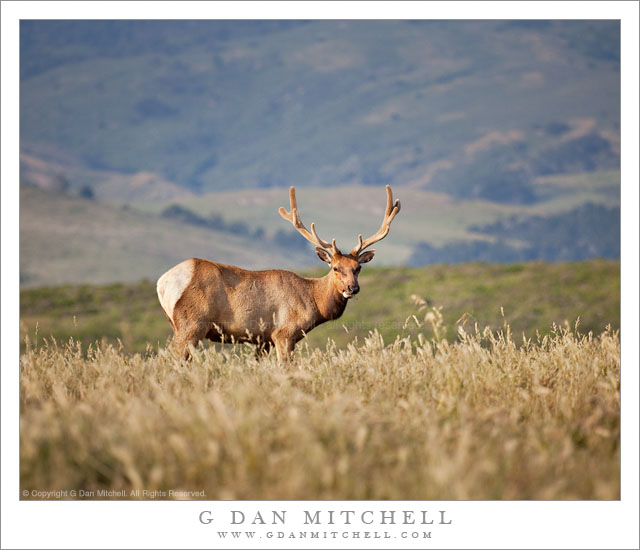
A bull tule elk grazes among the grassy hills near Drakes Bay, Point Reyes National Seashore.
The group of bull tule elk that I encountered at Point Reyes National Seashore on Memorial Day was large and tended to stick together very closely. Most of the photographs that I shot include multiple animals. However, this fellow paused for a moment as the others moved to the right and I had a chance to make a few photographs containing only a single elk. He was even thoughtful enough to pose in front of the rolling green hills rising above Tomales Bay in the distance!
The elk were apparently native to Point Reyes – and much of the rest of California – but were decimated in the 1800s as a result of hunting and displacement by cattle. As I understand it, a small group was reintroduced to Point Reyes in the 1970s or thereabouts. Eventually they were so successful that the herd began to expand to other areas of the park, and the area has now reached it normal carrying capacity for these animals. This specimen and the group it was part of were along the top of the rolling hills above Drakes Bay.
Four tule elk in the meadows at Point Reyes National Seashore.
When the day started I had no idea that I might be photographing wildlife today, much less tule elk! In fact, today was meant to be primarily a photography day. We decided to spend the day on a coastal drive, starting with breakfast in Santa Cruz and then heading north to… wherever we ended up. We had a vague idea that it might be interesting to end up at Point Reyes Station perhaps, where there was an open art studio event going on.
By mid-afternoon, that is indeed where we ended up. We stopped in town to get coffee and a snack and wander about just a bit. With no specific plan in mind we sort of decided to head on out to Point Reyes – the actual “point,” not just the general park. On the way back we took a detour down to Drakes Bay for a quick stop. As we drive back up from there to the top of the hill near the main road we saw some strange shapes in the distance behind a fence. The looked like antlers, but that didn’t seem right – this particular area is dairy country and the elk that I had heard about were in a different area of the park. But as we reached the top of the hill it became completely obvious that a small herd of tule elk were grazing right on the other side of the fence. We pulled over and I grabbed my long lens. The elk were kind enough to occasionally look up from the business of grazing and pose dramatically in the low late-afternoon light from the west.
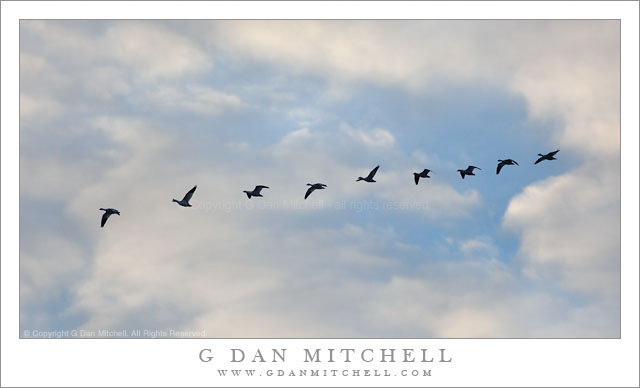
A flock of snow geese against the partly cloudy winter sky above the Merced National Wildlife Reserve, California.
Yes, yet another in the series of photographs of migratory birds above the Merced National Wildlife Reserve made on a winter evening in February. While I missed the “fly in” (though saw it happening a ways north of my position) I did watch hundreds and hundreds of birds of all types pass overhead. Every time I would start to wonder “where are the birds?” or worry about whether I would miss the fly in, another flock would appear and traverse the sky above me.
It was my good fortune – certainly little careful planning was involved! – to be out here during a brief evening window of interesting light and sky as a storm cleared. In fact, as I drove towards the Refuge I at first thought that some of the larger clouds to the west might block the evening light or even bring a bit of rain. However, as sunset approached the clouds continued to thin and I ended up with a beautiful sky full of broken clouds that were gently illuminated as the day ended.
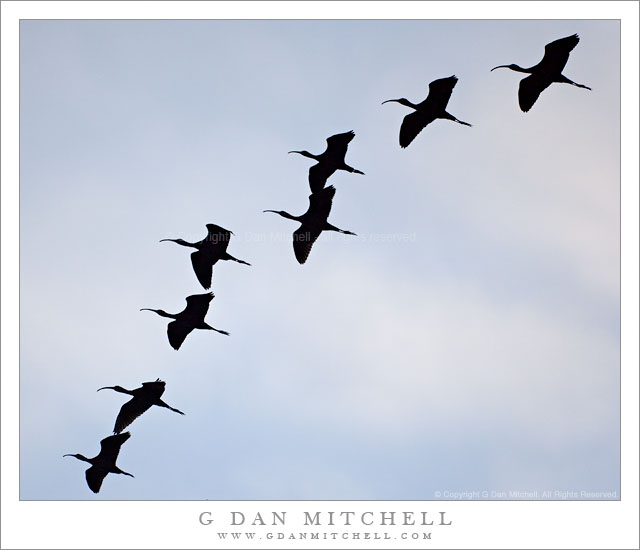
A flock of white-faced ibises is silhouetted against evening blue sky and clouds above the Merced National Wildlife Refuge.
On this winter evening I visited, for the first time, the Merced National Wildlife Reserve on a detour I took while returning home from a few days photographing in Death Valley. This winter I have (finally!) started to become aware of the amazing annual influx of migratory birds in California’s Central Valley and I managed to get out there a couple of times to view and photograph the magnificent flocks of birds. Being new at this, I have been working at figuring out just how to photograph this subject, and I’ve come up with a few approaches that seem to work, though I have a lot to learn. In this case, I had figured out that if I just picked a spot and waited that eventually flocks would fly over my position, and that I would have a chance of photographing them against the evening sky and clouds. Being almost completely ignorant when it comes to identifying these birds – but no less impressed with them because of this – I had virtually no idea what I was photographing in the moment when I tracked the birds and made the exposures. In fact, it wasn’t until later that I noticed the wonderful curved bills of these birds and then found out from my friend Tom Clifton (who does know how to identify these critters) what they were.
As the birds approach I work to synchronize my camera motion with the speed and direction of their flight. I try to keep them in the frame, and preferably in the frame in a way that might create an interesting composition. And while I do that I try to keep some attention on the background against which they fly and some small remaining bit of my attention on the technical matter of keeping at least one of them under an autofocus point in the camera’s viewfinder. As a flock approaches, things seem to start out fairly slowly and it may seem like the birds are taking a long time to arrive. But as they get closer – especially when shooting with a 400mm focal length and double-especially when they are as close as this flock – the action speeds up, and as they pass overhead it is all I can do to keep them centered in the viewfinder as I let the camera’s burst mode do its job at the right moment.
There are things about the experience that the camera cannot capture. The cold and damp of a Central Valley winter evening might be evoked by the right sort of landscape photograph, but not by a photograph like this one – yet this is an integral part of the experience. Even more than that, the sound of these birds, alone or in huge groups, sticks in my mind as much or more than the visual image. If you have been there and heard it, perhaps a photograph may cause you to recall it.
Photographer and visual opportunist. Daily photos since 2005, plus articles, reviews, news, and ideas.
Manage Consent
To provide the best experiences, we use technologies like cookies to store and/or access device information. Consenting to these technologies will allow us to process data such as browsing behavior or unique IDs on this site. Not consenting or withdrawing consent, may adversely affect certain features and functions.
Functional
Always active
The technical storage or access is strictly necessary for the legitimate purpose of enabling the use of a specific service explicitly requested by the subscriber or user, or for the sole purpose of carrying out the transmission of a communication over an electronic communications network.
Preferences
The technical storage or access is necessary for the legitimate purpose of storing preferences that are not requested by the subscriber or user.
Statistics
The technical storage or access that is used exclusively for statistical purposes.The technical storage or access that is used exclusively for anonymous statistical purposes. Without a subpoena, voluntary compliance on the part of your Internet Service Provider, or additional records from a third party, information stored or retrieved for this purpose alone cannot usually be used to identify you.
Marketing
The technical storage or access is required to create user profiles to send advertising, or to track the user on a website or across several websites for similar marketing purposes.