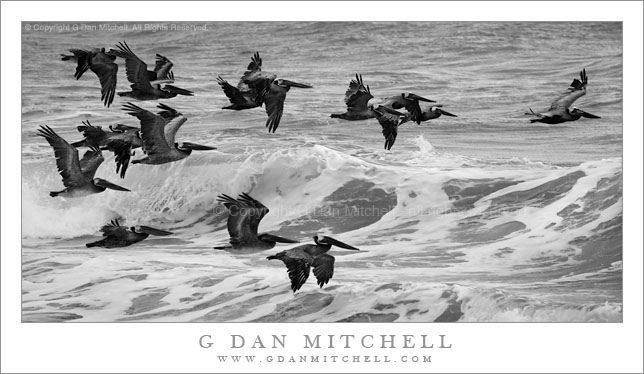
Black and white photograph of a flock of pelicans in flight just above Pacific Ocean surf at Waddell Creek Beach, Big Basin State Park, California.
Every five or ten minutes another flock of northbound pelicans descended to the water just offshore at Waddell Creek Beach at Big Basin State Park along the California coast just north of the town of Davenport. It was late and the light was diffused and subdued by high clouds and the incoming fog bank a this flock skimmed just above the surf.
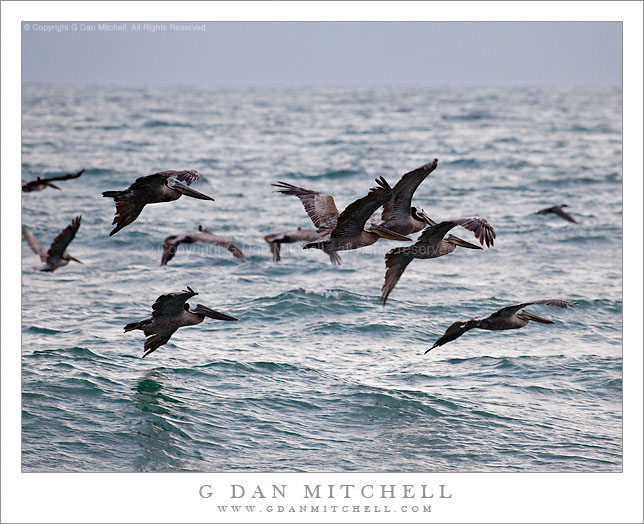
A flock of low flying pelicans above the Pacific Ocean turns toward the horizon at Waddell Creek Beach, Big Basin State Park, California.
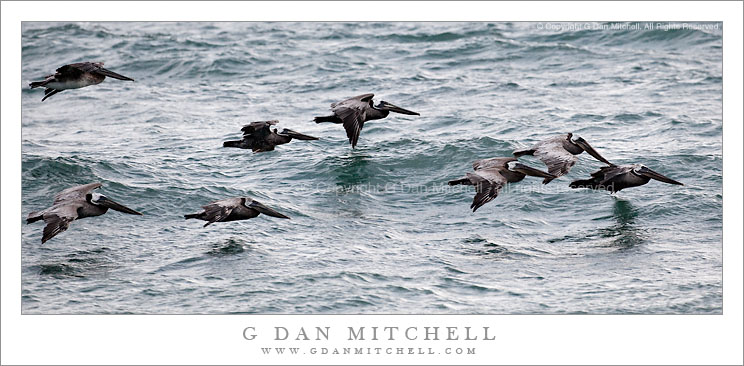
As I spend more time along this section of the California coast I have started to understand the “pelican highway” that these birds follow as they fly along the coastline. Just south of Waddell Creek Beach they fly along the edge of coastal bluffs (or sometimes skim along the water’s surface not far from the shoreline) before they pull in for a rest stop at this beach. Sometimes they seem to come down along the freshwater creek that arrives here from the Santa Cruz Mountains and Big Basin Redwoods State Park. On this June evening they seemed to be making only a quick stop. Several flocks came north along the waterline and when they arrived at my position they briefly stopped in the water just offshore before taking off once again and continuing north along the coast.
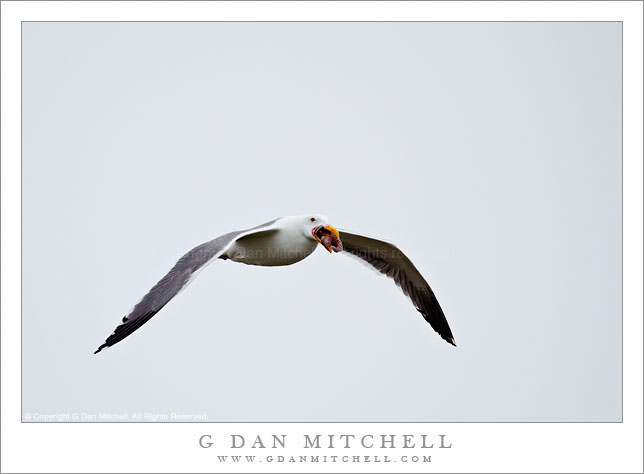
A seagull in flight carrying a starfish in its beak.
This is an odd little photograph that I’ve been holding on to for some time, waiting to finally post it. When you photograph the natural word, every so often something unexpected happens, and sometimes you don’t even realize what happened until later. (I once made a photograph of a fog shrouded Pacific Coast scene, and it wasn’t until months later while working on the photograph in post that I realized that a small but energetic waterfall was in the scene!)
In mid-May I spent some time photographing shore birds skimming along the cliff edge above the Pacific coast not far from Davenport California. The basic approach is to find a location where the birds come close to the cliff edge and where there is a suitable background (if the birds follow the “right” path) and to then wait and quickly track the birds as they cross my field of view, often shooting in burst mode when they are in their best positions. After a while the actions begin (fortunately!) to become somewhat automatic: spot bird or group of birds, find bird(s) in viewfinder, get birds into the right part of the frame, begin panning with the anticipated path of the bird(s), keep bird(s) in the good part of the frame and under AF points, track and shoot, watch bird(s) disappear, lather, rinse, repeat.
As this bird went past I recall thinking something like, “What the heck was in its mouth?” No time to actually see while shooting, but later I found that it was carrying a medium size starfish, fully intact and with legs extending from its mouth!
“Crouching Marmot” — A marmot crouches on rocks at Olmsted Point, Yosemite National Park, California
Oh, no, not another marmot! Yes. Another marmot. And I think I have at least one more to post before I’m done. Once again, this critter was hanging out in the rocks at Olmsted Point when I visited on my way across Tioga Pass on June 5, 2010.
I’d love to be able to say that I had to carefully stalk this marmot across the alpine tundra of the high Sierra, but that wouldn’t be true. First, it is really hard to closely approach marmots that are not accustomed to humans, and the back-country marmots tend to be fairly skittish. Second, I would not be carrying the lens that I used for this shot on back-country pack trips. The truth is that this critter is one of the many that hang out at Olmsted Point along Tioga Pass Road. These marmots won’t – fortunately! – eat out of your hand or anything like that, and they do retain some caution… but they will come relatively close to you. I was there because it was the day that the pass was frst opened for the season. The marmots almost seemed a bit amused by all of the humans who showed up that day, and they also seemed to be enjoying a bit of late spring sun.
My approach to photographing them was pretty simple. I put a long lens on my camera – a 400mm telephoto – and found a comfortable spot below the rocks where they hang out. I waited quietly, and when they began to “come out to play,” I was able to photograph them from a decent distance and avoid spooking them.
G Dan Mitchell is a California photographer and visual opportunist. His book, “California’s Fall Color: A Photographer’s Guide to Autumn in the Sierra” (Heyday Books) is available directly from him.
Photographer and visual opportunist. Daily photos since 2005, plus articles, reviews, news, and ideas.
Manage Consent
To provide the best experiences, we use technologies like cookies to store and/or access device information. Consenting to these technologies will allow us to process data such as browsing behavior or unique IDs on this site. Not consenting or withdrawing consent, may adversely affect certain features and functions.
Functional
Always active
The technical storage or access is strictly necessary for the legitimate purpose of enabling the use of a specific service explicitly requested by the subscriber or user, or for the sole purpose of carrying out the transmission of a communication over an electronic communications network.
Preferences
The technical storage or access is necessary for the legitimate purpose of storing preferences that are not requested by the subscriber or user.
Statistics
The technical storage or access that is used exclusively for statistical purposes.The technical storage or access that is used exclusively for anonymous statistical purposes. Without a subpoena, voluntary compliance on the part of your Internet Service Provider, or additional records from a third party, information stored or retrieved for this purpose alone cannot usually be used to identify you.
Marketing
The technical storage or access is required to create user profiles to send advertising, or to track the user on a website or across several websites for similar marketing purposes.